Takeaway: move every PHP-FPM server to 8.5.13, 8.4.28, 8.3.37 or 8.2.36 (or 8.6.0, released the same day). If you cannot patch tonight, check two settings first: fastcgi_keep_conn on in nginx (or enablereuse=on in Apache) and catch_workers_output = yes in an FPM pool. Those are the setups the two worst bugs need. On Ubuntu’s own php8.3 packages, php -v will keep saying 8.3.6 after the fix, so read the package changelog, not the version string.
PHP’s security team announced the release on 18 Nov for 19 Nov, 14:00 to 14:30 UTC, with the highest severity rated CRITICAL and the note that the CRITICAL issues “require either non-default configuration or uncommon setups”. The PHP 8 ChangeLog now lists 8.6.0 and 8.5.13 dated 19 Nov 2026, and the GitHub advisories for the FPM bugs name the patched version on every branch.
Why we did this: our WordPress sites (with the Paperkite plugin) and the Laravel apps we moved from 10 to 13 run on PHP-FPM behind nginx on a CloudPanel VPS. Our PHP 8.6 post for plugin authors covered the feature release; this one is the security side of the same day.
Fixed versions per branch
| Branch | Fixed in | Source |
|---|---|---|
| 8.6 | 8.6.0 | ChangeLog 8.6.0 |
| 8.5 | 8.5.13 | ChangeLog 8.5.13 |
| 8.4 | 8.4.28 | GHSA- |
| 8.3 | 8.3.37 | GHSA- |
| 8.2 | 8.2.36 | GHSA- |
The 8.4, 8.3 and 8.2 numbers come from the “patched versions” fields of the two FPM advisories, both published 19 Nov. PHP 8.1 and older get no release. PHP 8.2 itself reaches end of life on 31 Dec 2026, so a server still on 8.2 needs this patch now and a branch move soon.
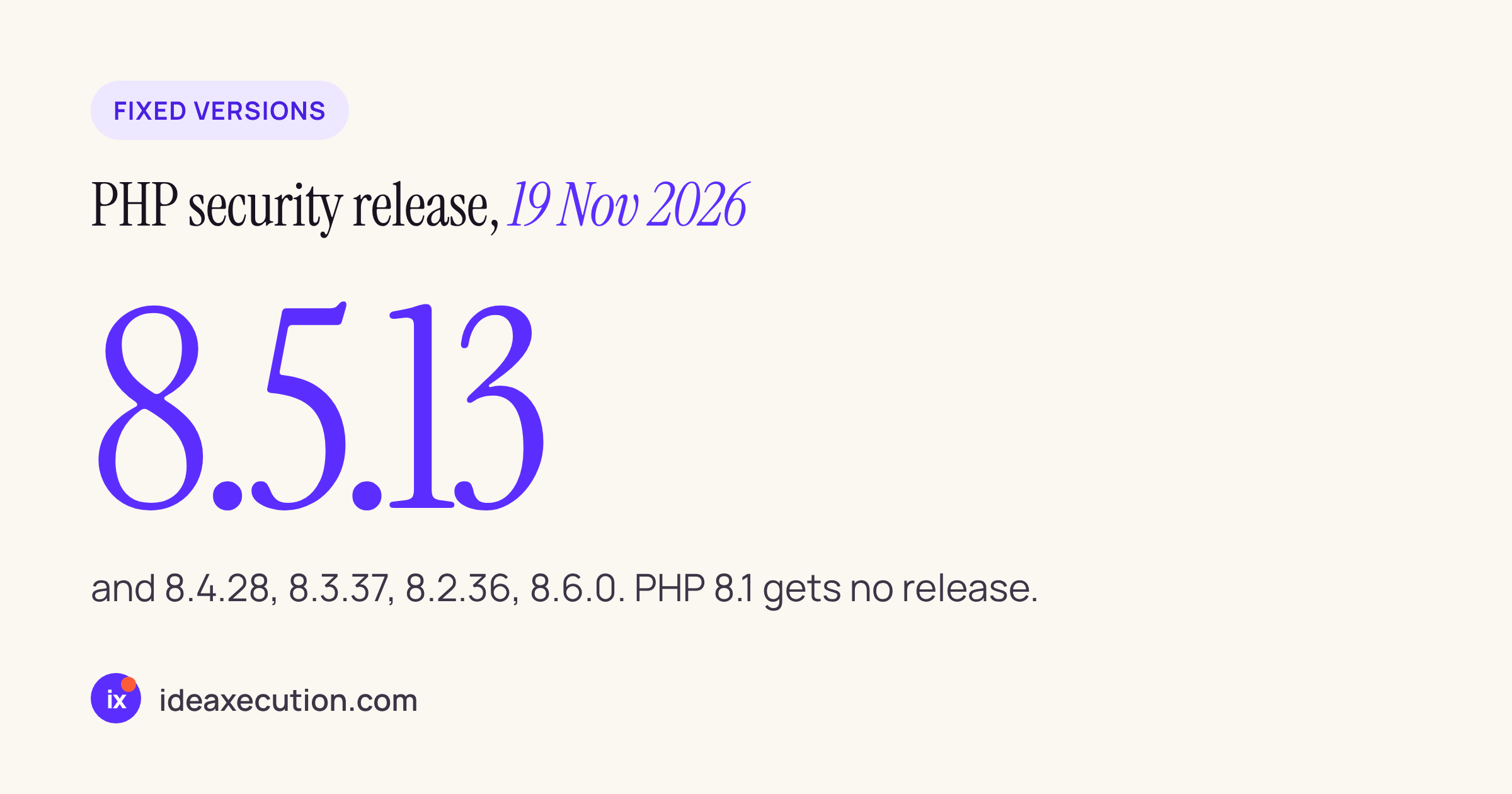
The fixed version per branch. Anything older on the same branch needs the update; 8.1 gets no release.
What the release fixes
The 8.5.13 and 8.6.0 sections of the ChangeLog carry the same 20 security entries. Grouped by the part of PHP they touch:
The URI extension is new in 8.5, so those two entries do not apply to older branches. CVE-2026-115560 is the session serializer issue we checked WordPress for earlier; this release is the upstream fix for it.
The two FPM bugs and the settings they need
These two are why the release is rated CRITICAL, and both depend on configuration you can check in a minute.
Request smuggling (GHSA-qc49, CVSS 9.2)
The advisory says exploitation “requires a front end that enables persistent backend connections” plus “an application path that opens php://input without reading it fully”. The front ends it names are nginx with fastcgi_keep_conn on, Apache mod_proxy_fcgi with enablereuse=on, HAProxy FastCGI setups that keep backend connections, and LSAPI. It also says “Standard nginx and Apache configurations that close the FastCGI connection after each request are not affected”. The impact it describes is attacker-controlled PHP code running as the worker.
WordPress and Laravel both read php://input (the REST API, webhooks, JSON requests), so on a kept-open connection we would not try to argue that no code path leaves a body unread. The setting is the thing to check.
epoll use-after-free (GHSA-jm4m, CVSS 8.8)
This one needs local code execution in an FPM worker and a pool with catch_workers_output enabled, on the epoll event backend (the Linux default). PHP’s default is catch_workers_output = no, but the advisory notes that the official PHP-FPM Docker images turn worker output capture on. With a root FPM master, the advisory says the pool user can escalate to root. Its stated workaround is to disable catch_workers_output in affected pools.
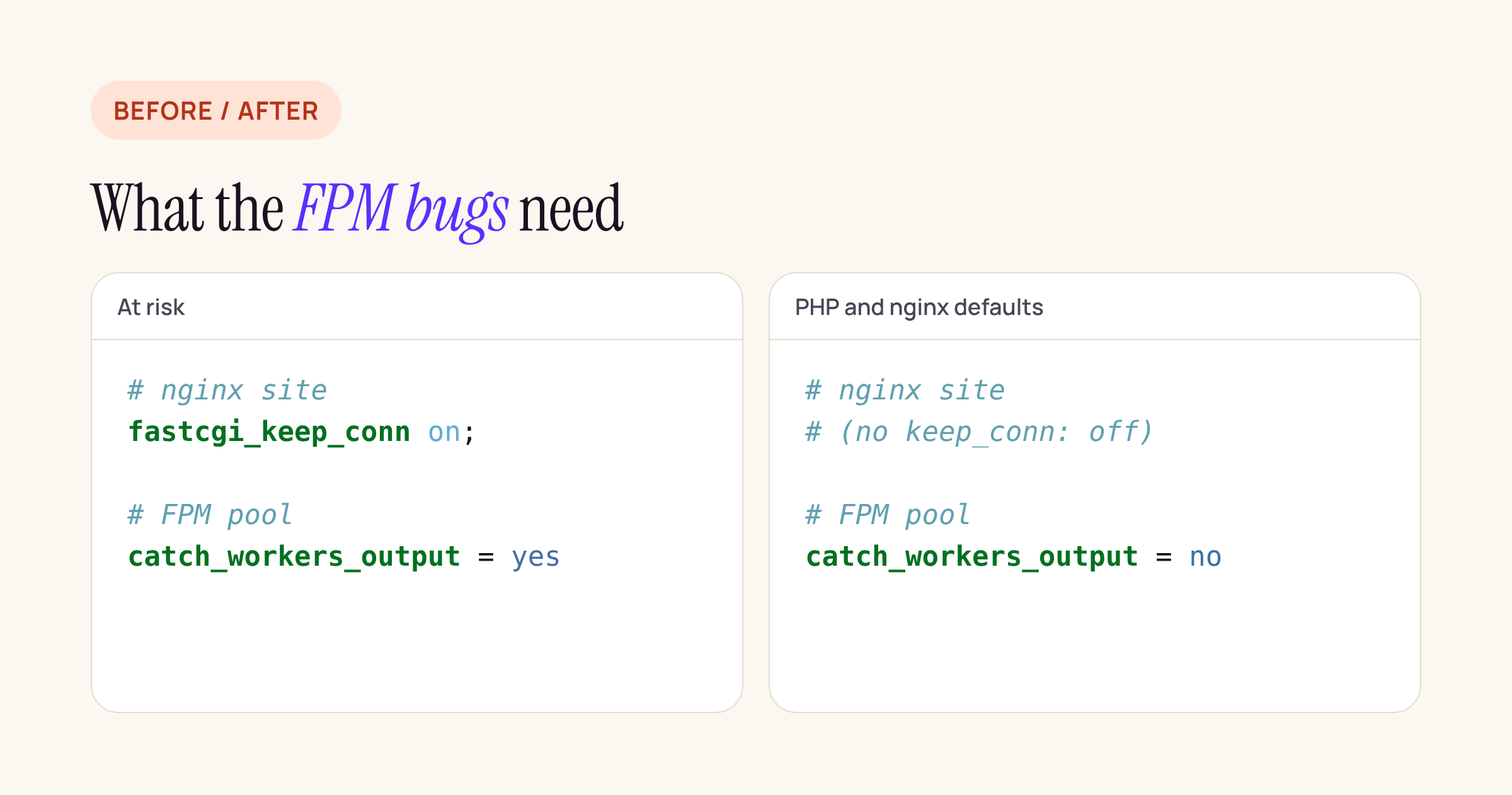
Left: the settings the two advisories need. Right: the defaults, which close the FastCGI connection and keep worker output off.
A read-only check for every PHP on the server
We wrote a small script that lists every PHP binary, says whether it is patched, and looks for the two risky settings. It changes nothing. Run it as root so it can read every pool file:
#!/usr/bin/env bash
# php-nov26-check.sh: is this server patched for the 19 Nov 2026 PHP releases,
# and does it use the setups the two worst FPM bugs need?
# Read-only. Run as root so it can read every pool file.
set -u
FIXED="8.2.36 8.3.37 8.4.28 8.5.13 8.6.0"
CVE=CVE-2026-129289   # FPM request smuggling, in every branch

ver_ok() {  # $1 = x.y.z built from upstream source
  local b=${1%.*}
  for f in $FIXED; do
    [ "${f%.*}" = "$b" ] || continue
    [ "$(printf '%s\n%s\n' "$f" "$1" | sort -V | head -1)" = "$f" ] && return 0
    return 1
  done
  return 1   # branch without a 19 Nov release (8.1 and older)
}

echo "== PHP binaries"
seen=" "
for bin in /usr/bin/php[0-9]* /usr/sbin/php-fpm* /usr/bin/php-cgi*; do
  [ -x "$bin" ] || continue
  bin=$(readlink -f "$bin")
  [[ "$seen" == *" $bin "* ]] && continue; seen+="$bin "
  v=$("$bin" -v 2>/dev/null | head -1 | awk '{print $2}')
  pkg=$(dpkg -S "$bin" 2>/dev/null | cut -d: -f1)
  pv=${pkg:+$(dpkg-query -W -f='${Version}' "$pkg" 2>/dev/null)}
  # Ondrej Sury's packages carry upstream version numbers; Ubuntu and Debian
  # keep the old number and backport fixes, so read their changelog instead.
  if [[ -n "$pv" && "$pv" != *sury* && ( "$pv" == *ubuntu* || "$pv" == *deb* ) ]]; then
    log=/usr/share/doc/$pkg/changelog.Debian.gz
    if zgrep -q "$CVE" "$log" 2>/dev/null; then s="distro build, $CVE in changelog: patched"
    else s="distro build, $CVE not in changelog yet"; fi
  elif ver_ok "$v"; then s="patched"
  else s="UPDATE NEEDED"; fi
  printf '%-12s %-7s %s\n  -> %s\n' "$(basename "$bin")" "$v" "${pv:-built from source}" "$s"
done

echo "== FPM pools (GHSA-jm4m: catch_workers_output + epoll)"
for f in /etc/php/*/fpm/pool.d/*.conf; do
  [ -f "$f" ] || continue
  c=$(grep -E '^\s*catch_workers_output\s*=' "$f" | tail -1 | awk -F= '{gsub(/ /,"",$2);print $2}')
  st=$(grep -E '^\s*pm\.status_path\s*=' "$f" | tail -1 | awk -F= '{gsub(/ /,"",$2);print $2}')
  printf '%s\n  catch_workers_output=%s status=%s\n' "${f#/etc/php/}" "${c:-no}" "${st:-off}"
done

echo "== Front end keeps FastCGI connections open? (GHSA-qc49)"
hits=$(grep -rEn '^\s*fastcgi_keep_conn\s+on' /etc/nginx 2>/dev/null | cut -d: -f1,2)
echo "nginx keep_conn on: ${hits:-none}"
hits=$(grep -rEin 'enablereuse=on' /etc/apache2 /etc/httpd 2>/dev/null | cut -d: -f1,2)
echo "apache enablereuse:  ${hits:-none}"

echo "== Extensions named in the advisories"
for bin in /usr/bin/php[0-9]*; do
  [ -x "$bin" ] || continue
  m=$("$bin" -m 2>/dev/null | grep -Eix 'soap|phar|dom' | tr '\n' ' ')
  printf '%-10s %s\n' "$(basename "$bin")" "${m:-none}"
done
We ran it on an Ubuntu 24.04 test server with Ubuntu’s own php8.3-fpm and php8.3-cgi packages (8.3.6-0ubuntu0.24.04.13) and nginx. First with the stock configuration, then with catch_workers_output = yes in the pool and a site that sets fastcgi_keep_conn on, to see that both get flagged:
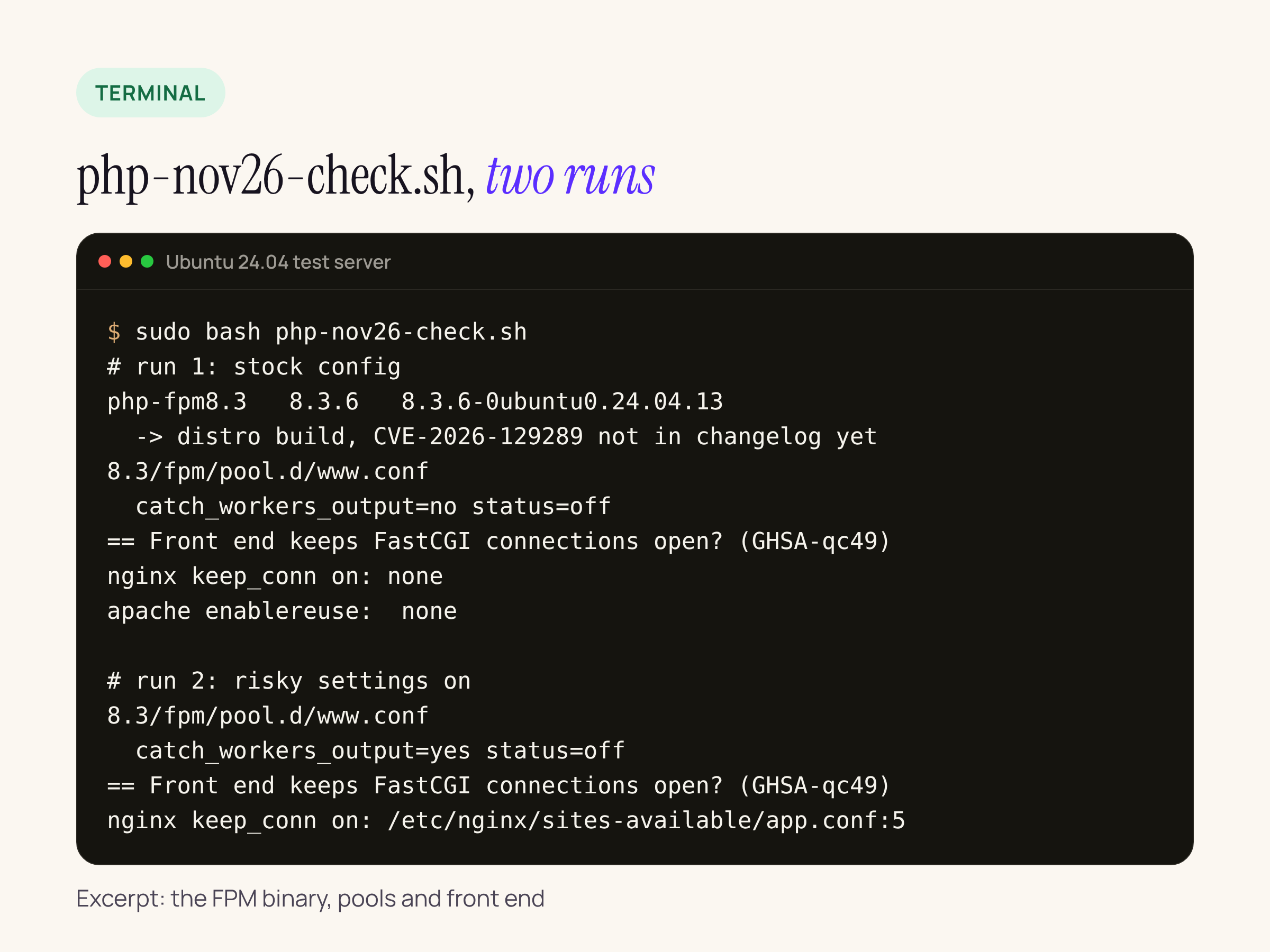
Real output from our test server, with the risky settings switched on for the second run.
Two things in that output are worth knowing before you patch:
- The version string lies on distro packages. Ubuntu and Debian keep
8.3.6and backport fixes, so the script reads/usr/share/doc/<package>/changelog.Debian.gzfor the CVE id instead. On the evening of 19 Nov (IST) the newestphp8.3package in noble-security was still0ubuntu0.24.04.13, dated 19 Oct, without these CVEs. On a distro build you wait for the Ubuntu security notice and then upgrade; until then the two settings are your mitigation. - Packages from Ondrej Sury’s PPA, Docker images and source builds carry the upstream number, so
php-fpm8.4 -vshowing 8.4.28 really means patched.
Patch steps on an Ubuntu server
For PHP from Ondrej Sury’s PPA, patch every installed branch, then restart each FPM service:
sudo apt-get update
apt list --upgradable 2>/dev/null | grep -E '^php8\.[2-6]'
sudo apt-get install --only-upgrade $(dpkg-query -W -f='${Package}\n' 'php8.*')
for s in $(systemctl list-units --type=service --no-legend 'php*-fpm*' | awk '{print $1}'); do
  sudo systemctl restart "$s"
done
sudo bash php-nov26-check.sh
Then confirm what a request actually runs, not what the CLI says. Each FPM pool can be a different branch, and CloudPanel gives each site its own pool. A one-line file in a site’s web root, removed right after, shows the real version per site:
<?php echo PHP_VERSION, ' ', PHP_SAPI;
For Laravel, run php artisan about with the same binary the site’s pool uses (php8.4 artisan about), since queue workers and the scheduler run from the CLI and need their own restart: php artisan queue:restart after the upgrade so long-running workers pick up the new binary.
If you cannot patch tonight
- nginx: remove
fastcgi_keep_conn on(the default is off) and reload. Apache: dropenablereuse=onfrom theProxyPassor<Proxy>line. This is the advisory’s own mitigation for GHSA-qc49. - FPM: set
catch_workers_output = noin every pool and restart FPM. That is the stated workaround for GHSA-jm4m. With it off, whatever workers print to stdout or stderr is discarded, so make sure your apps log to a file or syslog first. - Keep
pm.status_pathoff or behind an IP allow list; the status page XSS (GHSA-3mg3) only matters if it is reachable. - If nothing on the server serves PHP through
php-cgi, it is a fine moment to remove the CGI package; the PATH_INFO bug lives there.
These reduce exposure to the two FPM bugs only. The session, Core and Date use-after-free fixes have no configuration workaround, so the upgrade still has to happen.
What to watch next
Ubuntu’s own php8.1 (22.04) and php8.3 (24.04) packages get these fixes through Ubuntu security notices, not through the upstream version number. When the notice for your release is out and the package is installed, the first section of the script switches from “not in changelog yet” to “patched” with no change to the script.