WordPress 7.1.5 came out on 18 November 2026 as a security release with 20 listed fixes, and the release post asks everyone to update now. The short version: update to 7.1.5 (or the backport for your branch), then check that the files really changed, because four of the fixes need no login at all, including a privilege escalation through Template Part block attributes that the release post says could lead to remote code execution.
We downloaded the official 7.1.4 and 7.1.5 zips from wordpress.org and diffed them. Leaving out version.php, the About screen and build metadata, 21 files carry the fixes: 18 PHP files and three editor scripts (plus their minified copies). The release post names the fixes but gives no file list and no severity labels, so the mapping below comes from our diff.
Why we did this: this site runs on WordPress with our own Paperkite plugin, and we look after other WordPress sites on a CloudPanel VPS. For a plugin author, the diff also shows which core APIs were tightened.
What changed, by number
The diff touches 28 paths in total. Leaving out version.php, wp-admin/about.php, the .min.js builds and the asset version hashes, these carry the fixes:
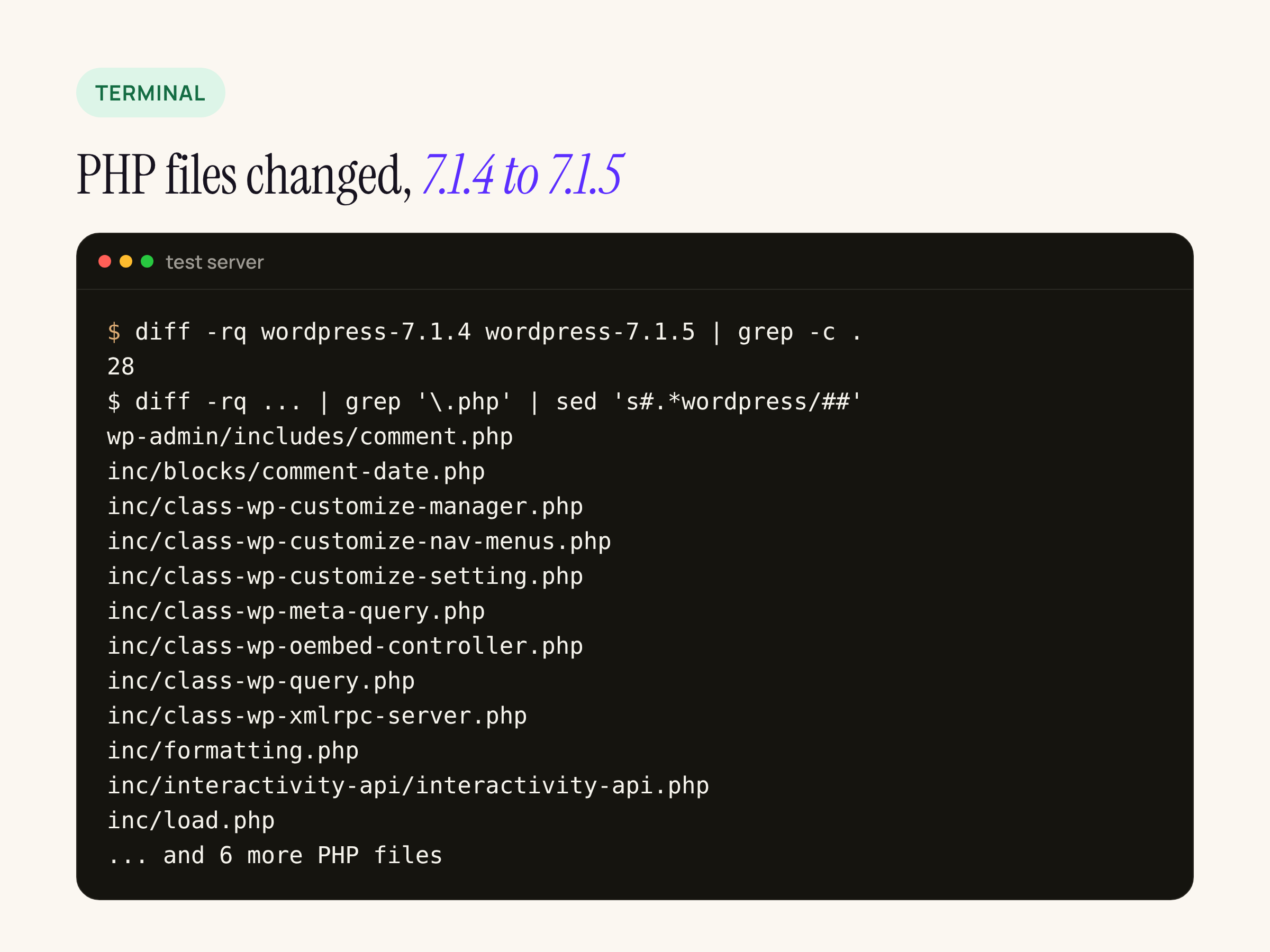
Real output from our test server: the PHP files that differ between the 7.1.4 and 7.1.5 packages (wp-includes/ shortened to inc/).
The 20 fixes and the files behind them
Fix names and who can trigger each one are from the WordPress 7.1.5 release post. Files and what changed are from our diff. Where two fixes touch the same file, or a fix has no clear match, we say so.
- JSON media type regex (hardening). Who: hardening, no attacker named. Files:
wp-includes/load.php. The-in the character class is escaped, so the range no longer matches more than intended. - Super Admin takeover via Customizer menu previews. Who: Site Admin (Multisite). Files:
class-wp-customize-nav-menus.php. The args hash gets acustomize_nav_menu_args|prefix, so it cannot collide with otherwp_hash()values. - Reflected XSS in the legacy media popup. Who: not stated. Files: No clear match. The closest change:
rest-api.phpno longer treats admin screens as REST entry points. - XSS in
wp_interactivity_data_wp_context(). Who: not stated. Files:interactivity-api.php. The store namespace goes throughesc_attr(). - SQL injection in
WP_Meta_Queryvia nested relations. Who: not stated. Files:class-wp-meta-query.php. Newsanitize_relation(), also applied to nested clauses. - Private taxonomy terms via REST search. Who: Unauthenticated. Files:
class-wp-rest-term-search-handler.php. Returns nothing when no searchable taxonomy is left. - User emails via REST comments. Who: Author and up. Files:
class-wp-rest-comments-controller.php. Reassigning a comment’s author now needs a permission check. - SQL injection via the front page setting in changeset previews. Who: not stated. Files:
class-wp-query.php,formatting.php,class-wp-customize-setting.php. Query vars go through$wpdb->prepare();show_on_frontis sanitized; option previews are suspended while saving. - XSS via scripts in oEmbed responses. Who: Contributor and up. Files:
class-wp-oembed-controller.php.scriptsis removed from proxied oEmbed data. - Stored XSS via shortcode attributes in comments. Who: Unauthenticated. Files:
shortcodes.php. Hex or octal escapes that decode to<,>,"or'become character references. - DoS via batched XML-RPC pingbacks. Who: Unauthenticated. Files:
class-wp-xmlrpc-server.php. One pingback persystem.multicallrequest. - Author assignment via REST posts and templates. Who: Editor and up. Files:
class-wp-rest-posts-controller.php,class-wp-rest-templates-controller.php. The new author must be a member of the site. - Stored XSS via Customizer previews. Who: Administrator. Files:
class-wp-customize-setting.php(shared with 8). Preview and sanitize paths reworked. - Comment editing bypass in the admin. Who: Author and up. Files:
wp-admin/includes/comment.php. Moving a comment to another post is checked separately; the type can no longer change. - Data via XML-RPC
wp.getComments. Who: Subscriber and up. Files:class-wp-xmlrpc-server.php(shared with 11). Author email and IP are blank unless you can moderate or edit the comment. - Imgur embed variation removed (hardening). Who: hardening, no attacker named. Files:
js/dist/block-library.js. Theimgurvariation is gone. - Stored XSS in the Comment Date block. Who: Contributor and up. Files:
blocks/comment-date.php. The formatted date goes throughesc_html(). - Privilege escalation via Template Part attributes, possible RCE. Who: Unauthenticated. Files:
js/dist/core-data.js(our reading). NewisSafeEntityKey()rejects record keys with../,%2f,?,#or control characters. - XSS via Openverse image metadata. Who: not stated. Files:
js/dist/editor.js. Title, creator and license are escaped; onlyhttp(s)links are kept. - Stored XSS via media filenames (media to File block). Who: Contributor and up. Files:
js/dist/block-library.js. The filename goes throughescapeEditableHTML().
A note on item 18. No PHP file for the Template Part block changed. The only new guard we can tie to entity records, which is how the editor loads template parts, is isSafeEntityKey() in core-data.js. That match is our reading of the diff, not something the release post states.
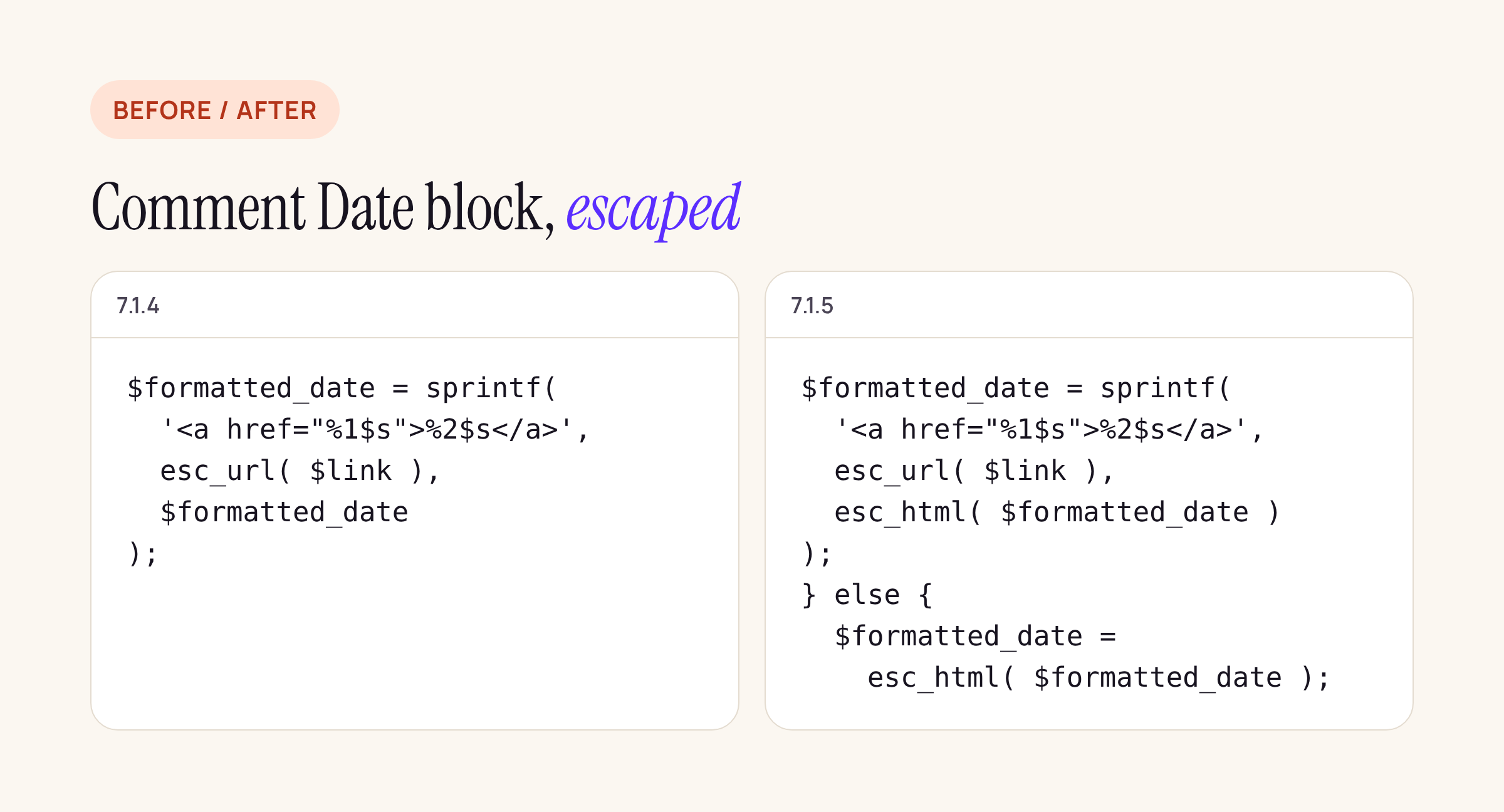
Item 17 in code: the date string was printed raw inside the link, and is now escaped.
What a site owner should do
- Update. Sites with background updates on get 7.1.5 by themselves. Otherwise use Dashboard, Updates, Update Now, or WP-CLI:
wp core update. - If you are on an older branch, the release post says the fixes are being backported “as a courtesy” to every branch back to 4.7, and that those backports “are in progress”. Only the latest version is supported, so plan the move to 7.1.
- Confirm the files. A host or a deploy script can leave old core files behind. The script below reads the version and looks for one marker from each of six fixed files.
- If you do not use XML-RPC (no Jetpack, no old mobile app, no remote publishing), block
xmlrpc.phpat the web server. Items 11 and 15 are both XML-RPC.
The check is read-only and needs only Bash and grep:
#!/usr/bin/env bash
# wp-715-check.sh <wordpress-dir>
# Read-only: core version, and whether the 7.1.5 fixes are in the files.
set -u
WP="$1"

ver=$(sed -n "s/^\$wp_version = '\(.*\)';/\1/p" "$WP/wp-includes/version.php")
echo "core version: $ver"

check() {  # file, marker, label
  if grep -qF -- "$2" "$WP/$1"; then s=fixed; else s=MISSING; fi
  printf '%-8s %s\n' "$s" "$3"
}
check wp-includes/class-wp-meta-query.php 'function sanitize_relation' 'WP_Meta_Query relation'
check wp-includes/class-wp-xmlrpc-server.php 'pingback_processed' 'XML-RPC pingback multicall'
check wp-includes/shortcodes.php 'A hex or octal escape' 'shortcode attribute escapes'
check wp-includes/blocks/comment-date.php 'esc_html( $formatted_date )' 'Comment Date block'
check wp-includes/js/dist/core-data.js 'isSafeEntityKey' 'core-data entity keys'
check wp-includes/rest-api/search/class-wp-rest-term-search-handler.php "empty( \$query_args['taxonomy'] )" 'REST term search'
We ran it on the unpacked 7.1.4 and 7.1.5 packages on our Linux test server (Ubuntu 24.04, Bash 5.2):
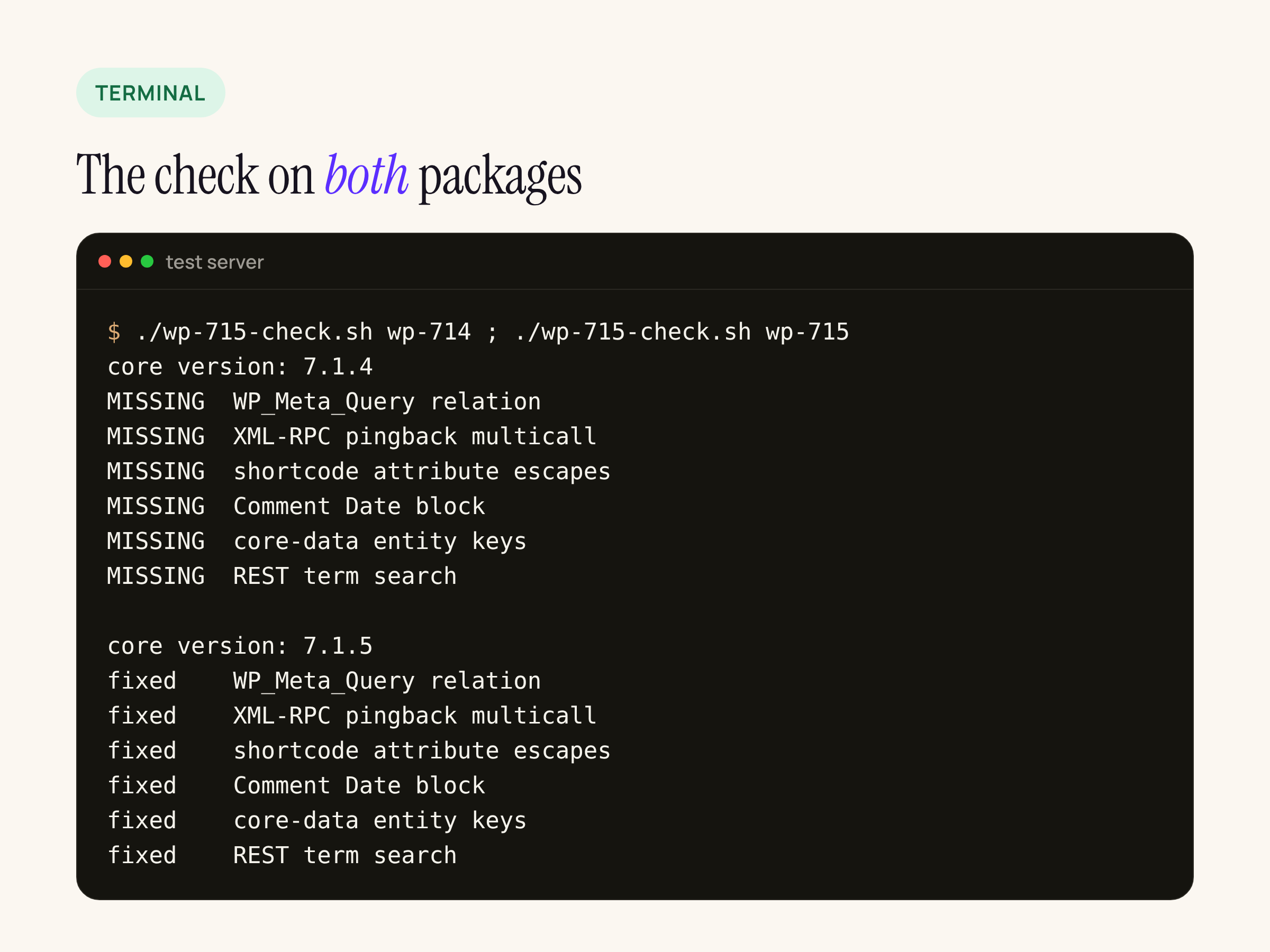
Real output: every marker is missing in 7.1.4 and present in 7.1.5.
The markers come from the 7.1.5 files. A backport to 6.x may word a comment differently, so on older branches trust the version number from the release archive first and treat a MISSING line as a prompt to look, not as proof.
What a plugin author should check
Some fixes change core behaviour that plugins can depend on:
WP_Meta_Queryrelations. Anything other thanANDorORis now cleaned up, including in nested arrays. If your plugin builds meta queries from request data, test the odd values you allow, such as lowercaseor.WP_Querynumeric vars.p,page_id,menu_orderand themdate parts now go through$wpdb->prepare(), and an array value is queried as0rather than dropping the condition. Code that passed an array by mistake now gets no posts instead of every post.- REST author changes. On posts and templates, the new author must be a member of the site (
is_user_member_of_blog()). On Multisite, tools that assign posts to network users who are not on that site now get an error. - Shortcode attributes. Escapes like
\x3cin attributes now decode to<, not<. A shortcode that relied on getting raw markup back through an escaped attribute will see entities. - Customizer options. While an option is being saved or sanitized, its preview filter now passes the original value through. Custom settings that read other previewed options during
sanitize_callbackmay see the saved value.
A quick grep -rn "WP_Meta_Query\|meta_query\|add_shortcode\|register_setting" . in a plugin folder shows which of these points apply to it.
Other notes from the release post
- WordPress 7.0 removed 1024-bit root certificates from the bundled CA list. 7.1.5 applies the same change to 6.9.12 and earlier.
- WordPress 7.2 is planned for 8 December 2026, and 7.2 RC 2 already contains these fixes. Our post on checking bundled @wordpress packages before 7.2 covers what else changes then.
- For the PHP side of the same week, see the PHP security release of 19 Nov 2026.