PHP 8.6.0 is planned for Thursday 19 November 2026; the current build is 8.6.0RC7, announced on php.net on 12 November. The short answer for WordPress: core is ready. We ran a scan for every 8.6 deprecation over a fresh WordPress 7.1.4 download and found one hit, in a bundled third-party library. The risk sits in plugins: a plugin that declares its own global clamp() without a function_exists() guard will stop loading on 8.6, because clamp() is now a built-in function. Search your plugins for that first.
Why we did this: ideaxecution.com runs on WordPress with our own Paperkite plugin, which replaced about 20 third-party plugins, and we build Laravel apps for clients. Every PHP release lands on our code before it lands on anyone else’s.
This post covers the 8.6 changes from the official UPGRADING notes and RFCs, plus a scan of WordPress core we ran on a Linux test server (Ubuntu 24.04). It is written from RC7 and will be updated on release day.
What WordPress 7.1.4 core looks like under PHP 8.6
We downloaded WordPress 7.1.4 from wordpress.org (1,512 PHP files) and ran the scan script below over it.
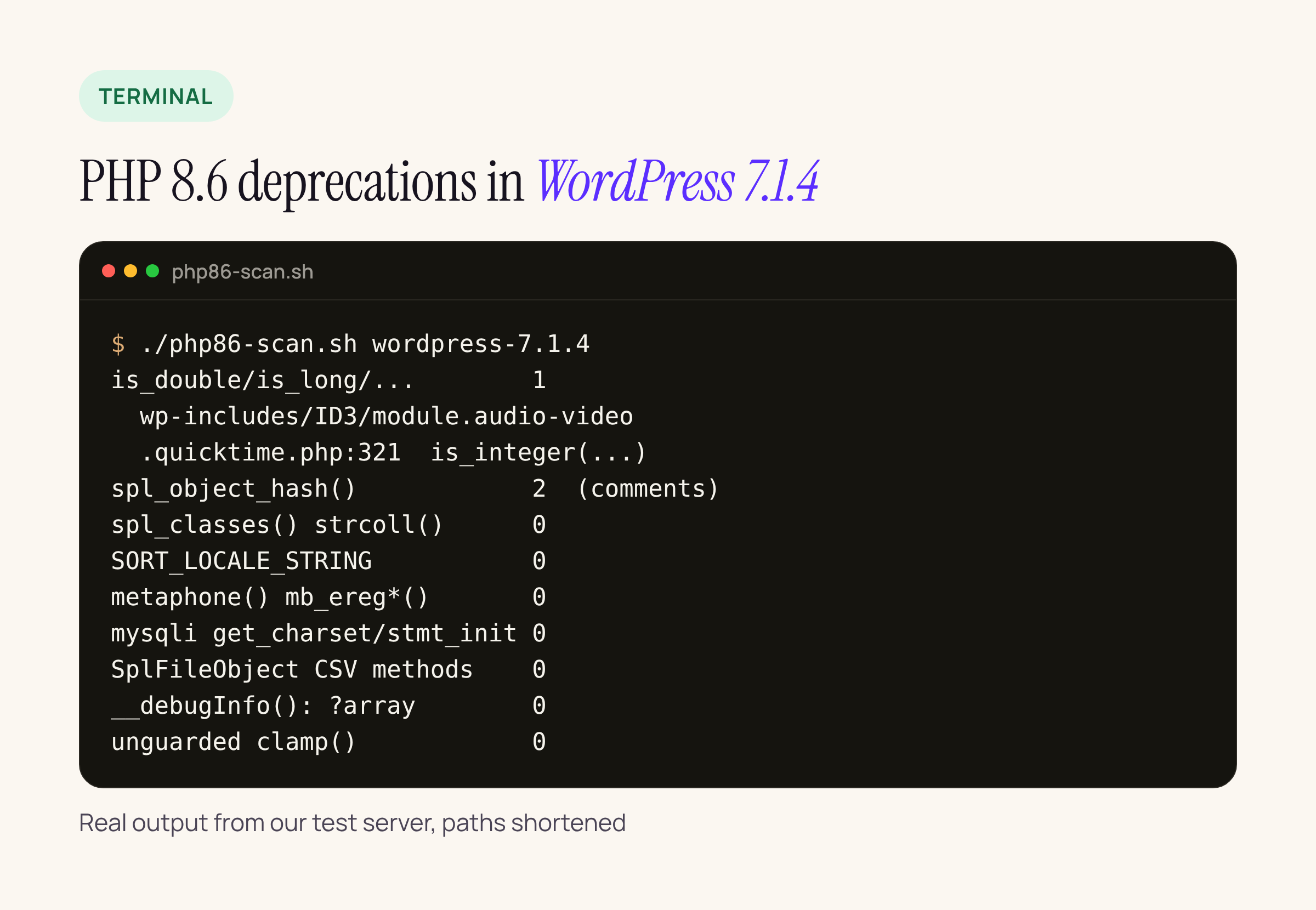
Real output from our test server: one deprecated call in core, inside the bundled getID3 library.
is_integer()inwp-includes/ID3/module.audio-video.quicktime.php, line 321. PHP 8.6 deprecatesis_integer(),is_long(),is_double()anddoubleval()in favour ofis_int()andis_float()(RFC). It is a deprecation notice, not an error, and getID3 is an upstream library that core updates from time to time.spl_object_hash()appears only in two doc comments inwp-includes/plugin.php. Core switched the hook system tospl_object_id()in 7.1.0, which is exactly what 8.6 asks for.clamp()is already handled.wp-includes/compat.phpships a polyfill, added in 7.1.0, wrapped inif ( ! function_exists( 'clamp' ) ). On PHP 8.6 the built-in function exists, so the polyfill is skipped.- Sessions: core never calls
session_start()(the only two hits are Site Health strings telling you not to), so the new session defaults below do not touch core itself.
The change that can take a site down: clamp()
The clamp RFC adds clamp(mixed $value, mixed $min, mixed $max): mixed to core PHP. It returns $value when it is inside the range, otherwise the nearest bound, and throws a ValueError when $min is greater than $max or either bound is NAN.
Because the name is now taken, any plugin or theme that declares a global function clamp() without a guard fails at load time with a “cannot redeclare” fatal error. Helpers named clamp are common in themes, page builders and image plugins.
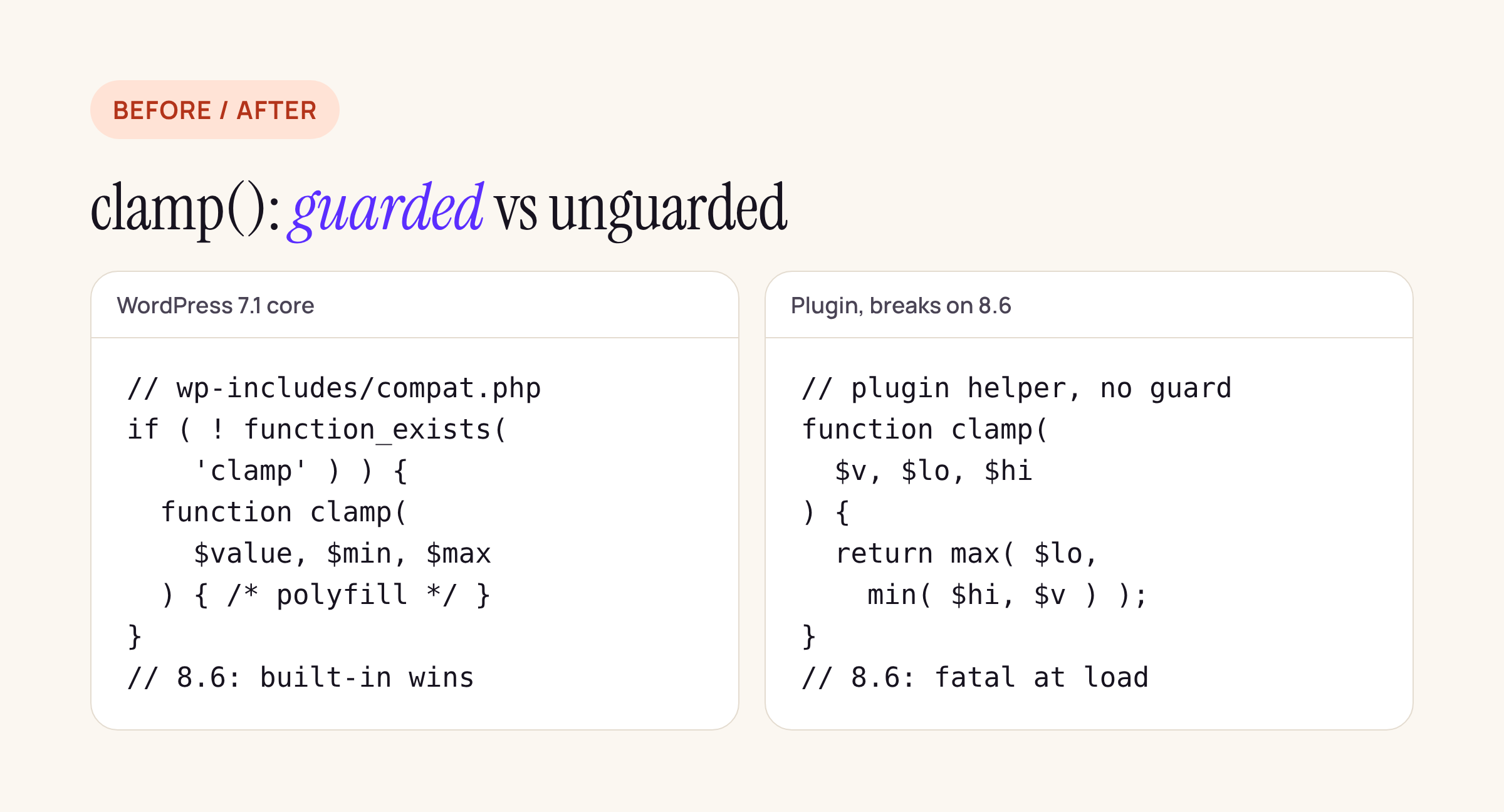
The fix is either the guard WordPress uses, or a prefixed or namespaced name. A namespaced function (MyPlugin\clamp()) does not clash with the global one.
// before: fatal on PHP 8.6
function clamp( $v, $lo, $hi ) {
    return max( $lo, min( $hi, $v ) );
}

// after: use the built-in when it exists
if ( ! function_exists( 'clamp' ) ) {
    function clamp( $v, $lo, $hi ) {
        return max( $lo, min( $hi, $v ) );
    }
}
One difference to keep in mind: the built-in throws a ValueError when $min > $max. A userland helper that silently returned something in that case will now throw, so check call sites that build bounds from settings.
Deprecations most likely to show up in plugins
These are the 8.6 deprecations from the UPGRADING file, section 4 that we expect to meet in WordPress plugins and Laravel apps. All of them raise E_DEPRECATED in 8.6 and are planned for removal in PHP 9.
| Deprecated in 8.6 | Use instead | Source |
|---|---|---|
is_double(), is_long(), is_integer(), doubleval() |
is_float(), is_int(), floatval() |
RFC |
spl_object_hash() |
spl_object_id() |
RFC |
spl_classes() |
ReflectionExtension::getClassNames() |
RFC |
strcoll(), SORT_LOCALE_STRING |
Collator::compare(), Collator::sort() |
RFC |
metaphone() |
a userland phonetic library | RFC |
mysqli_get_charset(), mysqli::stmt_init() |
mysqli_character_set_name(), prepare() |
RFC |
mbstring regex (mb_ereg*) |
PCRE (preg_*) |
RFC |
SplFileObject CSV methods (fgetcsv, fputcsv, …) |
see the RFC for replacements | RFC |
Objects passed to http_build_query(), array_walk() |
get_object_vars() first |
RFC |
Third argument to define() |
drop it | RFC |
Returning a value from __construct() or __destruct() |
return nothing | RFC |
return inside a finally block |
move the return out | RFC |
__debugInfo(): ?array |
__debugInfo(): array |
UPGRADING |
More than 16 filters in one php://filter URL |
stream_filter_append() |
RFC |
The deprecations RFC also proposed deprecating list(); that vote did not reach the two-thirds majority and it is not in the UPGRADING notes, so list() stays.
Behaviour changes that do not raise a notice
Some 8.6 changes alter results without any warning, which makes them easier to miss than a deprecation:
- Session defaults (RFC):
session.use_strict_modeis now1,session.cookie_httponlyis now1andsession.cookie_samesiteis nowLax. A plugin that uses native PHP sessions and relies on cross-site POSTs (a payment gateway returning to the site, for example) or reads the session cookie from JavaScript should be tested.session_encode()now returns an empty string instead offalsefor an empty session. trim()now strips form feed (\f) by default, along withltrim()andrtrim()(RFC). This matters only if you parse data where a form feed is meaningful.fclose(),file_put_contents()andcopy()now returnfalsewhen the final flush or close fails. Code that treated a non-false return as success becomes more accurate, but check any=== falsebranches that used to be dead code.- New
ValueErrors for out-of-range arguments, for example an invalid$modeinarray_filter()or out-of-range$decimalsinnumber_format()(UPGRADING, section 1).
The scan script
The script is a set of grep patterns, one per deprecation. It lists counts and the first three hits for each. Patterns that would need a parser (objects passed to array_walk(), return in finally) are left out; review those by hand.
#!/usr/bin/env bash
# php86-scan.sh: list PHP 8.6 deprecations in a plugin or app tree
dir="${1:-.}"
check() {
  n=$(grep -rnE --include='*.php' "$2" "$dir" | wc -l)
  printf '%-28s %s\n' "$1" "$n"
  [ "$n" -gt 0 ] && grep -rnE --include='*.php' "$2" "$dir" | head -3 | cut -c1-110
}
check "is_double/is_long/..."  '\b(is_double|is_long|is_integer|doubleval)\s*\('
check "spl_object_hash()"      '\bspl_object_hash\s*\('
check "spl_classes()"          '\bspl_classes\s*\('
check "strcoll()"              '\bstrcoll\s*\('
check "SORT_LOCALE_STRING"     '\bSORT_LOCALE_STRING\b'
check "metaphone()"            '\bmetaphone\s*\('
check "mysqli get_charset"     '\bmysqli_get_charset\s*\(|->get_charset\s*\('
check "mysqli stmt_init"       '\bmysqli_stmt_init\s*\(|->stmt_init\s*\('
check "mb_ereg* (mbregex)"     '\bmb_(ereg|eregi|regex)[a-z_]*\s*\('
check "SplFileObject CSV"      '[-]>(fgetcsv|fputcsv|setCsvControl|getCsvControl)\s*\('
check "__debugInfo(): ?array"  'function\s+__debugInfo\s*\(\s*\)\s*:\s*(\?array|array\s*\|\s*null)'
check "unguarded clamp()"      '^function\s+clamp\s*\('
check "session_start()"        '^[^*/]*\bsession_start\s*\('
Run it on wp-content/plugins and wp-content/themes, then on anything flagged run the plugin with WP_DEBUG and WP_DEBUG_LOG on under PHP 8.6 to see the notices in context. The ->fgetcsv style patterns can match unrelated objects with the same method names, so read each hit.
Laravel 13 apps
The same script works on a Laravel app: run it on app/ for your own code and on vendor/ to see which packages still need a release. Two points specific to Laravel:
- Laravel handles sessions through its own drivers (file, database, Redis) rather than PHP’s native
session_start(), so the newsession.*ini defaults do not change a standard Laravel app. Packages invendor/that start native sessions are the exception. - Check
composer.jsonconstraints before switching the CLI and FPM versions. A package pinned tophp: "~8.5.0"will blockcomposer installon 8.6 even if its code is fine.
What is new and worth using
- Partial function application (RFC):
?stands for one argument,...for the rest, and the result is aClosure. For examplearray_map(str_replace('hello', 'hi', ?), $arr). clamp(), covered above.Time\Duration(RFC), aSortDirectionenum (RFC),grapheme_strrev()and readonly properties with default values (RFC).- JSON error positions:
json_last_error_msg()andJsonExceptionnow say where the error is (php.watch).
A WordPress plugin that supports older PHP versions cannot use partial application or the new classes directly, because they are syntax and symbols the older versions do not have. clamp() is the exception: core’s polyfill makes it safe to call on any PHP version WordPress 7.1 supports.
What to check on your own site
- Run the scan over
wp-content/pluginsandwp-content/themes, and fix any unguarded globalclamp()first. - Turn on
WP_DEBUG_LOGon a staging copy with PHP 8.6 and load every admin screen your plugins add. - If a plugin uses native sessions, test logins and any payment or OAuth return flows with the new
SameSite=Laxdefault. - For Laravel, run the scan on
app/andvendor/, thencomposer update --dry-rununder 8.6 to find blocking constraints.
PHP 8.6 gets active support until the end of 2028 and security fixes until the end of 2030 (php.watch), so there is no rush to switch on release day. There is every reason to know where your plugins stand before your host offers it.