Takeaway: from 2 December 2026, GitHub Actions blocks pull_request_target events by default in every public repository on GitHub Free, Team and Enterprise Cloud, unless an Actions event policy explicitly allows them (GitHub changelog, 2 Nov 2026). A blocked workflow does not run; it shows up as a failed run with an error annotation. If you maintain a public library or sample app, list your pull_request_target workflows this week and decide, for each one, between an explicit allow and a rewrite.
We ran a small scan over 31 public mobile repositories (React Native core and libraries, Expo, Android samples, Swift packages) on 25 Nov 2026. Nine of them use the trigger, in 23 workflows. Below: the numbers, what those workflows do, the script, and a rewrite of the most common pattern that passes actionlint 1.7.12.
Why we did this: our React Native banking and TV apps depend on most of these libraries, and when a library’s CI stops labelling or checking pull requests, fixes reach us more slowly. The same check applies to any public repository of our own.
What changes on 2 December
From the changelog and Socket’s write-up (5 Nov, updated 18 Nov):
| Point | What the sources say |
|---|---|
| Date | Enforcement starts 2 Dec 2026 (it was first planned for 2 Nov). Brownouts ran on 9 and 16 Nov, 16:00 to 18:00 UTC |
| Scope | Public repositories only. Private and internal repositories are not affected. GitHub Enterprise Server is not affected |
| Effect | Blocked attempts create failed runs with an error annotation; the workflow does not execute |
| Until then | The default rule runs in evaluate mode: workflows run, with warnings, and Insights shows which runs would be blocked |
| Opt out | Allow pull_request_target in an Actions event policy at repository, organization or enterprise level; workflow file targeting allows specific files only (docs) |
| Existing policies | Not replaced by the new default |
| Plans | Actions policies became free on all plans (Socket, update of 17 Nov) |
Neither source says that pull requests from branches in the same repository are exempt, and neither says that GITHUB_TOKEN or secrets behave differently. The reason for the change is the known one: pull_request_target runs in the context of the base repository and can read its secrets, so a workflow that runs code from the pull request hands that code the secrets.
What we found in 31 mobile repos
We cloned the .github folder of each repository’s default branch and listed every workflow file that triggers on pull_request_target.
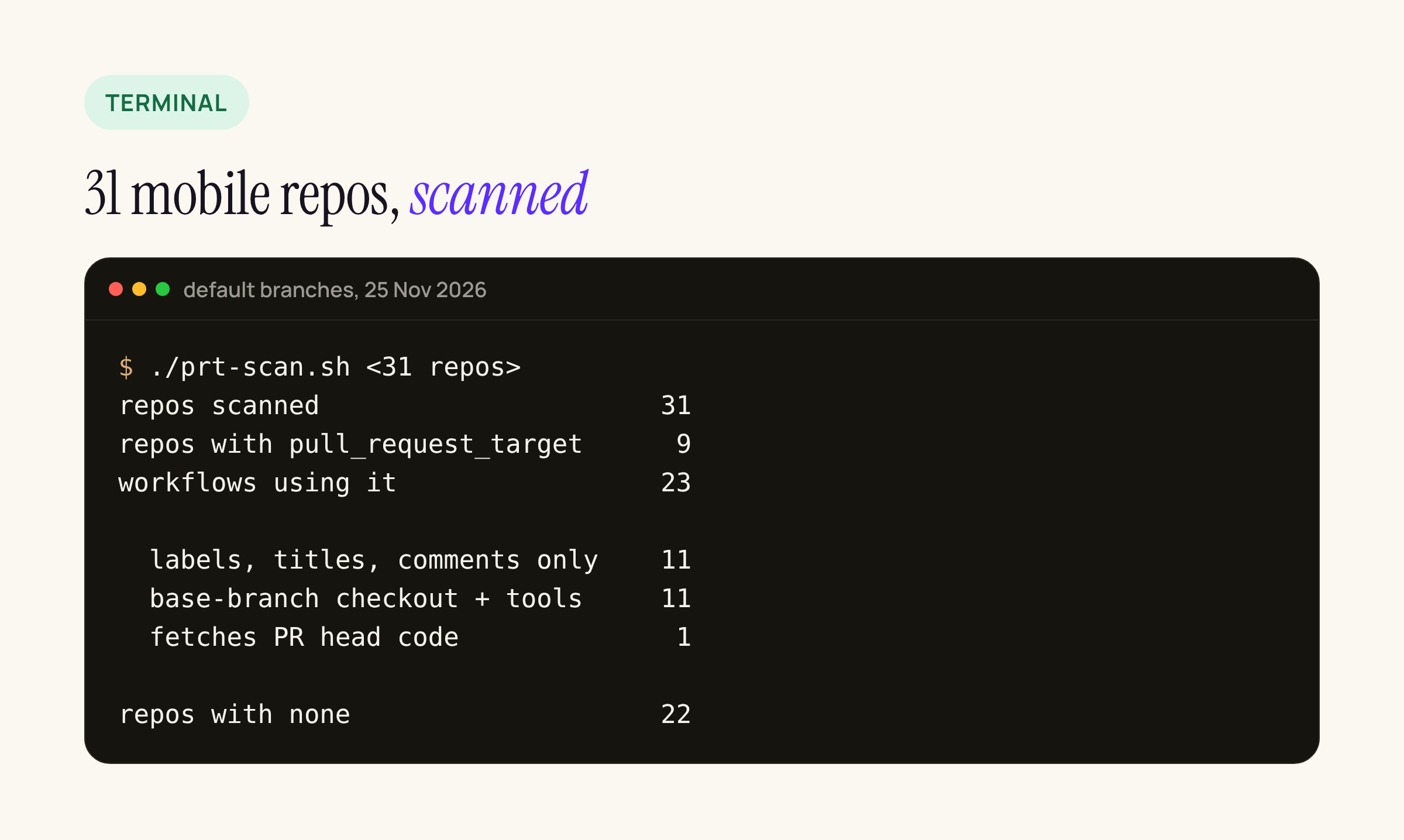
Tallied from the scan script’s output, default branches as of 25 Nov 2026.
| Repository | Workflows on pull_request_target |
What they do |
|---|---|---|
| expo/expo | 8 | code mentions, contributor labels, issue triage, evidence and triage checks, automated review, SDK cherry-picks |
| software-mansion/react-native-reanimated | 5 | PR description and label format, Slack notice, cache cleanup on close, a label-triggered verification job |
| facebook/react-native | 3 | PR body analysis, JS API change report, visual test approval |
| callstack/react-native-paper | 2 | contributor label, PR checks |
| Shopify/flash-list | 1 | CLA check |
| swiftlang/swift-package-manager | 1 | PR dependency check (a reusable workflow, read-only permissions) |
| invertase/react-native-firebase | 1 | semantic PR title |
| react-native-community/cli | 1 | release drafter |
| react-navigation/react-navigation | 1 | PR description and screenshot check |
The 22 repositories with none: react-native-screens, react-native-safe-area-context, react-native-gesture-handler, react-native-vision-camera, react-native-maps, react-native-permissions, react-native-vector-icons, async-storage, react-native-bottom-sheet, Hermes, Yoga, Flutter, Kotlin, swift-nio, swift-testing, and Google’s nowinandroid, compose-samples, architecture-samples, sunflower, snippets, xr-samples and accompanist. Android and Apple sample repositories do not use the trigger at all; the libraries with bots and contributor checks do.
Sorting the 23 workflows by what they touch:
- 11 only read pull request metadata (title, body, author, labels) and write labels or comments. No checkout of pull request code.
- 11 check out the base branch and run the repository’s own scripts or actions. Several (Expo’s especially) say so in a comment at the top of the file, and React Native’s API report reads one file from the pull request head with
git showas data, without running it. - 1 fetches the pull request head: Reanimated’s label-triggered verification job. It only runs when a maintainer adds a specific label, fetches the head into a separate folder with git hooks and symlinks turned off, and restores a trusted checkout afterwards.
We can see the workflow files, not the repositories’ settings. Any of these projects may already have an event policy that allows the trigger, in which case nothing changes for them on 2 December.
The scan script
Run it with any list of owner/repo names. It needs only git and grep, and it never downloads anything outside .github.
#!/usr/bin/env bash
# List workflows that trigger on pull_request_target in each repo.
# Usage: ./prt-scan.sh owner/repo [owner/repo ...]
set -u
for repo in "$@"; do
  dir=$(mktemp -d)
  git clone -q --depth 1 --filter=blob:none --sparse \
    "https://github.com/$repo.git" "$dir" || continue
  git -C "$dir" sparse-checkout set .github >/dev/null
  for wf in "$dir"/.github/workflows/*.y*ml; do
    [ -e "$wf" ] || continue
    grep -qE '^\s*-?\s*pull_request_target\s*:?\s*$|pull_request_target\s*:|\[.*pull_request_target' "$wf" || continue
    head_refs=$(grep -cE 'pull_request\.head\.(sha|ref)|refs/pull/' "$wf")
    printf '%-38s %-42s head-refs=%s\n' "$repo" "$(basename "$wf")" "$head_refs"
  done
  rm -rf "$dir"
done
head-refs counts lines that mention the pull request head SHA, head ref or refs/pull/. It is a pointer for reading, not a verdict: Reanimated’s cache cleanup scores 2 because it deletes caches keyed on refs/pull/..., which is harmless.
Allow it, or rewrite it
For each workflow there are two honest options.
Allow it explicitly. If the workflow only reads metadata and posts labels or comments, or checks out the base branch and never runs pull request code, an event policy that allows pull_request_target for that one workflow file is the smallest change. Use file targeting rather than a repository-wide allow, so a future workflow does not inherit it.
Rewrite it. If the workflow builds, tests or lints pull request code, or you would rather not keep an exception, split it in two: a pull_request workflow that does the work with read-only permissions and no secrets, and a workflow_run workflow that reads its result and does the privileged part (the comment, the label).
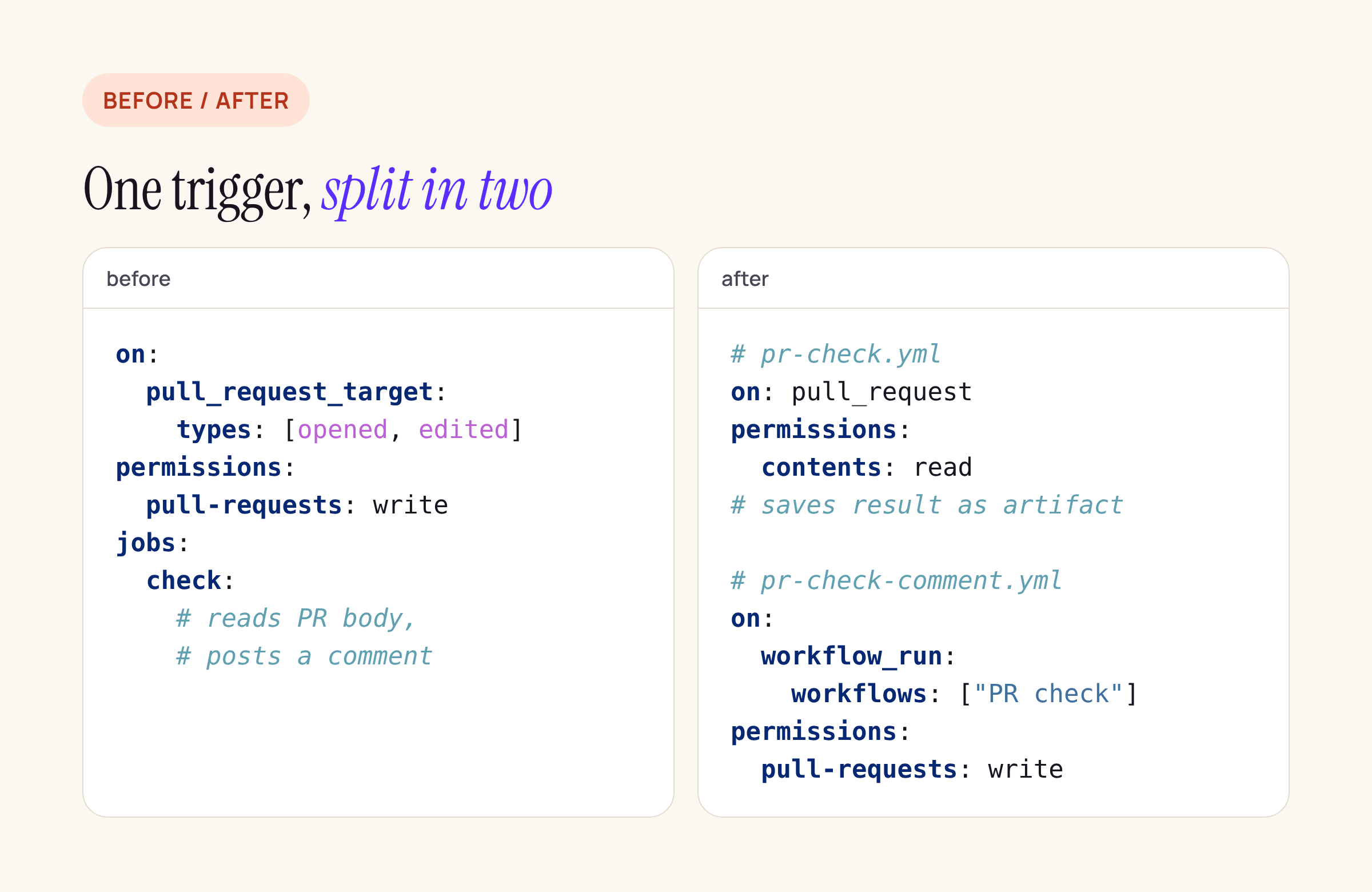
The common “check the PR description and comment” job, before and after.
The two files in full:
# .github/workflows/pr-check.yml
name: PR check
on:
  pull_request:
    types: [opened, edited, reopened, synchronize]
permissions:
  contents: read
jobs:
  check:
    runs-on: ubuntu-latest
    steps:
      - name: Check the description
        env:
          BODY: ${{ github.event.pull_request.body }}
          NUMBER: ${{ github.event.pull_request.number }}
        run: |
          mkdir -p out
          echo "$NUMBER" > out/number
          if [ "${#BODY}" -gt 1000 ]; then
            echo "too-long" > out/result
          else
            echo "ok" > out/result
          fi
      - uses: actions/upload-artifact@v4
        with:
          name: pr-check
          path: out/
# .github/workflows/pr-check-comment.yml
name: PR check comment
on:
  workflow_run:
    workflows: ["PR check"]
    types: [completed]
permissions:
  pull-requests: write
  actions: read
jobs:
  comment:
    runs-on: ubuntu-latest
    if: github.event.workflow_run.event == 'pull_request'
    steps:
      - uses: actions/download-artifact@v4
        with:
          name: pr-check
          run-id: ${{ github.event.workflow_run.id }}
          github-token: ${{ secrets.GITHUB_TOKEN }}
      - name: Comment when the check failed
        env:
          GH_TOKEN: ${{ secrets.GITHUB_TOKEN }}
          REPO: ${{ github.repository }}
        run: |
          number=$(tr -cd '0-9' < number)
          result=$(tr -cd 'a-z-' < result)
          if [ "$result" = "too-long" ]; then
            gh pr comment "$number" --repo "$REPO" \
              --body "Please keep the description under 1000 characters."
          fi
Three details matter. The artifact comes from an untrusted run, so the second workflow strips it down to digits and a fixed word before using it, and never executes anything from it. Pull request text reaches the shell only through environment variables, never through ${{ }} inside run:. And the privileged workflow never checks out the pull request.
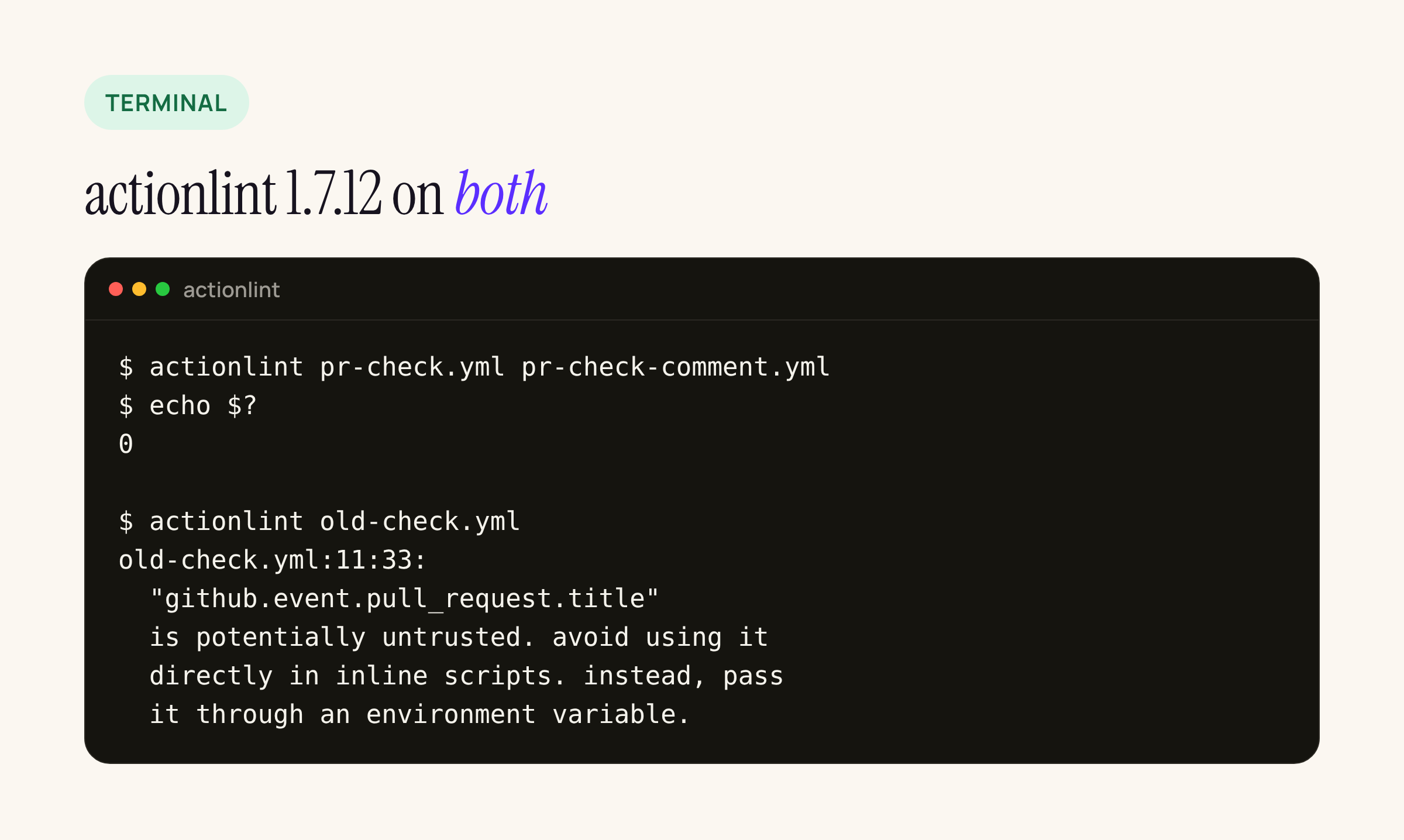
actionlint 1.7.12 on our two files, and on a deliberately bad one-liner for comparison.
We checked both files with actionlint 1.7.12: no findings. For comparison we also linted a one-line pull_request_target workflow that puts github.event.pull_request.title straight into run:; actionlint flags it as untrusted input. That rule is worth keeping in CI whichever option you pick. Runtime behaviour of the pair on a live repository is outside this post; try it on a fork before you move a busy repository over.
A checklist for this week
- Run the scan on your own public repositories, or search them for
pull_request_target. - Open each match and note: does it check out or run pull request code, and which secrets can it read?
- Metadata-only and base-checkout workflows: allow them by file in an event policy, or rewrite them if you prefer no exceptions.
- Anything that runs pull request code: rewrite with
pull_requestplusworkflow_run. - Look at the Actions policy Insights before 2 December to see which runs the default rule would block.
- After 2 December, watch for failed runs with the blocking annotation on new pull requests from contributors.
We will update this post if GitHub publishes more detail on or after 2 December.