Short version: if your app is on React Native 0.88.1, the upgrade to 0.89 is mostly deletions. Remove every fabricEnabled, turboModulesEnabled and bridgelessEnabled reference on Android and iOS (they no longer exist), add @react-native/community-cli-plugin to devDependencies and move to @react-native-community/cli 21, replace blurOnSubmit with submitBehavior, and plan for targetSdk 37 (Android 17). We diffed the npm packages of react-native 0.88.1 (27 Oct 2026) and 0.89.0-rc.1 (10 Nov 2026), and the community template at the same two versions, to see which of the release notes actually show up in code.
Why we did this: our Beacon-type banking apps and our TV apps run on React Native 0.88.1. Before the 0.89 final lands we want the upgrade list in one place, checked against the shipped sources rather than the changelog alone.
What we compared
npm pack react-native@0.88.1 react-native@0.89.0-rc.1
npm pack @react-native-community/template@0.88.1 \
  @react-native-community/template@0.89.0-rc.1-8daacc8
diff -rq 0.88.1/package 0.89.0-rc.1/package | wc -l   # 1502 entries
The release notes we checked the diff against are the 0.89.0-rc.0 notes (4 Nov) and the 0.89.0-rc.1 notes (10 Nov, Hermes and Metro 0.88.0 bumps). Neither page gives a date for 0.89.0 final, so this post covers the release candidate and will be updated when the final ships.
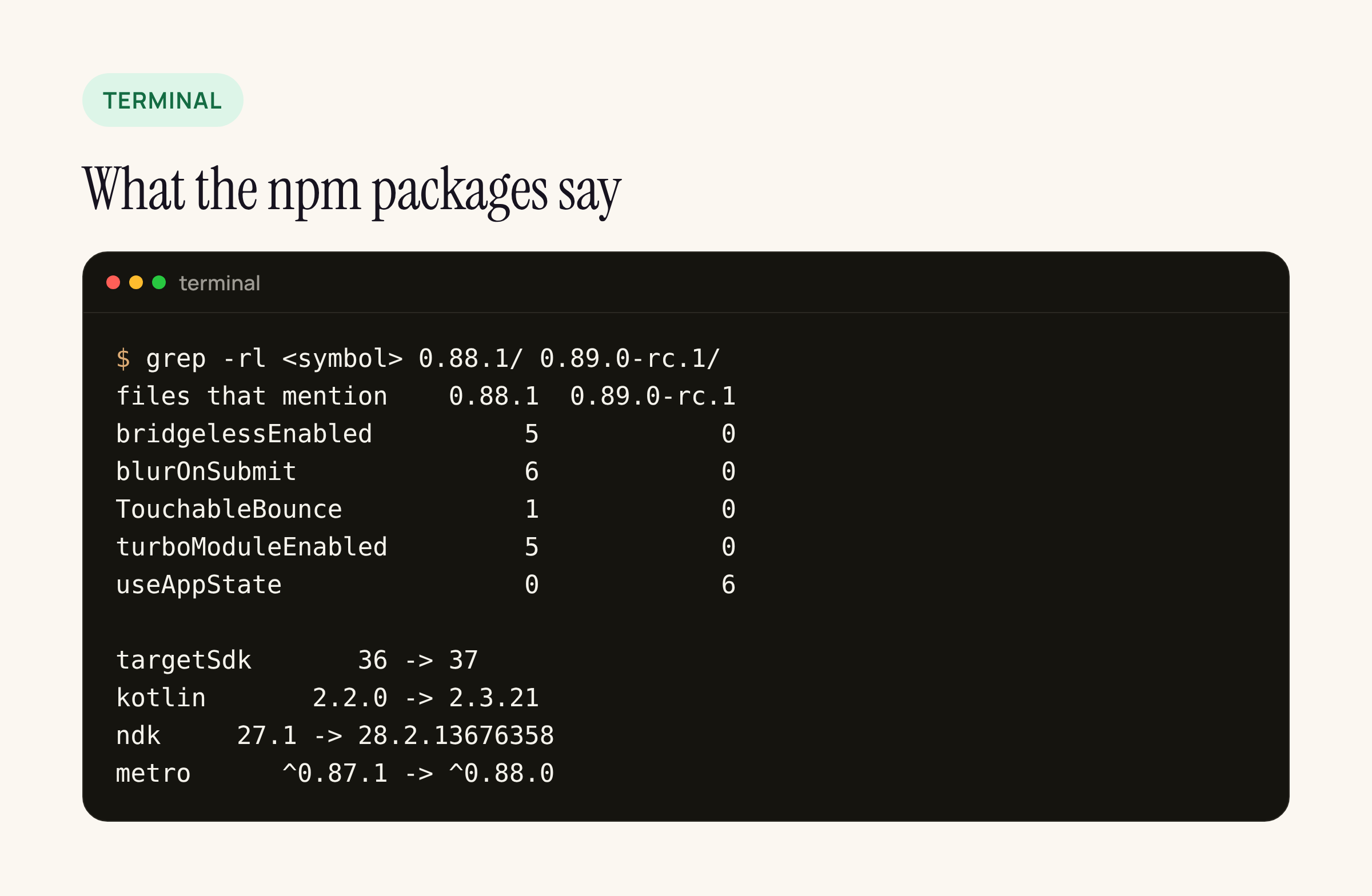
Real output from our test server: how many files in each npm package mention each symbol, plus the version pins from gradle/libs.versions.toml.
Bridgeless is the only mode: the flags are gone
The headline of 0.89 is that the New Architecture no longer has switches. On Android, DefaultNewArchitectureEntryPoint loses the three-argument load(turboModulesEnabled, fabricEnabled, bridgelessEnabled) overload and the fabricEnabled, turboModulesEnabled, concurrentReactEnabled and isConfigurationValid members. What is left is a single load() and a releaseLevel property that picks the feature flag set.
The template’s MainActivity.kt shows the edit almost every app needs:
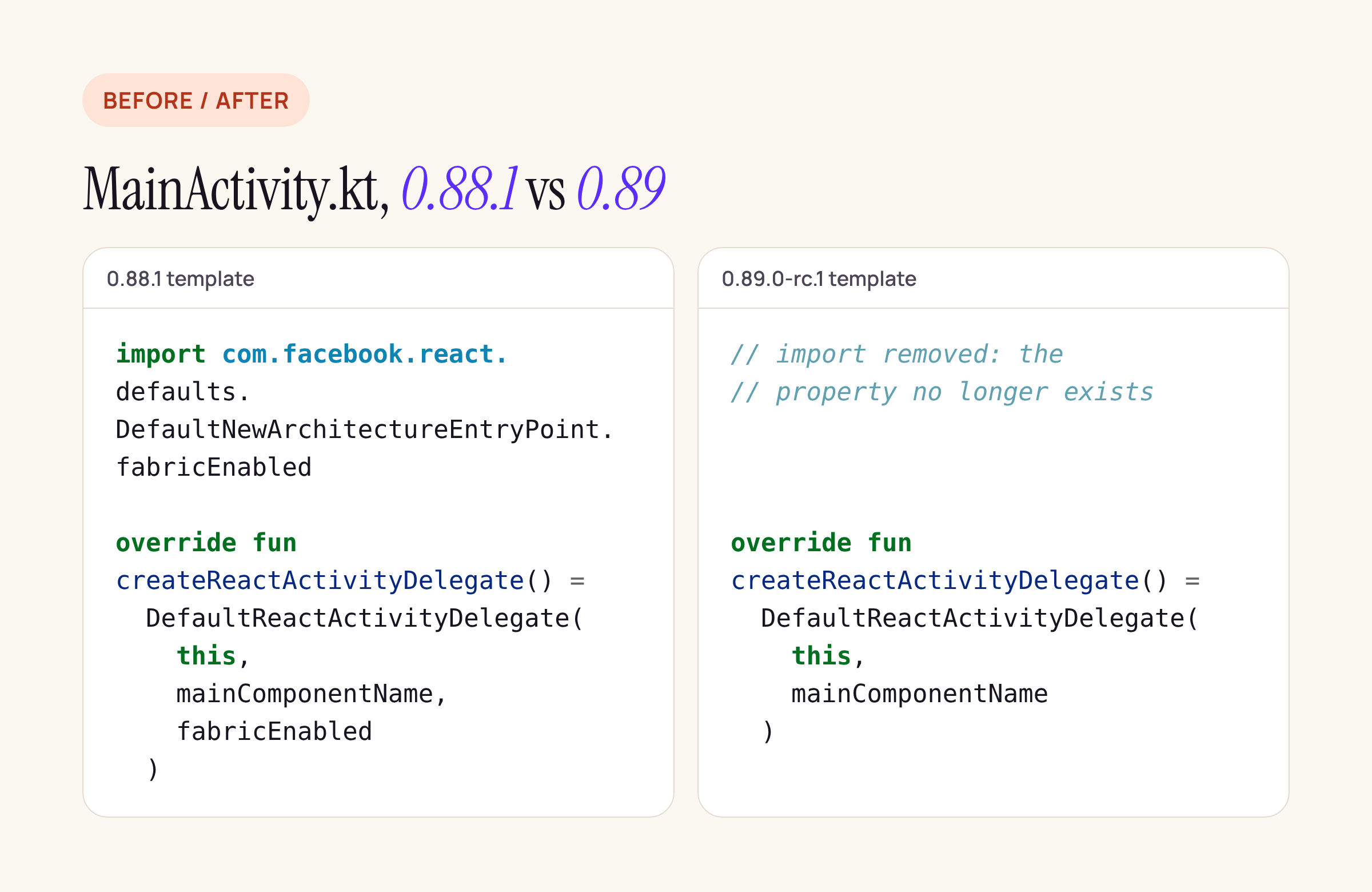
The fabricEnabled import has to go, because the property it imports no longer exists.
A detail worth knowing: DefaultReactActivityDelegate in 0.89.0-rc.1 still has constructors that accept a fabricEnabled: Boolean, marked @Suppress("UNUSED_PARAMETER"). So passing false there compiles and does nothing. If your app relied on turning Fabric off for one screen, that option is gone.
On iOS the same cleanup happened in RCTRootViewFactory.h:
- the
fabricEnabled,bridgelessEnabledandturboModuleEnabledproperties ofRCTRootViewFactoryConfigurationare removed; initWithBundleURLBlock:andinitWithBundleURL:are the initializers to use; the variants withnewArchEnabled:still exist but are marked “The flag is ignored”;- the bridge-era blocks (
createBridgeWithDelegate,sourceURLForBridge,extraModulesForBridgeand others) are now deprecated with “This API will be removed along with the legacy architecture”.
Several legacy iOS files are gone from the package as well: RCTModuleData, RCTCxxBridgeDelegate.h, RCTBridge+Inspector.h and the old RCTNativeAnimatedModule. A native module or a third-party library that still imports any of these will fail to compile on 0.89, so search your ios/ folder and your node_modules for them before you bump.
grep -rlE "RCTModuleData|RCTCxxBridgeDelegate|RCTBridge\+Inspector|bridgelessEnabled|turboModuleEnabled" \
  ios/ node_modules/*/ios node_modules/@*/*/ios 2>/dev/null
CLI 21 and the plugin in devDependencies
The rc.0 notes list two CLI changes, and the template diff confirms both:
@react-native/community-cli-pluginis no longer picked up fromreact-native. It must be in yourdevDependencies. The 0.89 template adds it at the same version asreact-native.@react-native-community/cli21 is required. The template moves from20.2.0to21.0.0-alpha.1and drops the separatecli-platform-androidandcli-platform-iosentries.
"devDependencies": {
  "@react-native-community/cli": "21.0.0-alpha.1",
  "@react-native/community-cli-plugin": "0.89.0-rc.1"
}
The same notes remove @react-native/assets-registry. If you import AssetRegistry from that package, import it from react-native or use @react-native/asset-utils instead.
JavaScript API: removals and one new hook
From the package diff and the notes:
| Change | 0.88.1 | 0.89.0-rc.1 | What to do |
|---|---|---|---|
TextInput blurOnSubmit |
in 6 files | removed | use submitBehavior (rc.0 notes) |
TouchableBounce |
Libraries/Components/Touchable/TouchableBounce.js |
removed | move to Pressable |
unstable_getScrollParent |
exported from index.js |
removed from the exports | drop the call or copy the helper |
unstable_batchedUpdates |
exported | still exported, now @deprecated |
call the callback directly |
useAppState() |
absent | new hook in Libraries/AppState |
replaces most AppState.addEventListener effects |
structuredClone, DOMException |
not global | global Web APIs (rc.0 notes) | drop polyfills you added for them |
| Babel destructuring transform | on | off | check code that depended on the transform’s output |
The new hook returns one of 'active', 'background', 'inactive', 'unknown' or 'extension', per its type definition:
import {useAppState} from 'react-native';

function SessionGuard() {
  const state = useAppState();
  useEffect(() => {
    if (state === 'background') lockSession();
  }, [state]);
  return null;
}
For our banking apps this is the pattern that locks the session when the app leaves the foreground, so we will replace the hand-written listener with it on upgrade.
Android: targetSdk 37, Kotlin 2.3.21, NDK 28
The version catalog inside react-native and the template’s android/build.gradle agree:
| Setting | 0.88.1 | 0.89.0-rc.1 |
|---|---|---|
targetSdk |
36 | 37 |
compileSdk |
37 | 37 |
minSdk |
24 | 24 |
| Kotlin | 2.2.0 | 2.3.21 |
| NDK | 27.1.12297006 | 28.2.13676358 |
| AGP | 9.2.1 | 9.2.1 |
Metro (metro-runtime) |
^0.87.1 | ^0.88.0 |
Moving to targetSdk 37 opts your app into the Android 17 behaviour changes. We covered the code changes in targetSdk 36 to 37 (Android 17): what to change in your code, and the Gradle side of 0.89 in AGP 9.6 preview: Gradle 9.7.1 and what React Native 0.89 pins.
The local network permission: debug builds only
Android 17 adds a runtime permission for reaching devices on the local network, and Google Play’s policy deadlines page lists a Local Network Permission entry (announced 29 Oct 2026, deadline 25 Aug 2027): “Apps targeting Android 17 or higher (API 37+) must submit a Play Console declaration to use this permission.”
That made us check where React Native itself asks for it. In both 0.88.1 and 0.89.0-rc.1, ACCESS_LOCAL_NETWORK is declared only in ReactAndroid/src/debug/AndroidManifest.xml and src/debugOptimized/AndroidManifest.xml, with the comment that Android 17 devices need it “to reach the dev server over the local network” and that loopback via adb reverse is exempt. The main manifest declares no permissions at all. LocalNetworkPermissionUtil.kt also returns early with if (!ReactBuildConfig.DEBUG) return false.
So a release build of a plain React Native app does not carry the permission, and the Play declaration is not triggered by React Native. Check your merged release manifest anyway: a library that discovers printers, TVs or cast devices can add it.
./gradlew :app:processReleaseMainManifest
grep -n "ACCESS_LOCAL_NETWORK" \
  app/build/intermediates/merged_manifest/release/processReleaseMainManifest/AndroidManifest.xml
iOS: images from an asset catalog
The 0.89 template adds RCTUseAssetCatalog = true to Info.plist. In React/Base/RCTUtils.mm this switches RCTImageFromLocalAssetURL to load packager images from an RNAssets.bundle compiled at build time by react-native-xcode.sh. If that bundle is missing, React Native logs “RCTUseAssetCatalog is enabled but RNAssets.bundle was not found in the app” and returns no image. Apps with a custom build phase for the JS bundle should leave the key out until they have checked that their build produces RNAssets.bundle.
What to check on your own app
- Search Android and iOS sources, and your native dependencies, for
fabricEnabled,turboModulesEnabled,bridgelessEnabled,RCTModuleDataandRCTCxxBridgeDelegate. - Add
@react-native/community-cli-plugintodevDependenciesand move to@react-native-community/cli21. - Replace
blurOnSubmit,TouchableBounceand any@react-native/assets-registryimport. - Bump Kotlin to 2.3.21 and install NDK 28.2.13676358 on your CI image.
- Read the Android 17 behaviour changes before you ship with
targetSdk 37, and check the merged release manifest forACCESS_LOCAL_NETWORK. - Decide on
RCTUseAssetCatalogafter one Release build of your iOS app.
The sources above come from the npm packages; runtime behaviour on a device is outside this post. When 0.89.0 final ships we will update this page with the final versions and links.