If your React Native app reads contacts on Android, two dates matter. From 27 January 2027 Google Play’s Contacts Permissions policy applies: an app targeting Android 17 (API 37) may only request READ_CONTACTS when the Android Contact Picker is not enough for its core feature, and must file a Play Console declaration if it still does. And Android 17 itself, for apps targeting API 37, removes the account columns from the Contacts Provider’s data view and rejects loose SQL when the app has no READ_CONTACTS. The takeaway: if your app only needs the user to choose one contact (an invite, a payee, a share), move that flow to Intent.ACTION_PICK and read only the URI it returns; react-native-contacts 8.0.10 cannot do that today.
This is a source review: we unpacked the npm packages of react-native-contacts 8.0.9 and 8.0.10, expo-contacts 57.0.9 and 58.0.11 and react-native-pick-contact 0.0.6, read their android/ folders, and built the rule tables from Android’s and Play’s own pages (behaviour changes for Android 17 updated 11 November 2026, the contact picker page updated 9 November).
Why we did this: Peepal is a social app and our banking work has payee and invite flows; any of them that touches the address book goes through one of these libraries, and Play review is where a wrong permission shows up first.
The rules, in one table
| Change | Who it applies to | What it means in code | Source |
|---|---|---|---|
| Contacts Permissions policy | Apps on Play, deadline 27 Jan 2027 (announced 15 Apr 2026) | Apps targeting API 37+ may request READ_CONTACTS only if the Contact Picker is not sufficient for core functionality; others need a Play Console declaration |
Policy deadlines, Play policy preview |
| Manage Contacts permission | Deadline 25 Aug 2027 (announced 29 Oct 2026) | Restricted to core functionality when system pickers and intents are not enough; apps targeting API 38+ need a declaration | Policy deadlines |
| PII fields removed from the CP2 data view | Apps targeting API 37+ | ACCOUNT_NAME, ACCOUNT_TYPE and ACCOUNT_TYPE_AND_DATA_SET are gone from ContactsContract.Data; read them from RawContacts, joining on RAW_CONTACT_ID |
Behaviour changes, Android 17 |
| Strict SQL checks in CP2 | Apps targeting API 37+ without READ_CONTACTS |
Queries on ContactsContract.Data run with StrictColumns and StrictGrammar; an incompatible query throws |
Behaviour changes, Android 17 |
| New Contact Picker | Devices on Android 17+ | ContactsPickerSessionContract.ACTION_PICK_CONTACTS; the result is a session URI with temporary read access; custom selection and selectionArgs on it throw; account metadata is stripped |
Contact picker |
ACTION_PICK upgraded |
Apps targeting API 37+ | The system shows the new picker for the existing Intent.ACTION_PICK; EXTRA_USE_SYSTEM_CONTACTS_PICKER lets you try it on an older target |
Contact picker |
One date to be careful with: the react-native-contacts issue tracker and some blog posts give 28 October 2026 as the deadline. Google’s own deadlines table says 27 January 2027 for the Contacts Permissions row, so that is the date we work to.
What the three libraries do on Android
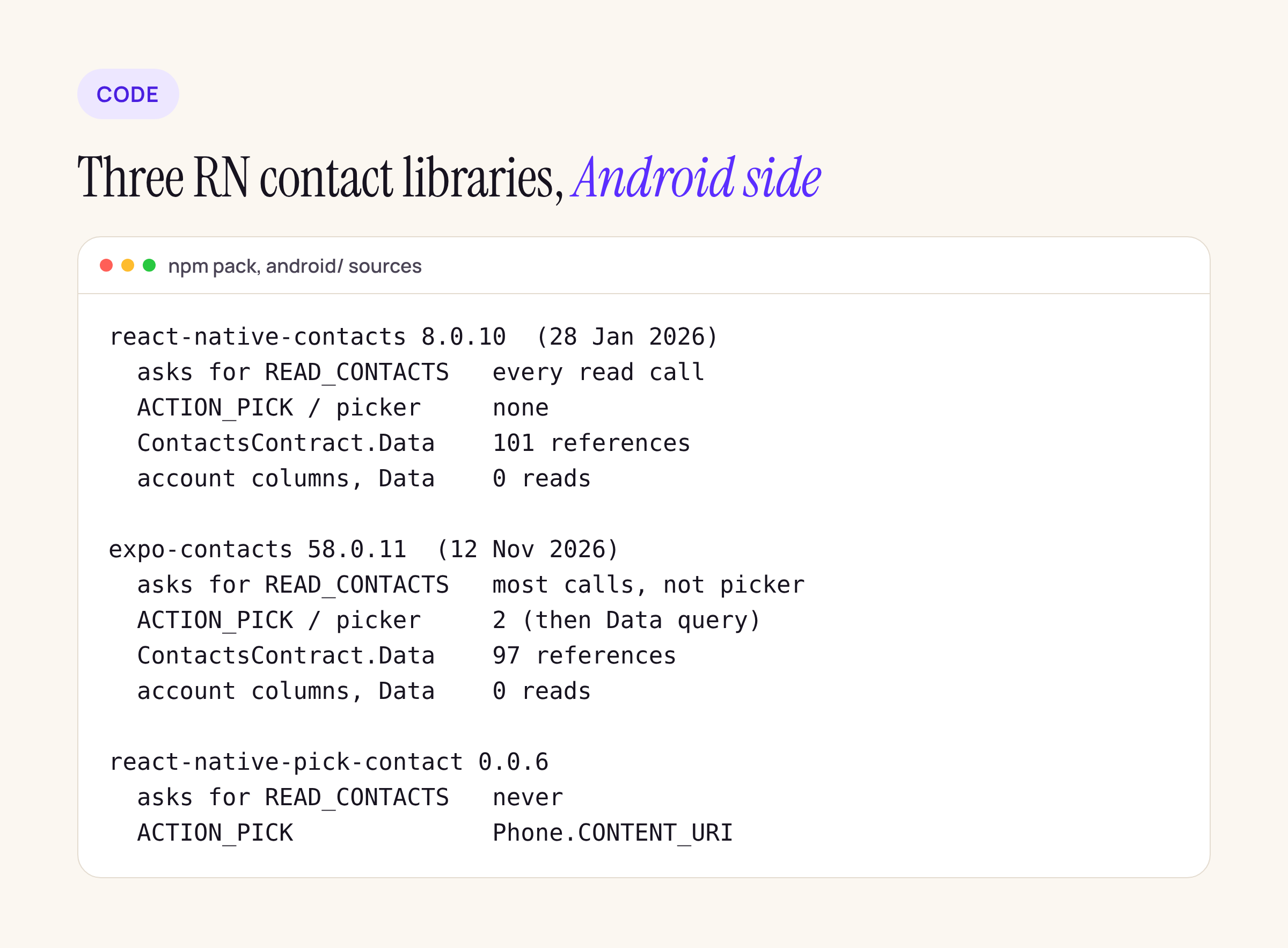
Counts are grep results over each package’s android/ folder; “account columns, Data” means reads of the account columns through the data view.
react-native-contacts 8.0.10
The latest release is 8.0.10 from 28 January 2026, and its android/ folder is identical to 8.0.9’s. Every read method goes through ContactsManagerImpl.java, which asks for Manifest.permission.READ_CONTACTS (line 48, requested at line 1150) before it queries. There is no ACTION_PICK and no picker intent anywhere in the Android sources. Issue #822 tracks this, with the maintainer aiming for a fix around November; no release since January contains one.
The good news is on the Android 17 provider side: the only account columns in the code are RawContacts.ACCOUNT_TYPE and ACCOUNT_NAME written as null when a contact is inserted (lines 654 and 655), which is the RawContacts table, not the data view. Its searches use plain LIKE ? selections in ContactsProvider.java, and because the library always holds READ_CONTACTS, the strict SQL mode does not apply to them.
So with this library, the question is not Android 17 breaking it but Play: if you keep it, you keep READ_CONTACTS, and from 27 January 2027 you need a declaration that explains why the picker is not enough. The library’s manifest declares no permission, so the line comes from your app’s own AndroidManifest.xml.
expo-contacts 58.0.11
Released 12 November 2026; we compared it with 57.0.9 and found no changes to the picker or the permission code between the two. Most functions call ensureReadPermission() first. The exception is presentContactPickerAsync, which starts Intent.ACTION_PICK with Contacts.CONTENT_TYPE, so on API 37 targets it should get the new picker.
But look at what happens with the result. The picked contact’s ID is passed to getContactById, which queries ContactsContract.Data.CONTENT_URI with the selection contact_id = ?. That is a query on the whole data table, not on the URI the picker granted. The picker’s grant covers the returned URI, and session URIs reject custom selections, so treat this path as one that still relies on READ_CONTACTS until you have checked it on an Android 17 device without the permission. The newer next/ API in the same package has a PickContactContract on Contacts.CONTENT_URI and returns the URI itself, which is the better starting point.
react-native-pick-contact 0.0.6
A small library built for this policy: its manifest is intentionally empty, it never requests READ_CONTACTS, and it starts ACTION_PICK on CommonDataKinds.Phone.CONTENT_URI. Its source comment explains why Phone and not Contacts: the returned URI is a data row that already carries the name and number, so no sub-path query is needed. It is young (0.0.6, last published August 2026), so read it before you adopt it; the pattern is the useful part.
The picker flow we move to
For “choose one contact” features, the whole native side fits in a few lines. The intent works on older Android versions and is shown as the new picker on API 37 targets. Treat this as a starting point and compile it against your module:
import android.provider.ContactsContract.CommonDataKinds.Phone

class PickPhone : ActivityResultContract<Unit, Uri?>() {
  override fun createIntent(context: Context, input: Unit) =
    Intent(Intent.ACTION_PICK, Phone.CONTENT_URI)

  override fun parseResult(code: Int, data: Intent?): Uri? =
    if (code == Activity.RESULT_OK) data?.data else null
}

// Read only the URI the picker returned: no selection, no sort order
fun readPicked(cr: ContentResolver, uri: Uri): Pair<String?, String?>? =
  cr.query(uri, arrayOf(Phone.DISPLAY_NAME, Phone.NUMBER),
           null, null, null)?.use { c ->
    if (c.moveToFirst()) c.getString(0) to c.getString(1) else null
  }
Two rules keep it inside the grant: query the returned URI and nothing else, and pass null for selection and arguments, because session URIs throw on custom selections. Then remove READ_CONTACTS from the manifest, and check the merged manifest (app/build/intermediates/merged_manifest/) to make sure no library adds it back.
If you still need the address book
Some features do need it: contact sync, finding friends who are already on the app. Then keep READ_CONTACTS, prepare the Play declaration, and check any query that reads account columns through the data view before you move to targetSdk 37:
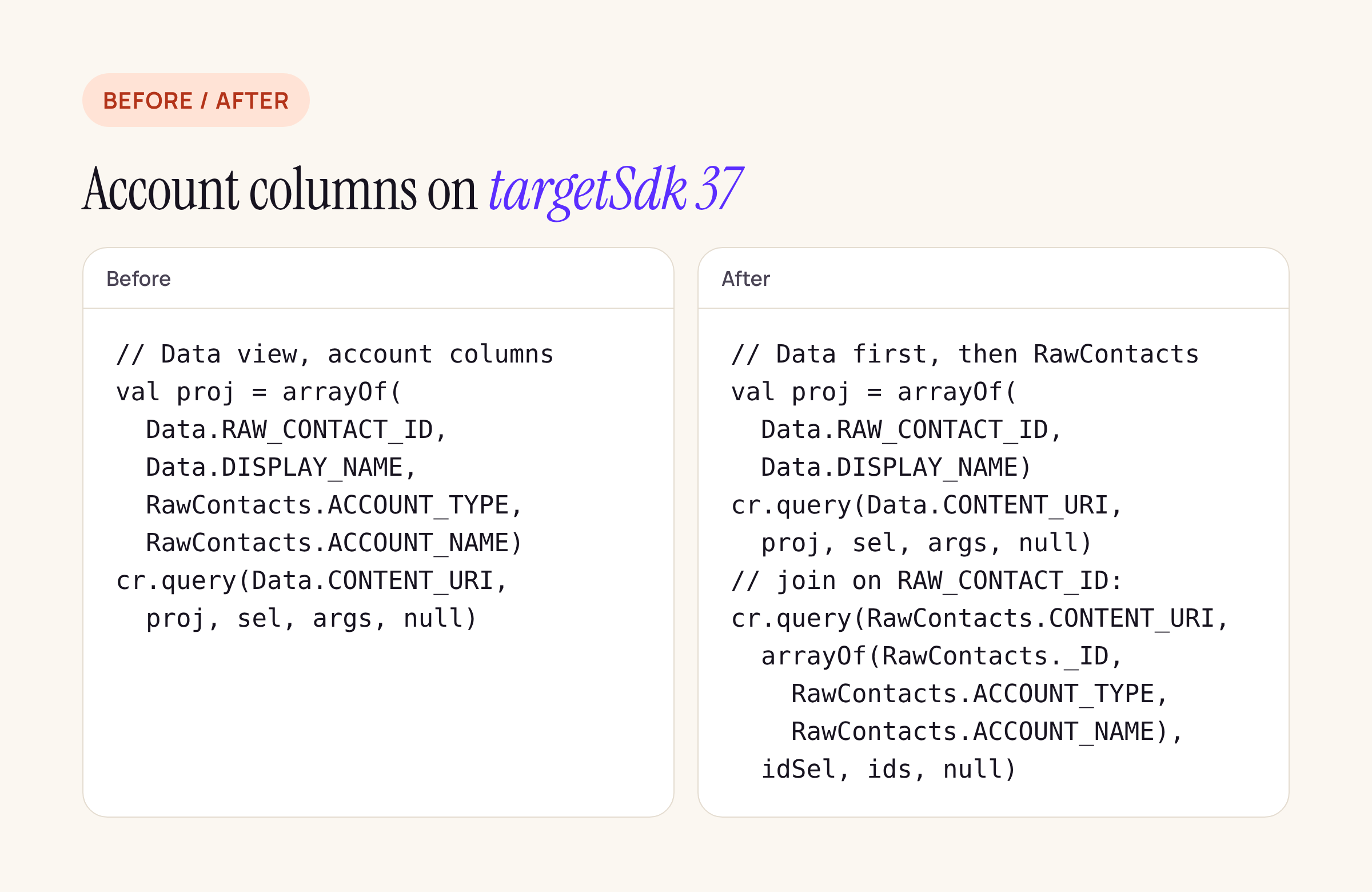
On targetSdk 37 the left query loses its account columns; read them from RawContacts with the raw contact IDs from the first query.
We covered the rest of the targetSdk 37 move in targetSdk 36 to 37 (Android 17): what to change in your code.
What to check on your own app
grep -rn "READ_CONTACTS\|WRITE_CONTACTS" android/and the merged manifest: which feature needs each line.- For each contacts feature: is it “pick one” (move to the picker) or “read many” (keep the permission, write the declaration)?
- Any projection on
ContactsContract.Datathat includesACCOUNT_NAME,ACCOUNT_TYPEorACCOUNT_TYPE_AND_DATA_SET, in your code and in your libraries. - On an Android 17 device with your app on targetSdk 37 and the permission revoked: pick a contact and confirm the name and number come back.