
The short version: Android Gradle plugin 9.6.0 (preview, alpha03 at the time of writing) raises the minimum Gradle to 9.7.1. React Native is two hops behind: both react-native 0.88.1 and 0.89.0-rc.1 pin AGP 9.2.1, and the 0.89.0-rc.1 template still ships the Gradle 9.4.1 wrapper. If you want AGP 9.6 in an RN app, the Gradle wrapper moves first, then AGP, and the RN 0.89 bump (targetSdk 37, NDK 28.2, Kotlin 2.3.21) is a separate step you should not mix in.
This post is a source diff of the npm packages react-native, @react-native/gradle-plugin and @react-native-community/template at 0.88.1 and 0.89.0-rc.1, plus a table we built from the AGP 9.5.0 and 9.6.0 release notes (both last updated 5 Nov 2026). Packages pulled on 16 Nov 2026.
Why we did this: our React Native banking and TV apps and the Kotlin apps behind Peepal and Shopkeeper all build with AGP, and we plan Gradle and AGP hops separately from React Native upgrades. When the next AGP lands we want to know how far RN trails it before anyone touches a build.gradle.
AGP 9.5 vs 9.6 in one table
Every row comes from the official release notes. AGP 9.6.0 is still labelled a preview; only alpha01 to alpha03 are listed, with no dates.
| AGP 9.5.0 | AGP 9.6.0 (preview) | Source | |
|---|---|---|---|
| Status | Stable (October 2026), 9.5.1 patch listed | alpha01 to alpha03 | 9.5.0 notes, 9.6.0 notes |
| Minimum and default Gradle | 9.6.0 | 9.7.1 | same pages, compatibility table |
| SDK Build Tools (min / default) | 36.0.0 | 36.0.0 | same |
| NDK default | 28.2.13676358 | 28.2.13676358 | same |
| JDK | 17 | 17 | same |
| Max API level | 37 | 37 | same |
| New feature | Backup and restore tests (experimental): android.experimental.testSuiteSupport=true, android.experimental.enableBackupTest=true, testOptions.backupTests |
On-device coverage for instrumented tests (experimental): android.experimental.androidTest.coverage.useOnDeviceAgent=true, android.experimental.reportAggregationSupport=true |
same |
| Deprecation noted | Configuration.setVisible(boolean) (issue 560282299) |
none listed | 9.5.0 notes |
So the only hard requirement change from 9.5 to 9.6 is Gradle 9.6.0 to 9.7.1. JDK, Build Tools and NDK defaults stay put.
The on-device coverage change
With the two flags set, a build that has enableAndroidTestCoverage turned on no longer adds JaCoCo instrumentation at build time. AGP puts a coverage agent (com.android.tools.test:coverage-agent, same version as AGP) into the test APK instead. You still run create{Variant}AndroidTestCoverageReport and the HTML and XML reports land where they did. The release notes list two requirements: a debuggable app and a device on Android 9 (API 28) or later.
# gradle.properties (AGP 9.6.0 preview only)
android.experimental.androidTest.coverage.useOnDeviceAgent=true
android.experimental.reportAggregationSupport=true
For an RN app this matters if you run Espresso or UI Automator tests with coverage in CI: check that your test devices or emulators run API 28 or later before switching.
What React Native pins: the source diff
We ran npm pack on react-native@0.88.1 and react-native@0.89.0-rc.1, unpacked both and diffed gradle/libs.versions.toml, the version catalog the Android build reads.
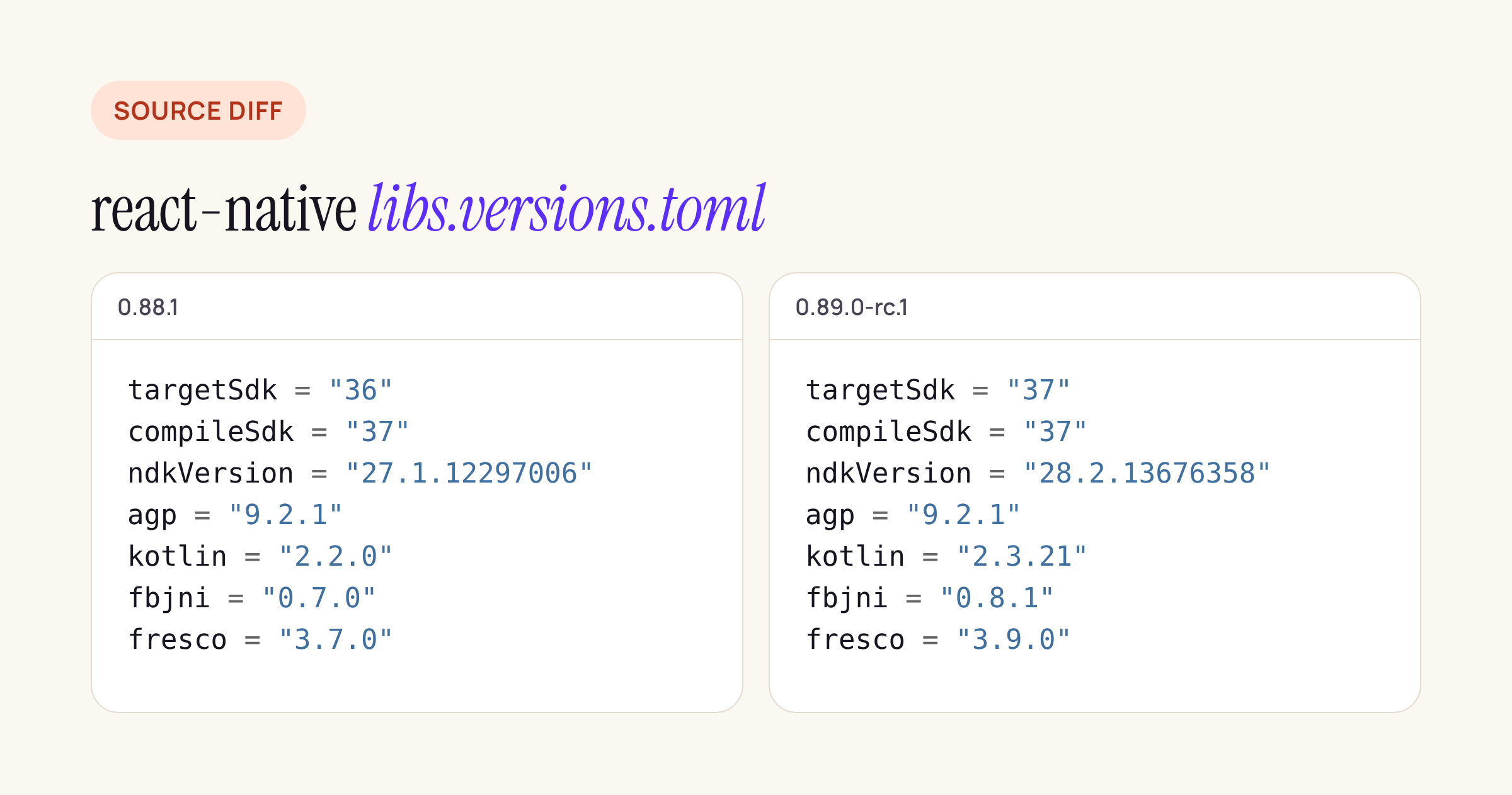
The lines that change between 0.88.1 and 0.89.0-rc.1. AGP and compileSdk do not.
The full list of changed versions:
targetSdk36 to 37ndkVersion27.1.12297006 to 28.2.13676358, the same NDK that AGP 9.5 and 9.6 use as defaultkotlin2.2.0 to 2.3.21fbjni0.7.0 to 0.8.1,fresco3.7.0 to 3.9.0,nlohmannjson3.11.2 to 3.12.0- new entry
androidx-activity = "1.10.1" ktfmtremoved from the catalog and plugins- unchanged:
agp = "9.2.1",compileSdk = "37",buildTools = "37.0.0",minSdk = "24"
The good news is in the NDK line: 0.89 moves to the NDK that current AGP versions already default to, so an app that also builds its own C++ no longer has two NDKs installed for one project.
Where an RN app gets its AGP version
The community template does not name an AGP version at all. android/build.gradle in the 0.89.0-rc.1 template has:
dependencies {
    classpath("com.android.tools.build:gradle")
    classpath("com.facebook.react:react-native-gradle-plugin")
    classpath("org.jetbrains.kotlin:kotlin-gradle-plugin")
}
The version comes from @react-native/gradle-plugin, which settings.gradle pulls in with includeBuild. Its react-native-gradle-plugin/build.gradle.kts declares implementation(libs.android.gradle.plugin), and its own catalog says agp = "9.2.1" in both 0.88.1 and 0.89.0-rc.1. That is why upgrading React Native alone never moves you past AGP 9.2.1.
Gradle wrapper and the AGP 9 opt-outs
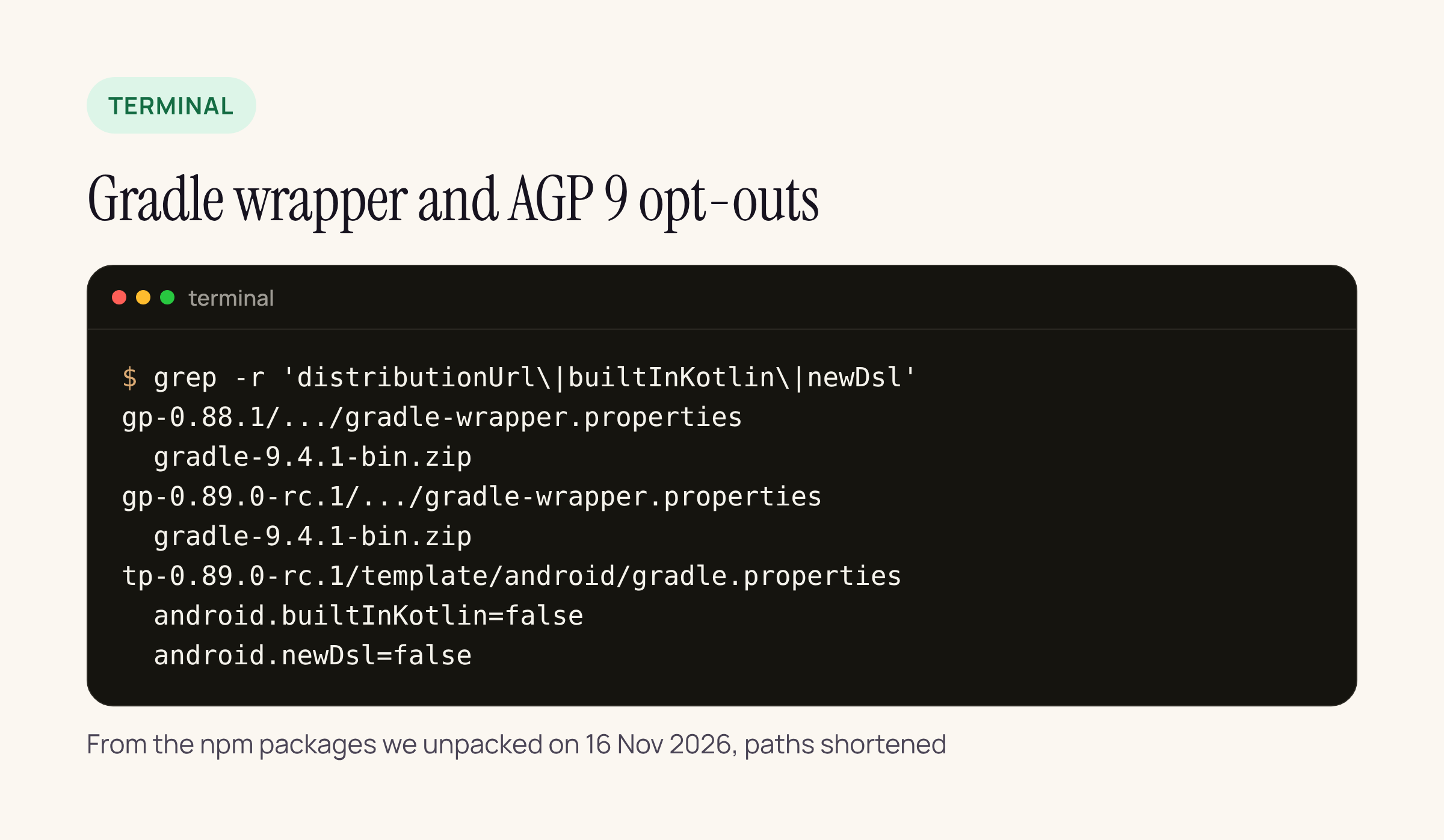
Both versions of the gradle plugin package and the template ship Gradle 9.4.1. The template’s gradle.properties also opts out of two AGP 9 defaults.
Two details from the template stand out. The wrapper is gradle-9.4.1-bin.zip in both versions, which is below what AGP 9.5 (9.6.0) and AGP 9.6 (9.7.1) require. And gradle.properties carries android.builtInKotlin=false and android.newDsl=false in both 0.88.1 and 0.89.0-rc.1. React Native still keeps the separate Kotlin Gradle plugin and the old DSL. If you move AGP up, leave those two lines alone unless you are also migrating to built-in Kotlin; that is its own project.
The upgrade order we use
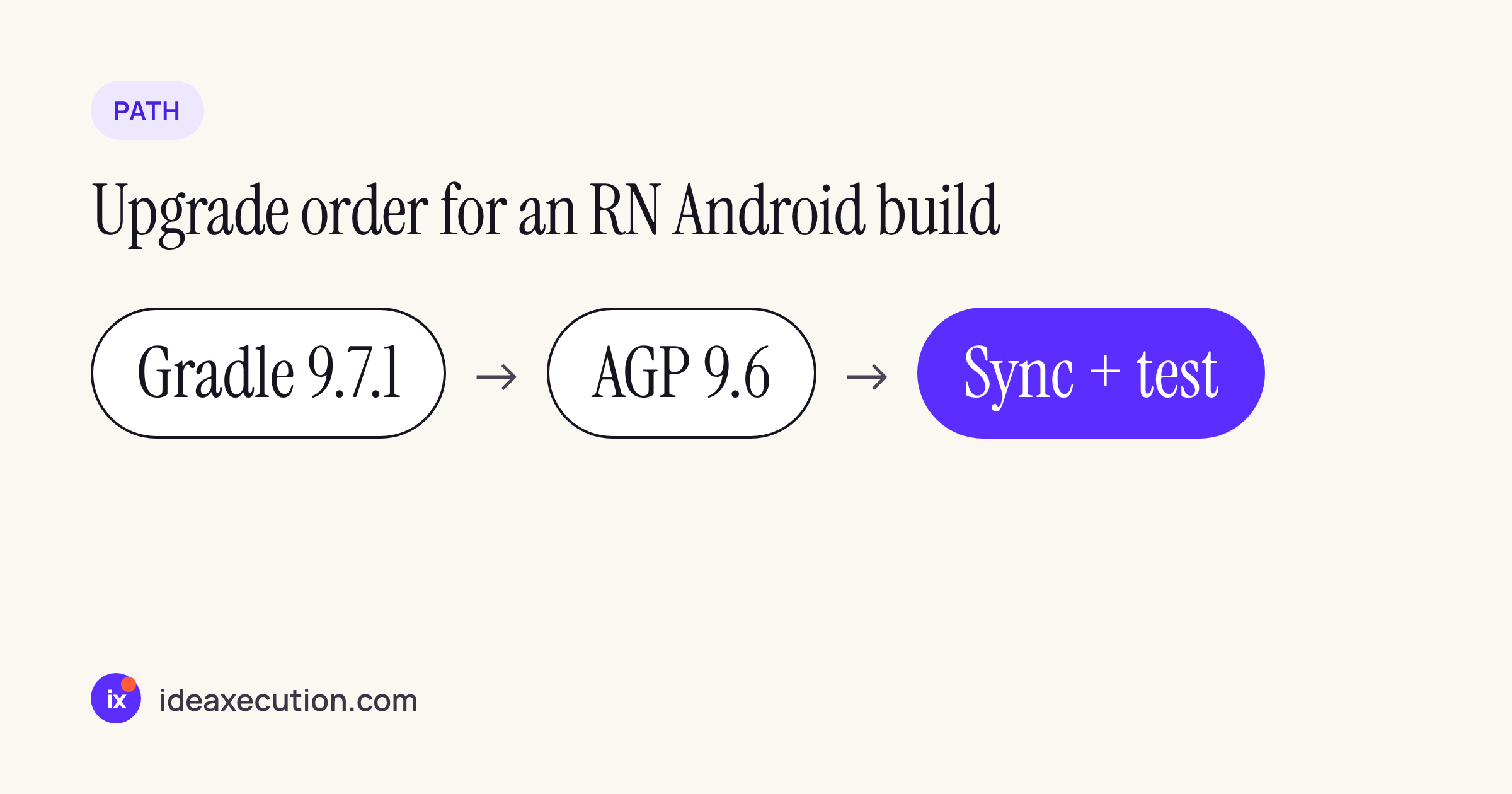
One change per commit, so a broken build points at one cause.
- Finish the React Native bump first, on its own branch. 0.88.1 to 0.89 already changes targetSdk, NDK and Kotlin. Do not stack an AGP change on top of it.
- Move the Gradle wrapper to 9.7.1. Gradle 9.7.1 is the minimum for AGP 9.6 and also satisfies AGP 9.5.
bash
   cd android
   ./gradlew wrapper --gradle-version 9.7.1
   ./gradlew --version
- Pin AGP in the root
build.gradle. Giving the classpath line a version makes Gradle resolve the higher AGP over the 9.2.1 that the RN plugin brings in. Treat this as a starting point and run a full build against your own project; React Native does not test against AGP 9.6 yet.
groovy
   classpath("com.android.tools.build:gradle:9.6.0-alpha03")
For a production app we would stop at a stable AGP (9.5.x today) and only try 9.6 on a branch.
4. Sync, then run the full CI matrix: assembleRelease, unit tests, and instrumented tests if you have them. If you want the new coverage agent, add the two flags above only after the plain build is green.
What to check on your own app
cat android/gradle/wrapper/gradle-wrapper.properties: anything below 9.7.1 blocks AGP 9.6../gradlew buildEnvironment | grep com.android.tools.build:gradle: shows which AGP actually won resolution.- Third-party libraries with their own
android/build.gradlethat hard-code an AGP or Kotlin version: those are the usual source of conflicts after a pin. ndkVersionin your app module: on 0.89 it should match 28.2.13676358 unless you have a reason to differ.
For the hop before this one, see our AGP 9.4 to 9.5 upgrade guide.