If your app still calls InteractionManager, it will build cleanly on React Native 0.88.1 and then close at launch in a Release build. We took a fresh React Native 0.85.3 app with four pieces of “0.85-era” code, moved it to 0.86.3, 0.87.1 and 0.88.1 with the official template diffs, and built each hop on our M1 lab Mac (macOS 15.7.3, Xcode 26.2, Swift 6.2.3, Node 24.22.3, CocoaPods 1.17.0, JDK 17). Every hop built for iOS. Only one of the four breaks crashed the app; two fail silently; and tsc is the only tool that flagged all of them.
The short version: run npx tsc --noEmit after every hop and treat its errors as release blockers, replace InteractionManager with requestIdleCallback before you ship 0.88, and delete package-lock.json when you move to 0.88.1.
Why we did this: our banking and TV apps are React Native CLI projects that sit two or three releases behind, like most client apps we inherit. A multi-version jump is the upgrade teams actually face, not the single 0.88 changelog.
The test app
The app is a plain @react-native-community/cli 0.85.3 project with one screen that uses the four patterns a public scan of 947 React Native apps found most often in code that breaks on newer versions (dev.to, 23 Oct 2026):
InteractionManager.runAfterInteractionsfor deferred work<StatusBar backgroundColor translucent>...StyleSheet.absoluteFillObjectin a style- a deep import from
react-native/Libraries/Utilities/codegenNativeComponent
Each hop applied the upgrade helper template diff with git apply, then ran npm install, tsc, pod install, pod update React-Core-prebuilt and a clean iOS Release build for the Simulator. At 0.85.3 and 0.88.1 we also installed the app on an iPhone 17 Pro simulator (iOS 26.3), took a screenshot and built an Android release APK.
What each hop changed
| Hop | tsc errors |
iOS build |
|---|---|---|
| 0.85.3 (start) | 1 | 47 s |
| to 0.86.3 | 1 | 43 s |
| to 0.87.1 | 4 | 41 s |
| to 0.88.1 | 4 | 45 s |
The tsc column counts errors in our one screen; the build column is a clean iOS Release build for the Simulator. What each template diff touched:
- 0.86.3:
package.jsononly. - 0.87.1: Gradle 9.4.1 wrapper, compileSdk 37, Kotlin 2.2.0,
edgeToEdgeEnabled=true, TypeScript 6, CLI 20.2.0. - 0.88.1:
SceneDelegate.swift,AppDelegate.swift, theInfo.plistscene manifest, React 19.3.0.
Build times are single clean Release builds on one Mac, listed to show that no hop made the native build slower in a way you would notice; they are not benchmarks.
Two things stand out. First, absoluteFillObject was already a type error at 0.85.3, the version we started from, so a team that does not run tsc in CI has been carrying it for a while. Second, the 0.87.1 hop is the one that changes the most: three of the four type errors arrive with it, together with the Android toolchain bump (buildToolsVersion 37.0.0, proguard-android-optimize.txt, and two AGP 9 opt-outs, android.builtInKotlin=false and android.newDsl=false).
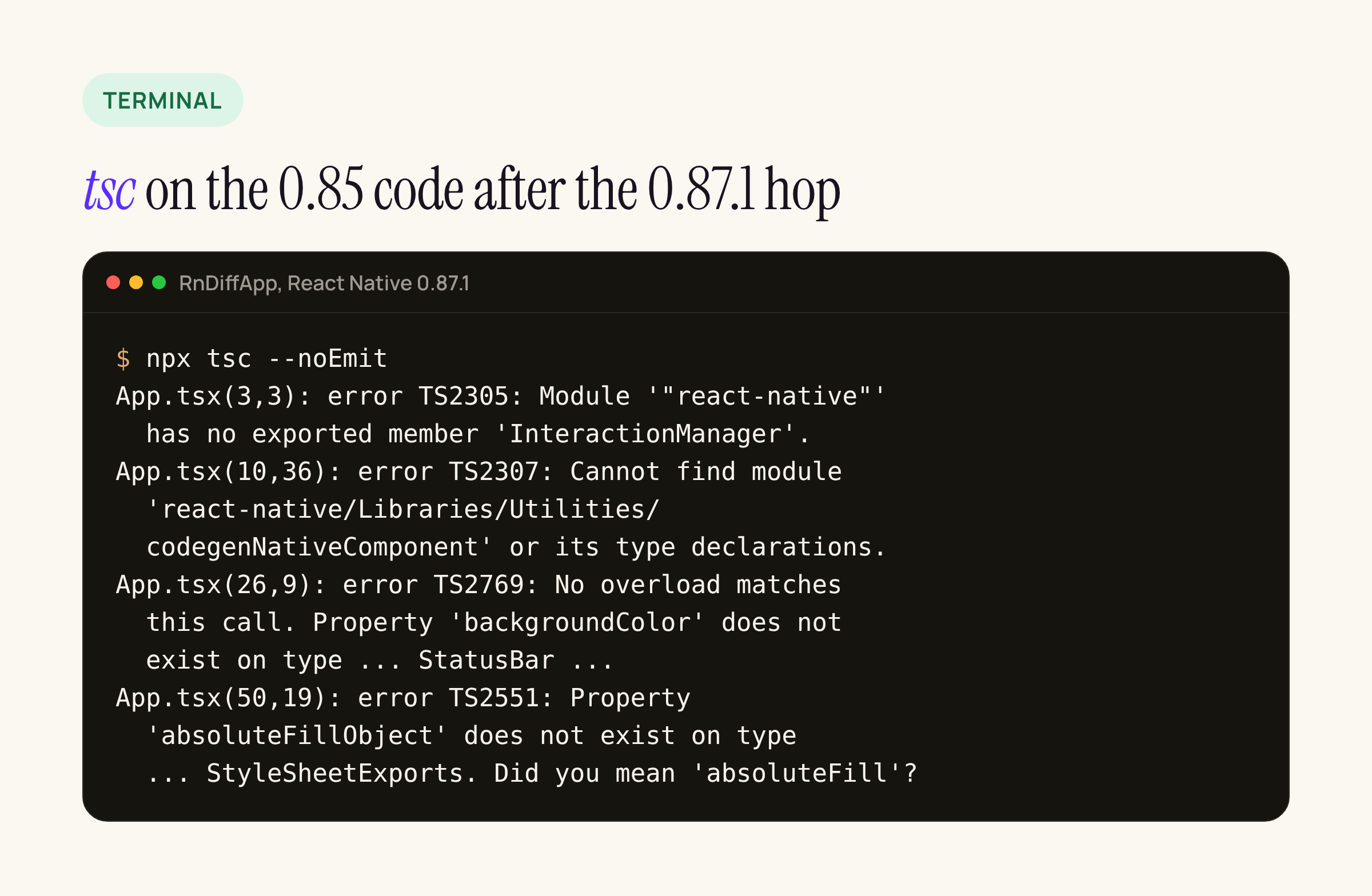
Real tsc output from the lab build at 0.87.1 (long type names shortened). 0.88.1 reports the same four errors.
Which break crashes, and why
Metro does not type-check, so all four problems bundle and the iOS build succeeds. What happens at runtime differs:
InteractionManager: crash. In 0.88.1 the export only exists in development builds, as a getter that throws “InteractionManager has been removed from react-native core. Please refactor long tasks into smaller ones, and use ‘requestIdleCallback’ instead.” In a Release build the property is simply not there, so InteractionManager.runAfterInteractions(...) throws a TypeError on the first render. That is what we saw: the 0.85 screen launched on 0.88.1, and 12 seconds later the app was no longer running and the simulator was back on the home screen. The same screen launched and stayed up at 0.85.3.
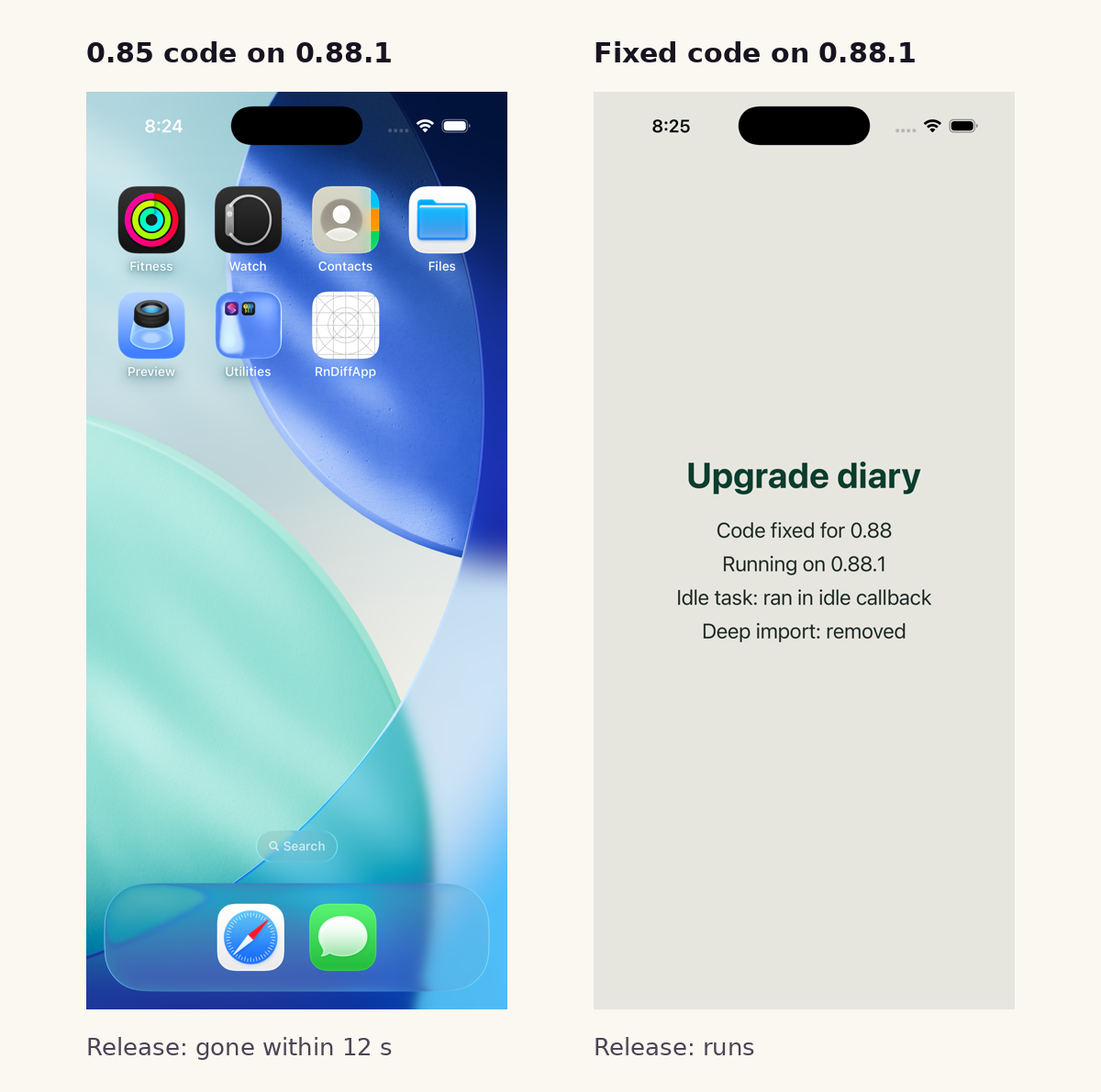
Release builds of the same screen on the iPhone 17 Pro simulator, before and after the fixes.
absoluteFillObject: silent layout change. The 0.88.1 StyleSheetExports only defines absoluteFill. Spreading undefined into a style object is valid JavaScript, so nothing throws; the view just loses its position: 'absolute' and its edges. An overlay that used to cover the screen collapses to an empty box in the normal layout flow. You will not find this in a crash log.
StatusBar backgroundColor and translucent: no error at all. Both were always Android-only props, so on iOS nothing changes. They left the types at 0.87.1, the same hop where the template sets edgeToEdgeEnabled=true and the app draws under the Android system bars. If you relied on them for a coloured status bar, put a view behind the status bar area (sized with react-native-safe-area-context) instead.
The deep import: types only, for now. Libraries/Utilities/codegenNativeComponent.js still ships in 0.88.1, so the import resolves at runtime. The exports map in package.json now points its legacy types at a react-native-legacy-deep-imports condition, so tsc fails. It works today and will break when the file moves.
The fixes
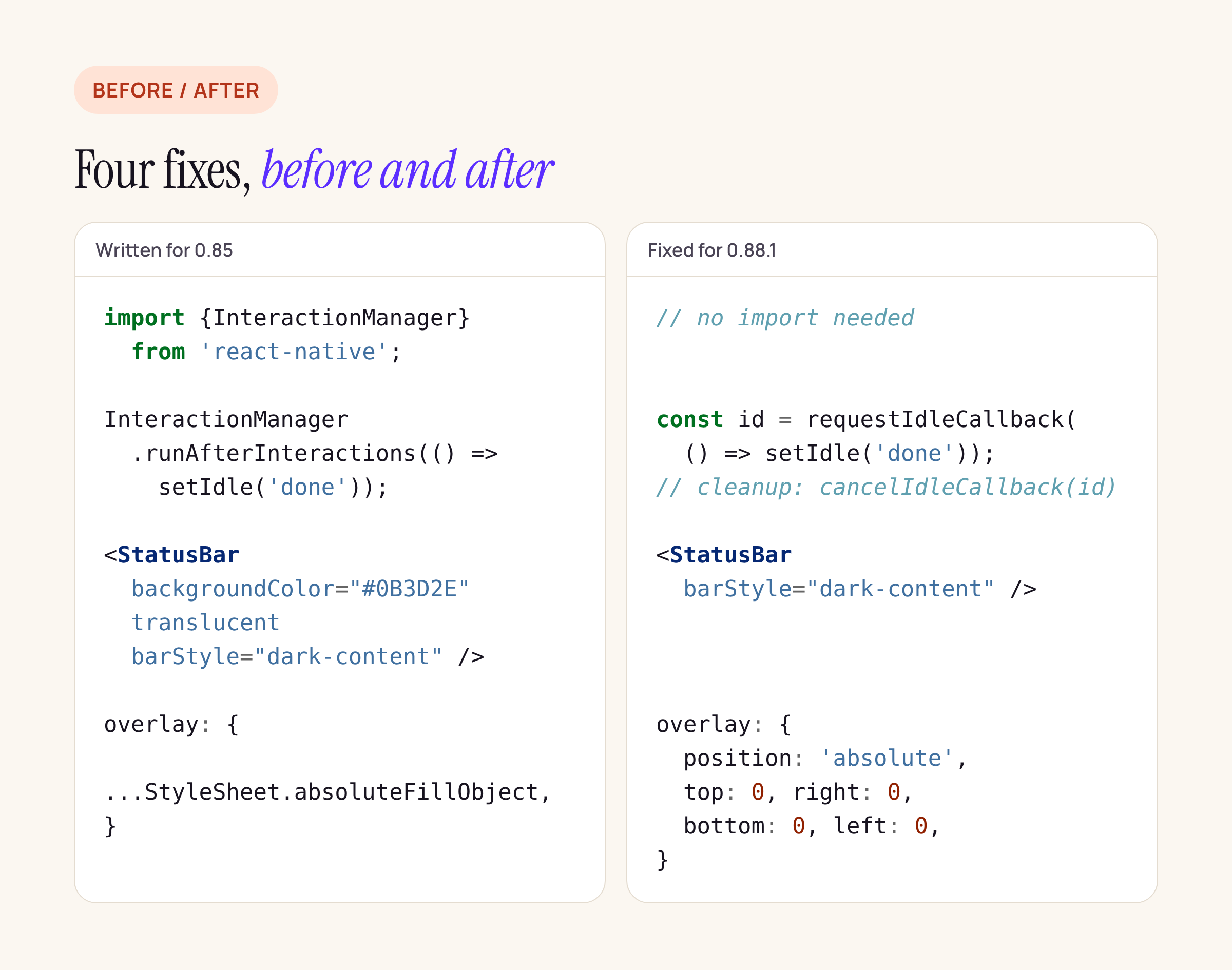
The changes we made to the screen. After them tsc reported nothing and the Release build ran.
useEffect(() => {
  const id = requestIdleCallback(() => setIdle('ran in idle callback'));
  return () => cancelIdleCallback(id);
}, []);
runAfterInteractions returned a handle with .cancel(); requestIdleCallback returns an id for cancelIdleCallback, so remember the cleanup. For the overlay, write out position: 'absolute' with the four edges, or use StyleSheet.absoluteFill (the frozen object, which you can pass directly instead of spreading). Drop the deep import, or move to whatever public API the module now offers.
Two upgrade steps that failed before the code did
The 0.88.1 template diff did not apply. git apply rejected the project.pbxproj and Info.plist hunks, because the template diff assumes a file state the app no longer had (a PrivacyInfo.xcprivacy build-file line and an RCTNewArchEnabled key that differed). We split the diff: the Swift files and package.json applied as they were, and we rebuilt the project and plist part against the app’s own files. What that part has to add:
SceneDelegate.swiftto the target’s sources (the 0.88 template moves the React Native factory out ofAppDelegate)UIApplicationSceneManifestwithUIApplicationSupportsMultipleScenesset tofalseand$(PRODUCT_MODULE_NAME).SceneDelegateas the delegate classUIViewControllerBasedStatusBarAppearanceflipped fromfalsetotrue
If your app has deep links, the new SceneDelegate must forward them to RCTLinkingManager; we cover that in a separate post on scene-based deep links.
npm install failed with ERESOLVE. With the 0.87.1 lockfile still in place, npm refused the 0.88.1 versions:
npm error ERESOLVE could not resolve
npm error Found: @react-native/new-app-screen@0.87.1
npm error Could not resolve dependency:
npm error @react-native/new-app-screen@"0.88.1" from the root project
npm error Conflicting peer dependency: react-native@0.88.1
Removing node_modules and package-lock.json and installing again took 78 seconds and resolved cleanly to react-native@0.88.1 and react@19.3.0. Commit the new lockfile in the same change as the version bump so CI does not hit the same wall. After the install, run pod install and then pod update React-Core-prebuilt; pod install alone keeps the previous prebuilt core.
Android at 0.88.1
The Android release build (assembleRelease, arm64-v8a only) succeeded at both ends with no code changes: 387 seconds at 0.85.3 with cold Gradle caches, 70 seconds at 0.88.1 by Gradle’s own count with the caches warm, so the two numbers say nothing about each other. The 0.88.1 APK was 18.0 MB on disk. The Android side of this jump is configuration, not code: all of it arrives in the 0.87.1 template diff listed above.
What to check on your own app
- Run
npx tsc --noEmitat every hop, not only at the end, and fail CI on it. - Search for
InteractionManager,absoluteFillObject,StatusBarprops andreact-native/Libraries/imports before you start. Fix them on your current version where you can:requestIdleCallbackand the explicit absolute style both work on 0.85. - Launch a Release build after the 0.88 hop. A Debug build shows the
InteractionManagermessage as a red box; a Release build just closes. - Expect to hand-merge the 0.88
project.pbxprojandInfo.plistchanges, and check your deep-link forwarding in the newSceneDelegate. - Regenerate the lockfile at 0.88.1.
The full hop order with Reanimated and Gesture Handler is in our earlier React Native 0.88 upgrade order post. Release notes: React Native 0.88.