
Two patch releases landed this week for Android builds: Gradle 9.9.2 and 8.14.8 on 19 November, and Android Gradle Plugin 9.5.2 with Android Studio Rabbit 2 Patch 2 on 20 November. For a React Native app the takeaway is short. Bump the Gradle wrapper to 9.9.2, and leave AGP where React Native pins it. We unpacked the npm packages of react-native 0.88.1 and 0.89.0-rc.2, their Gradle plugin and their app template: both versions ship Gradle 9.4.1, which sits inside the affected range of all four Gradle security advisories published on 19 November. Both pin AGP 9.2.1, so the two AGP 9.5.2 fixes do not touch a default React Native app.
Why we did this: our banking and TV apps build on React Native’s Android layer, and BMDB.fun ships to Android TV from the same toolchain, so a patch week means deciding which pins move on every one of them.
What each patch fixes
Gradle 9.9.2 (release notes) and 8.14.8 (release notes) carry the same four security fixes. Each advisory lists the affected versions as <= 8.14.7 and >= 9.0.0, <= 9.9.1, with 8.14.8 and 9.9.2 as the open-source fixes:
- GHSA-4mf6-7pm2-6wm8: SFTP repositories do not verify host keys (CVSS 8.9).
- GHSA-7f7r-77ff-fr6f: transitive snapshot dependencies skip dependency verification (8.8).
- GHSA-99wf-vhq9-wm2x: TestKit uses a predictable directory in the system temp folder (7.0).
- GHSA-35pj-rg5r-8rpv: the daemon registry is briefly readable by other local users when it is created (7.0).
The advisories also list patched builds for older lines (9.4.4, 9.6.4 and others), but only for Gradle’s paid security subscription. On the open-source side the choices are 9.9.2 or 8.14.8. 9.9.2 also fixes three regressions, including plugin resolution failing since 9.9.0 when a registry answers the plugin marker request with 401 (#39756, seen with GitLab group registries).
AGP 9.5.2 (Android Studio blog, 20 Nov) fixes two issues. The AGP release notes page did not list 9.5.2 yet when we checked; the blog post is the source.
- 581925548: fat AARs with multiple nested jars fail to merge Java resources, starting in 9.5.
- 582417470: an Android app will soon fail under Isolated Projects with
implementation(project(...)).
What React Native 0.88 and 0.89 pin
We ran npm pack on react-native, @react-native/gradle-plugin and @react-native-community/template for 0.88.1 (the latest tag) and 0.89.0-rc.2 (the next tag) and read the files that set the versions.
| RN 0.88.1 | RN 0.89.0-rc.2 | |
|---|---|---|
| Gradle wrapper | 9.4.1 | 9.4.1 |
| AGP | 9.2.1 | 9.2.1 |
| Kotlin | 2.2.0 | 2.3.21 |
| target / compile SDK | 36 / 37 | 37 / 37 |
The app template never names an AGP version. Its root build.gradle asks for classpath("com.android.tools.build:gradle") with no version, and the version arrives through @react-native/gradle-plugin, whose react-native-gradle-plugin/build.gradle.kts declares implementation(libs.android.gradle.plugin) against the agp = "9.2.1" catalog entry. So unless your team overrode it, the AGP in your React Native app is 9.2.1.
Gradle: move the wrapper to 9.9.2
Gradle 9.4.1 is inside >= 9.0.0, <= 9.9.1, so every app created from the 0.88.1 or 0.89 rc.2 template is in the affected range. The AGP compatibility table gives Gradle 9.4.1 as the minimum for AGP 9.2; it states minimums, so 9.9.2 is inside what AGP 9.2.1 accepts on paper.
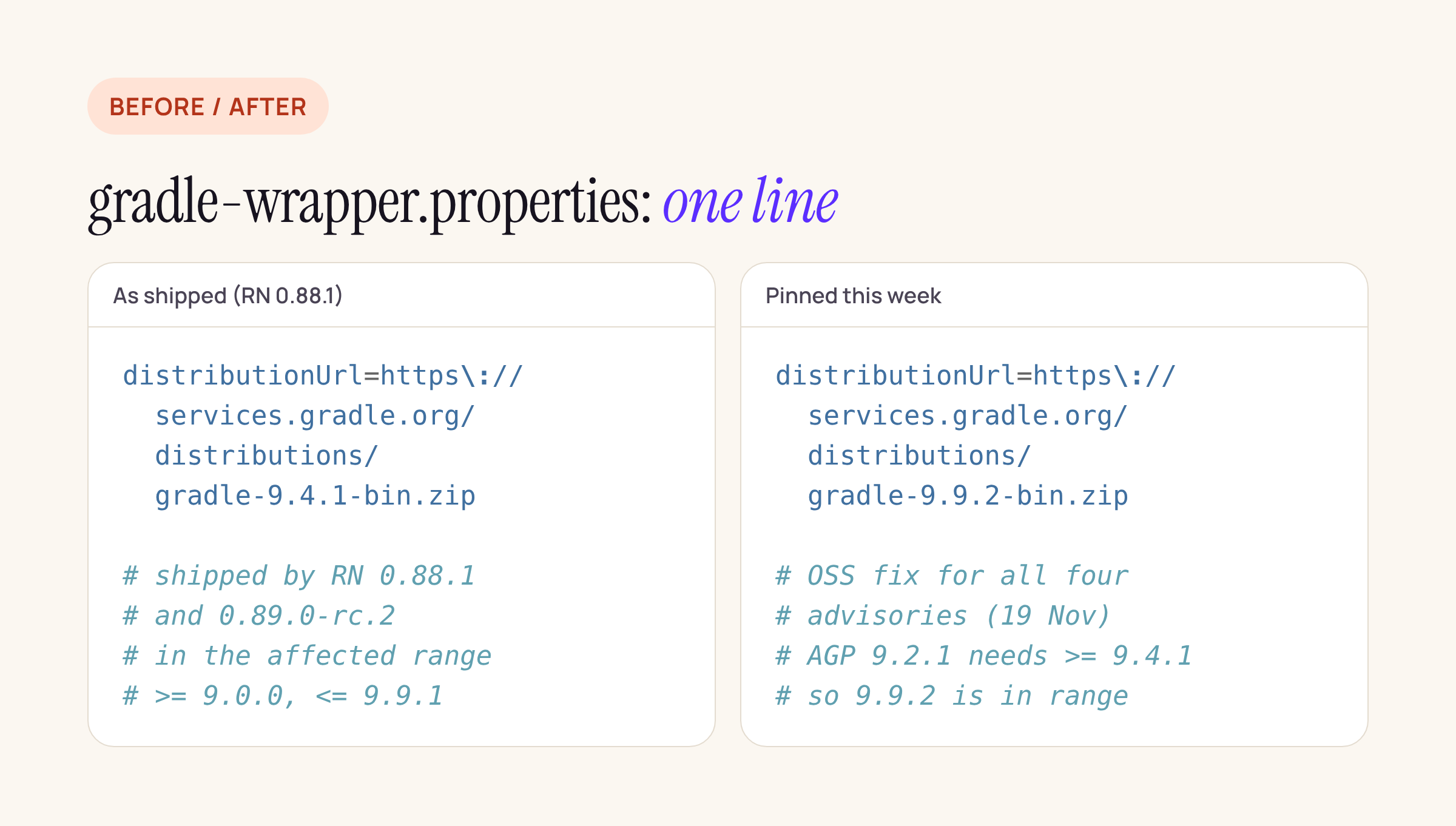
The wrapper line before and after, with the reasoning from the advisories and the AGP table.
Use the wrapper task with the checksum Gradle publishes on its releases page, so the download is verified:
cd android
./gradlew wrapper --gradle-version=9.9.2 \
  --gradle-distribution-sha256-sum=971fcd7150ca4ba04852c0b2ca0d2d0ab9468e14b03473eab19528809914c76b
./gradlew --stop
./gradlew assembleRelease
Gradle’s docs say to run ./gradlew wrapper a second time after the first: the first run only rewrites gradle-wrapper.properties, the second lets 9.9.2 update the wrapper jar and scripts. Commit all four wrapper files. A Gradle minor jump from 9.4 to 9.9 can surface new deprecation warnings from libraries; a release build plus your unit tests on CI is the check before merging.
Which advisories matter most depends on the setup. Shared CI runners are where the daemon registry and TestKit temp directory fixes count. Teams with gradle/verification-metadata.xml and snapshot dependencies get verification back for transitive snapshots. SFTP repositories are rare in React Native projects, but some private SDK mirrors still use them.
AGP 9.5.2: only if you moved off 9.2.1
AGP 9.5 needs Gradle 9.6.0 or newer, so a React Native app that is on 9.5.x already changed both the wrapper and the plugin by hand. If that is you, take 9.5.2: 9.5.0 and 9.5.1 carry the nested-jar regression.
For the fat-AAR bug we looked at what React Native libraries ship themselves. We unpacked 25 popular libraries from npm (react-native-screens 4.30.1, reanimated 4.8.0, worklets 0.14.0, gesture-handler 3.5.0, vision-camera 5.2.4, Firebase app 27.1.1, Stripe 0.85.1, Sentry 8.36.0, expo-modules-core 58.1.0 and 16 more) and searched their android/ folders for .aar and .jar files and for fileTree, flatDir or files(...) dependencies. None ships an AAR. Only @sentry/react-native carries jars, two stub jars in android/libs/, and the one referenced in its build.gradle is compileOnly, so it is not packaged. The fat AARs that can trigger the bug come from Maven: vendor SDKs for payments, KYC or analytics that bundle their own jars inside the AAR’s libs/ folder.
The Isolated Projects fix is worth knowing because of how React Native links libraries. autolinkLibrariesWithApp() in the Gradle plugin adds every native library with project.dependencies.project(mapOf("path" to path)), which is the implementation(project(...)) shape in issue 582417470. The 0.88.1 template does not turn Isolated Projects on (its gradle.properties has no org.gradle.unsafe.isolated-projects line), so a default app is not affected. Teams testing Isolated Projects on 9.5.x should be on 9.5.2 first.
Check your own project
We wrote a small checker that reads the wrapper version, finds the AGP version (in a version catalog, or in @react-native/gradle-plugin under node_modules), checks the Isolated Projects flag and counts nested jars in any AARs you point it at. The full script is about 40 lines of Python; the core is the range check from the advisories:
def ver(s): return tuple(int(x) for x in re.findall(r"\d+", s)[:3])

gv = ver(gradle_version)
affected = gv <= (8, 14, 7) or ((9, 0, 0) <= gv <= (9, 9, 1))
and the AAR scan:
with zipfile.ZipFile(aar) as z:
    jars = [n for n in z.namelist()
            if re.fullmatch(r"libs/[^/]+\.jar", n)]
fat = len(jars) >= 2
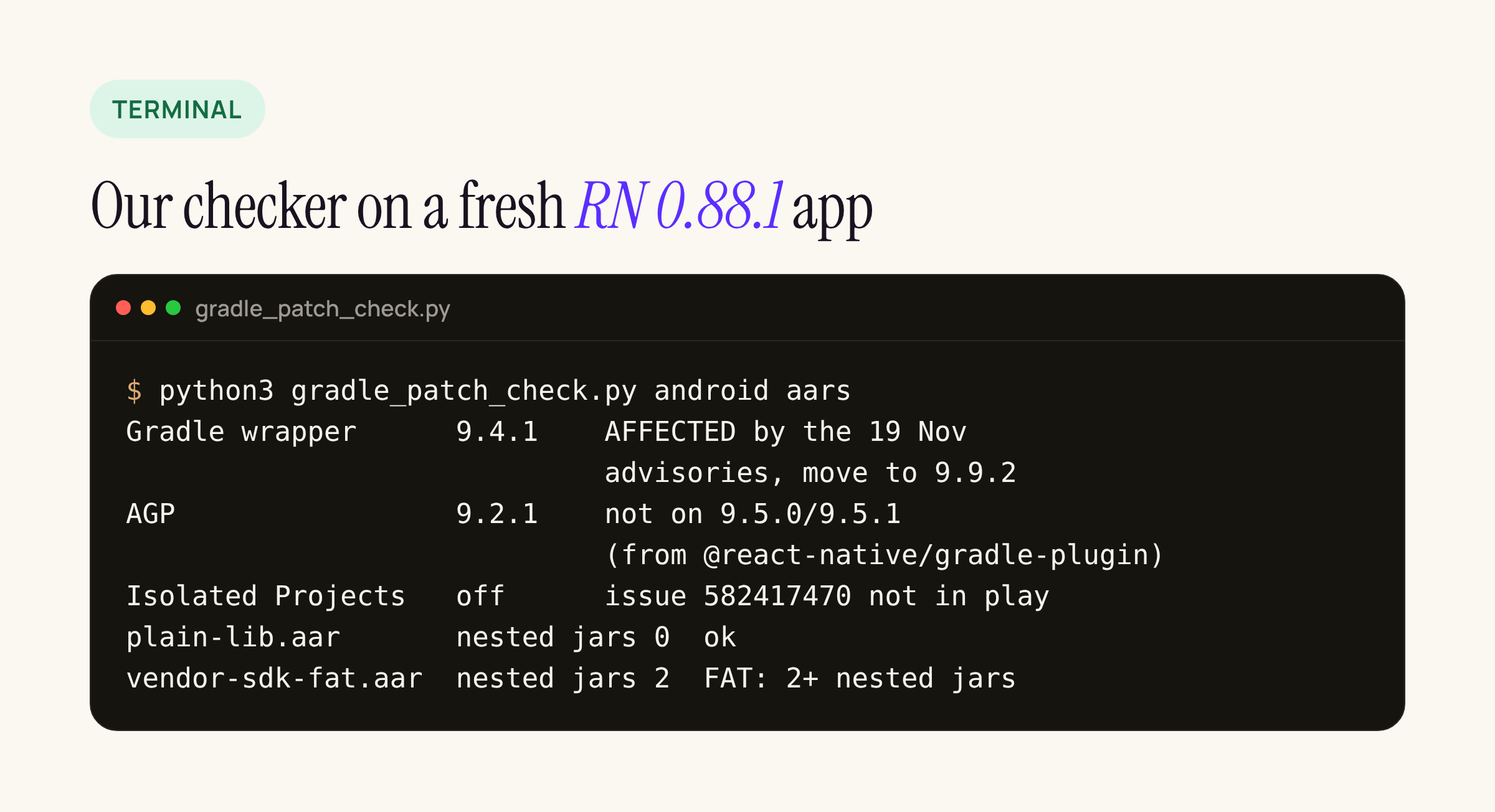
Real output from our test machine: the 0.88.1 template with its Gradle plugin, plus two test AARs we built (one plain, one with two nested jars).
To find vendor AARs in your own build, point the AAR scan at the Gradle cache after a build: $HOME/.gradle/caches/modules-2/files-2.1. Any AAR flagged with two or more nested jars is one that AGP 9.5.0 or 9.5.1 could fail to merge.
The pins we are taking
- Gradle wrapper: 9.9.2 (or 8.14.8 for any project still on Gradle 8).
- AGP: stay on the 9.2.1 that
@react-native/gradle-pluginbrings, until React Native moves it. Apps already on 9.5.x: 9.5.2. - Android Studio: Rabbit 2 Patch 2 is the current stable; it does not change the project’s AGP by itself.
For the larger AGP move, see our guide from AGP 8 to 9.5, and for the rest of the 0.89 native changes, React Native 0.89 rc.2: what changed in the native layer.