Takeaway: if your TV app is already on tv-material 1.0.x, the move to 1.1.0 (stable since 6 May 2026, with tv-foundation 1.0.0 the same day) is small: two focus API changes. The renames that break a catalogue screen (card layouts, the card scrim, ImmersiveList, ListItem, the TvLazy* layouts) all landed earlier, in tv-material 1.0.0-beta01 (1 May 2024) and tv-foundation 1.0.0-alpha11 and alpha12. An app still on the 2023 alphas has to cross both steps, and the order matters.
We built this map from the androidx TV release notes, checked every row against the version heading it sits under, and ran a small scanner over Google’s own android/tv-samples at commit c2987fd (18 Nov 2026).
Why we did this: BMDB.fun’s Android TV app is moving its browse screens from Leanback to Compose for TV (we wrote up the Leanback side of that port), and any Compose for TV code written in 2023 was written against the alphas.
The release timeline that matters
| Library | Version | Date |
|---|---|---|
| tv-material | 1.0.0-alpha10 | 4 Oct 2023 |
| tv-material | 1.0.0-beta01 | 1 May 2024 |
| tv-foundation | 1.0.0-alpha11 | 10 Jul 2024 |
| tv-material | 1.0.0 | 21 Aug 2024 |
| tv-foundation | 1.0.0-alpha12 | 15 Jan 2025 |
| tv-material | 1.1.0-alpha01 | 15 Jan 2025 |
| tv-material | 1.0.1 | 16 Jul 2025 |
| tv-material, tv-foundation | 1.1.0, 1.0.0 | 6 May 2026 |
All dates from the release notes page. Nothing newer than 1.1.0 and tv-foundation 1.0.0 is listed as of today.
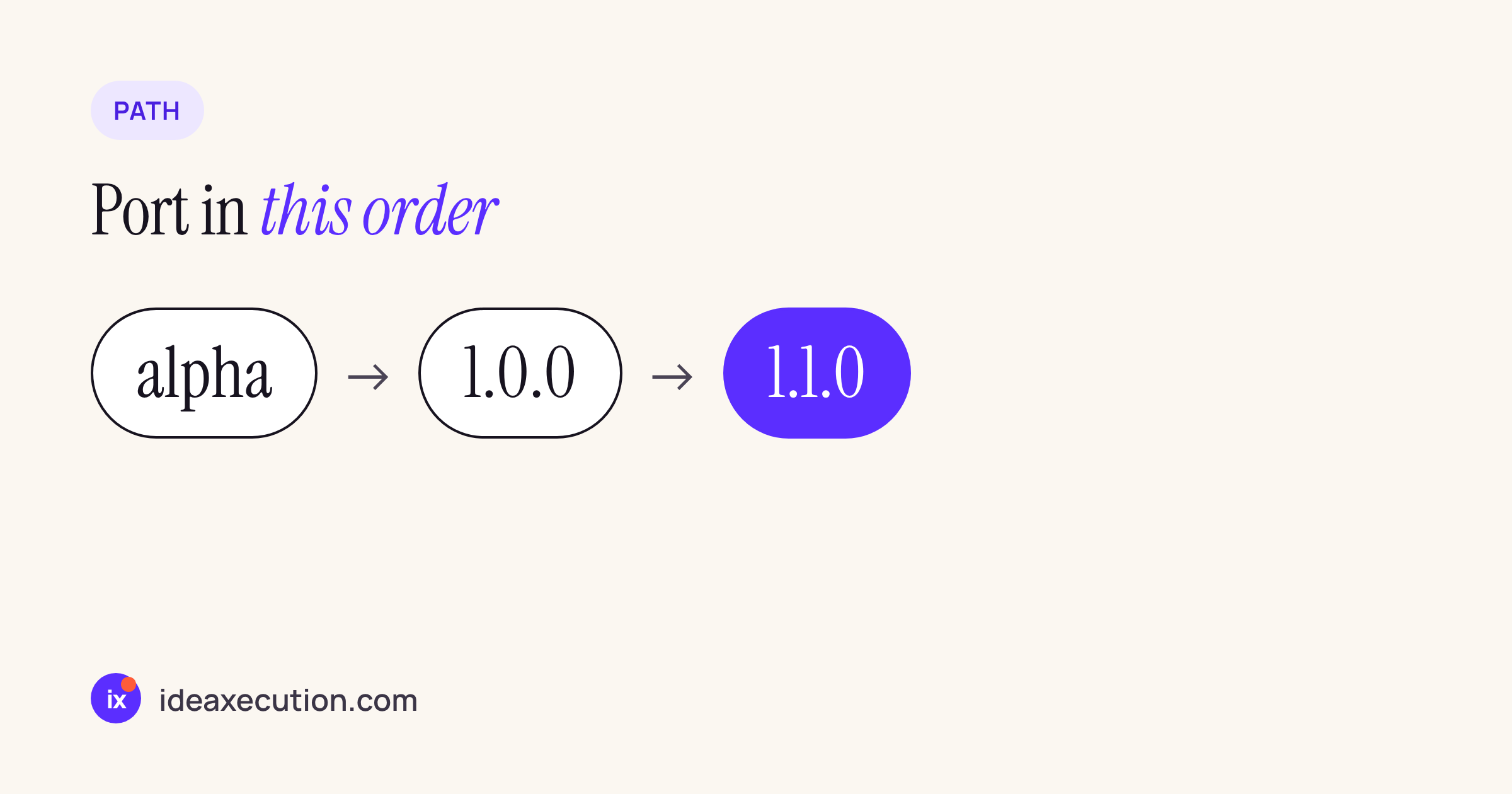
Cross 1.0.0 first: the renames below are compile errors, and fixing them against 1.0.0 keeps the focus changes of 1.1.0 out of the same diff.
Step 1: from the alphas to 1.0.0
Every one of these sits under tv-material 1.0.0-beta01 in the release notes, except the lazy layouts, which are tv-foundation.
| Before | After | Note |
|---|---|---|
StandardCardLayout |
StandardCardContainer |
renamed |
WideCardLayout |
WideCardContainer |
renamed |
CardDefaults. |
CardDefaults. |
renamed |
CardContainerDefaults. |
none | removed |
ImmersiveList |
none | removed from tv-material |
ListItem( parameters |
headlineContent first |
reordered |
ListItemDefaults. |
ListItemDefaults. |
renamed |
non-interactive Surface shape |
RectangleShape default |
behaviour change |
Surface contentColor |
no longer animates between states | behaviour change |
TvLazyRow, TvLazyColumn, TvLazy*Grid |
Compose LazyRow, LazyColumn, lazy grids |
deprecated in tv-foundation 1.0.0-alpha11, cleaned up in alpha12 |
Three of these need more than a find and replace:
ListItem. The parameters were rearranged andheadlineContentmoved to the top. Calls that relied on positional arguments or a trailing lambda for the headline will not match the new signature. Name every argument before you bump the version, and the bump becomes a no-op for those call sites.ImmersiveList. There is no replacement component. Google’s JetStream sample now has its own privateImmersiveListcomposable inTop10MoviesList.kt: aBoxholding a background image (shown while the row has focus), the selected movie’s description, and a regular row of cards. That is the pattern to copy.- Non-interactive
Surface. If you used it as a rounded panel and relied on the old default shape, it is now a rectangle. Passshapeexplicitly. This one does not fail the build, so it is easy to miss.
For the lazy layouts, the tv-foundation 1.0.0-alpha11 note says the TV lazy layouts were deprecated and points to a migration ticket; alpha12 removed them. Both of Google’s samples now import LazyRow and LazyColumn from androidx.compose.foundation.lazy (14 files in total).
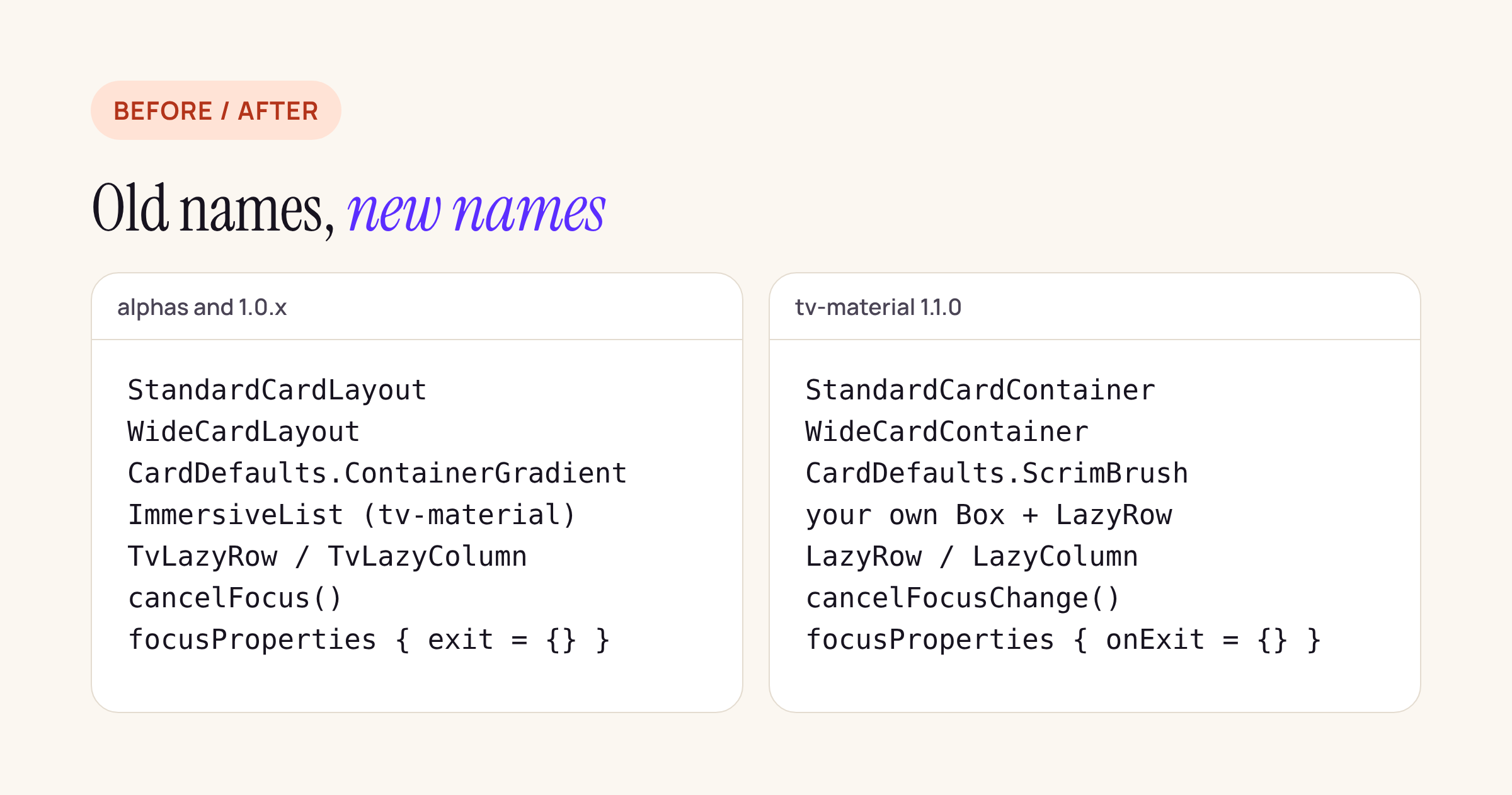
The renames at a glance. The last two rows are the tv-material 1.1.0 focus changes.
Step 2: from 1.0.x to 1.1.0
The 1.1.0-alpha01 notes list two API changes, and 1.1.0-beta01, rc01 and 1.1.0 itself add no further renames or removals:
| Before | After |
|---|---|
FocusEnterExitScope. |
cancelFocusChange( |
FocusProperties. and FocusProperties. |
onEnter and onExit |
This is the part most TV apps actually hit, because focus restoration on rows is written with exactly these properties. A typical “remember the last focused card” modifier from the 1.0 era:
.focusProperties {
    exit = {
        focusRequester.saveFocusedChild()
        FocusRequester.Default
    }
    enter = {
        if (focusRequester.restoreFocusedChild()) FocusRequester.Cancel
        else childFocusRequester
    }
}
The onEnter and onExit callbacks run inside a FocusEnterExitScope and return nothing, so the redirect becomes a call instead of a return value. A sketch of the same logic, to adapt and compile against your own Compose version:
.focusProperties {
    onExit = { focusRequester.saveFocusedChild() }
    onEnter = {
        if (focusRequester.restoreFocusedChild()) cancelFocusChange()
        else childFocusRequester.requestFocus()
    }
}
Test this on a D-pad, not only with touch or a mouse in the emulator: the behaviour you care about is what happens when focus leaves a row and comes back to it.
What Google’s own samples are on
We ran the scanner below over android/tv-samples at c2987fd. Both apps are already off every pre-1.0 name, but neither has moved to 1.1.0:
| Sample | Versions | Lambda enter/exit sites |
|---|---|---|
| JetStreamCompose | tv-material 1.0.0; tv-foundation not used | 3 (ModifierUtils. 170 and 174, tvmaterial/Dialog. 570) |
| TvMaterialCatalog | tv-material 1.0.0; tv-foundation 1.0.0-alpha11 | 2 (ThemeAndColorModeSelector. 82, FontScaleAndLayoutDirectionSelector. 83) |
The JetStream sites are the focus restorer shown above and a dialog that traps focus with exit = { FocusRequester.Cancel }. Those are the lines a 1.1.0 bump turns into the onEnter/onExit form. The catalog app also still pins the tv-foundation alpha that deprecated the TV lazy layouts, although its code no longer uses them.
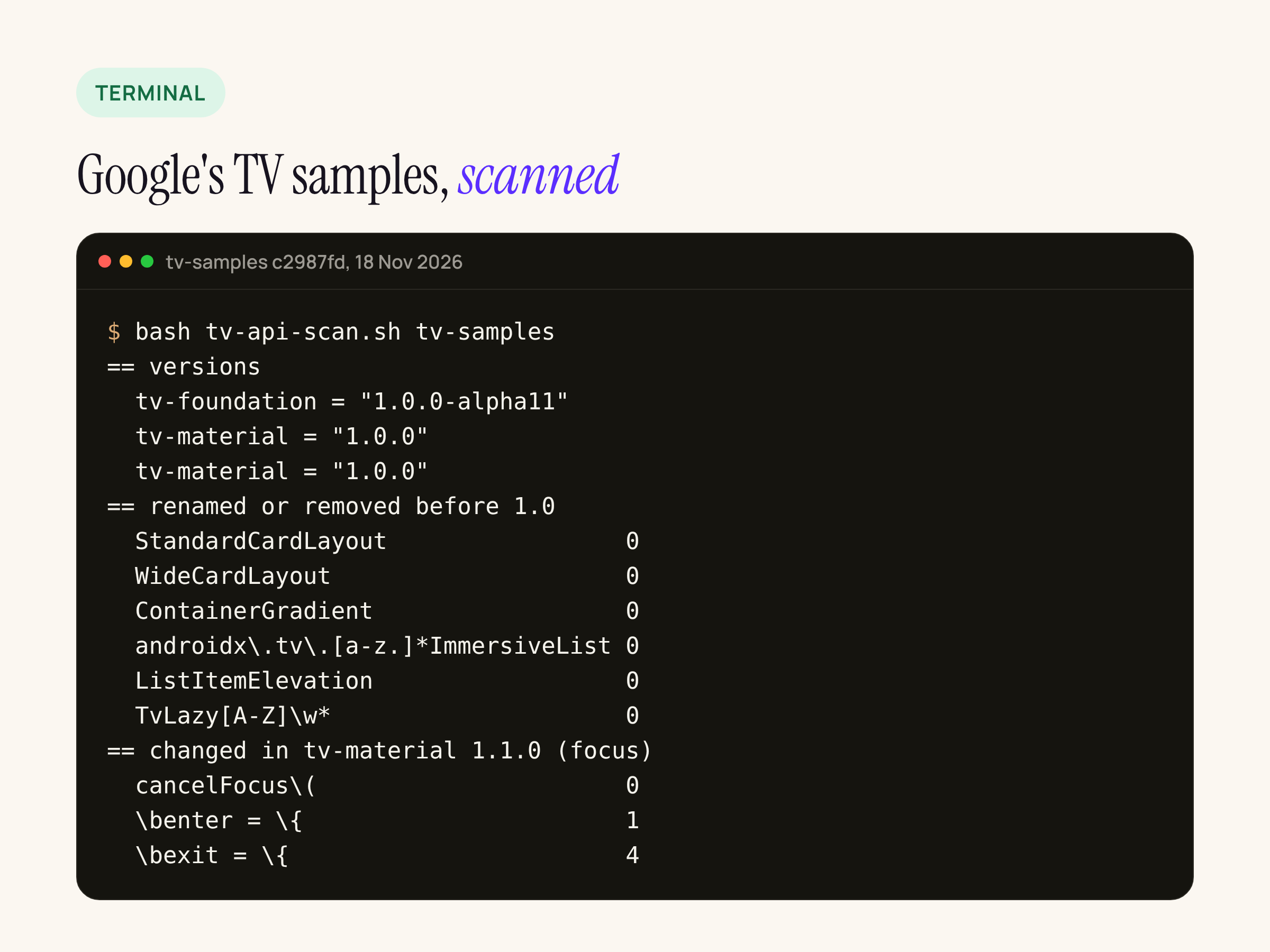
Real output of the scanner on tv-samples at c2987fd.
A scanner for your own project
The script only reads files. Point it at the root of an Android project:
#!/usr/bin/env bash
# tv-api-scan.sh <project dir>: Compose for TV APIs that changed
# between the tv-material alphas, 1.0.0 and 1.1.0.
cd "${1:-.}" || exit 1
count() { grep -rEo "$1" --include=*.kt . | wc -l; }
echo "== versions"
grep -rhE '^\s*tv-(material|foundation)\s*= "' --include=*.toml . | sed 's/^ */  /'
echo "== renamed or removed before 1.0"
for p in StandardCardLayout WideCardLayout ContainerGradient \
         'androidx\.tv\.[a-z.]*ImmersiveList' ListItemElevation 'TvLazy[A-Z]\w*'; do
  printf '  %-34s %s\n' "$p" "$(count "$p")"
done
echo "== changed in tv-material 1.1.0 (focus)"
for p in 'cancelFocus\(' '\benter = \{' '\bexit = \{'; do
  printf '  %-34s %s\n' "$p" "$(count "$p")"
done
echo "== lambda enter/exit sites"
grep -rnE '\b(enter|exit) = \{' --include=*.kt . | cut -d: -f1,2 | sed 's|.*/|  |'
On a small alpha-era test file (a TvLazyRow of StandardCardLayout cards with CardDefaults.ContainerGradient and a lambda exit), it reports StandardCardLayout 2, ContainerGradient 1, TvLazy 2 and one exit site, which is the work list for step 1 and step 2. The enter = { pattern deliberately skips AnimatedVisibility(enter = fadeIn()), which takes a value, not a lambda.
What to check on your own app
- Run the scanner and note the versions it prints. Alpha versions mean step 1 first.
- Name all
ListItemarguments and give every non-interactiveSurfacean explicitshapewhile still on the old version, so the bump changes nothing visible. - Replace
TvLazyRowandTvLazyColumnwith the Compose foundation versions and re-check focus on every row with a D-pad. - Bump to
tv-material1.0.0, fix the renames, ship. - Bump to 1.1.0 and port every
enter/exitlambda andcancelFocus()call, then re-test focus restore on rows and focus trapping in dialogs.