Swift 6.4 (released 15 Sep 2026) is the first version where a half-ported test target is safe. Under ST-0021, an XCTAssert inside a Swift Testing @Test no longer passes silently, and #expect inside an XCTestCase now reports. So port file by file, keep the suite green between commits, and raise the interop mode as you go: limited, then complete, then strict.
How much of the work is mechanical? We counted every XCTest call in the test targets of five Apple open-source packages on their main branches (18 Nov 2026). In swift-nio, 10,051 of 10,469 calls (96%) have a one-line replacement in Apple’s mapping table; in swift-algorithms, all 313 do. The rest is expectations, skips and project-specific helpers, and that is where the time goes.
Why we did this: the native iOS modules of our banking apps and both of our Mac apps, Nix and QuitAll, still carry XCTest targets, and new tests should not be written in a framework we plan to leave.
What Swift 6.4 changed
Before 6.4, mixing the two frameworks was a trap. ST-0021 describes the old behaviour as a false negative: an XCTAssert in a Swift Testing test was a no-op, and so was #expect in an XCTest. Swift 6.4’s release post puts the fix in one line: “You can now safely use XCTAssert in Swift Testing tests or #expect within XCTests (ST-0021).”
The behaviour is set by an interop mode:
| Mode | XCTest API inside a @Test |
|---|---|
| none | Ignored, as before 6.4 |
| limited | Reported as a runtime warning issue |
| complete | Reported as a failure |
| strict | Any XCTest API use is a fatal error |
Which mode you get by default depends on the toolchain and your package’s tools version, per Apple’s migration article: a toolchain older than 6.4 gives none; a 6.4 toolchain with swift-tools-version below 6.4 gives limited; 6.4 with 6.4 gives complete. You can override it with the SWIFT_TESTING_XCTEST_INTEROP_MODE environment variable. The proposal says strict may become the default in a future release.
None of the five packages we cloned declares tools version 6.4 yet (swift-nio 6.1, swift-argument-parser 6.0, swift-log 6.2), so on a 6.4 toolchain they all run in limited mode. Most existing apps will be in the same place.
The assertion mapping
This is Apple’s table from “Migrating a test from XCTest”: each XCTest call as a comment, its Swift Testing form below it.
// XCTAssert(x), XCTAssertTrue(x)
  #expect(x)
// XCTAssertFalse(x)
  #expect(!x)
// XCTAssertNil(x)
  #expect(x == nil)
// XCTAssertNotNil(x)
  #expect(x != nil)
// XCTAssertEqual(x, y)
  #expect(x == y)
// XCTAssertNotEqual(x, y)
  #expect(x != y)
// XCTAssertIdentical(x, y)
  #expect(x === y)
// XCTAssertNotIdentical(x, y)
  #expect(x !== y)
// XCTAssertGreaterThan(x, y)
  #expect(x > y)
// XCTAssertGreaterThanOrEqual(x, y)
  #expect(x >= y)
// XCTAssertLessThanOrEqual(x, y)
  #expect(x <= y)
// XCTAssertLessThan(x, y)
  #expect(x < y)
// XCTAssertThrowsError(try f())
  #expect(throws: (any Error).self) {
    try f()
  }
// XCTAssertNoThrow(try f())
  #expect(throws: Never.self) {
    try f()
  }
// try XCTUnwrap(x)
  try #require(x)
// XCTFail("...")
  Issue.record("...")
The gap Apple names: there is no equivalent of XCTAssertEqual(_:_:accuracy:). Use isApproximatelyEqual() from swift-numerics. swift-nio has two of those calls.
Around the assertions, the structure changes too:
| XCTest | Swift Testing |
|---|---|
XCTest subclass |
a type, @Suite optional |
set |
init |
tear |
deinit (class or actor only) |
func test |
@Test func x |
| stop at the first failure | #require |
XCTest |
confirmation |
XCTSkip |
., . |
XCTExpect |
with |
XCTAttachment |
Attachment. |
Every row is from Apple’s article. One behaviour change hides in it: Swift Testing runs tests in parallel by default, where XCTest ran them in order. A suite that shares state needs @Suite(.serialized).
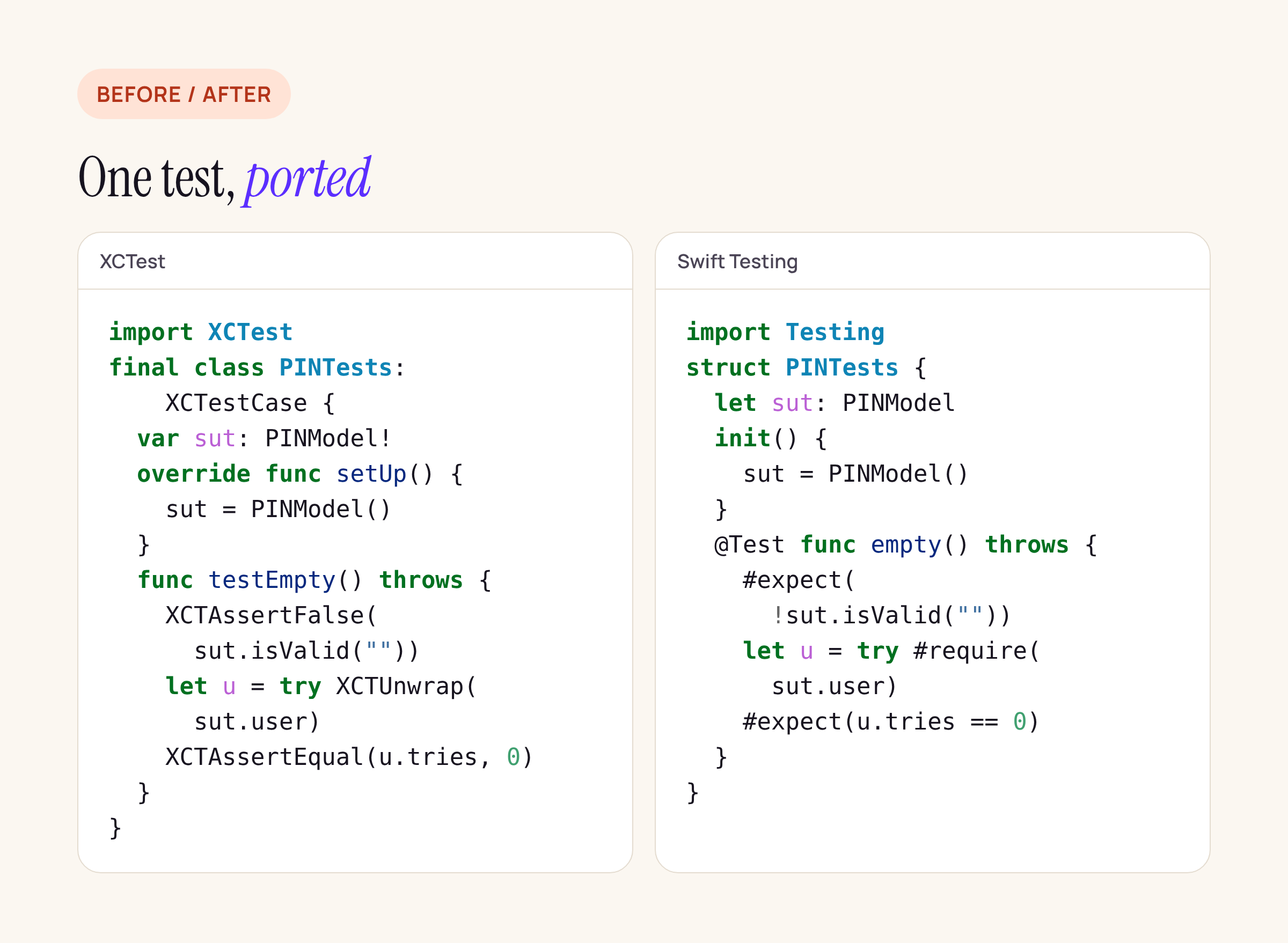
The same test before and after. Treat it as a pattern to adapt and compile against your own target.
How much real code the table covers
We wrote a 19-line counter that walks a package’s test folders, strips comments, and counts each XCTest form plus the files that import each framework:
#!/usr/bin/env python3
"""Count XCTest forms and Swift Testing use in Swift test files."""
import re, sys, pathlib, collections
FORMS = (r"XCTAssert\w*|XCTUnwrap|XCTFail|XCTSkip\w*|XCTExpectFailure"
         r"|XCTestExpectation|expectation\(|wait\(for:|fulfillment\(of:"
         r"|measure\w*\s*[({]|XCUIApplication")
total = collections.Counter()
files = st = 0
for p in pathlib.Path(sys.argv[1]).rglob("*.swift"):
    if "Tests" not in p.parts and not p.parent.name.endswith("Tests"):
        continue
    t = re.sub(r"//.*", "", p.read_text(errors="ignore"))
    if "XCTest" in t: files += 1
    if "import Testing" in t: st += 1
    for m in re.findall(FORMS, t):
        total[re.sub(r"[\s({]+$", "", m)] += 1
print(f"files importing XCTest: {files}, importing Testing: {st}")
for k, v in total.most_common():
    print(f"{v:6d}  {k}")
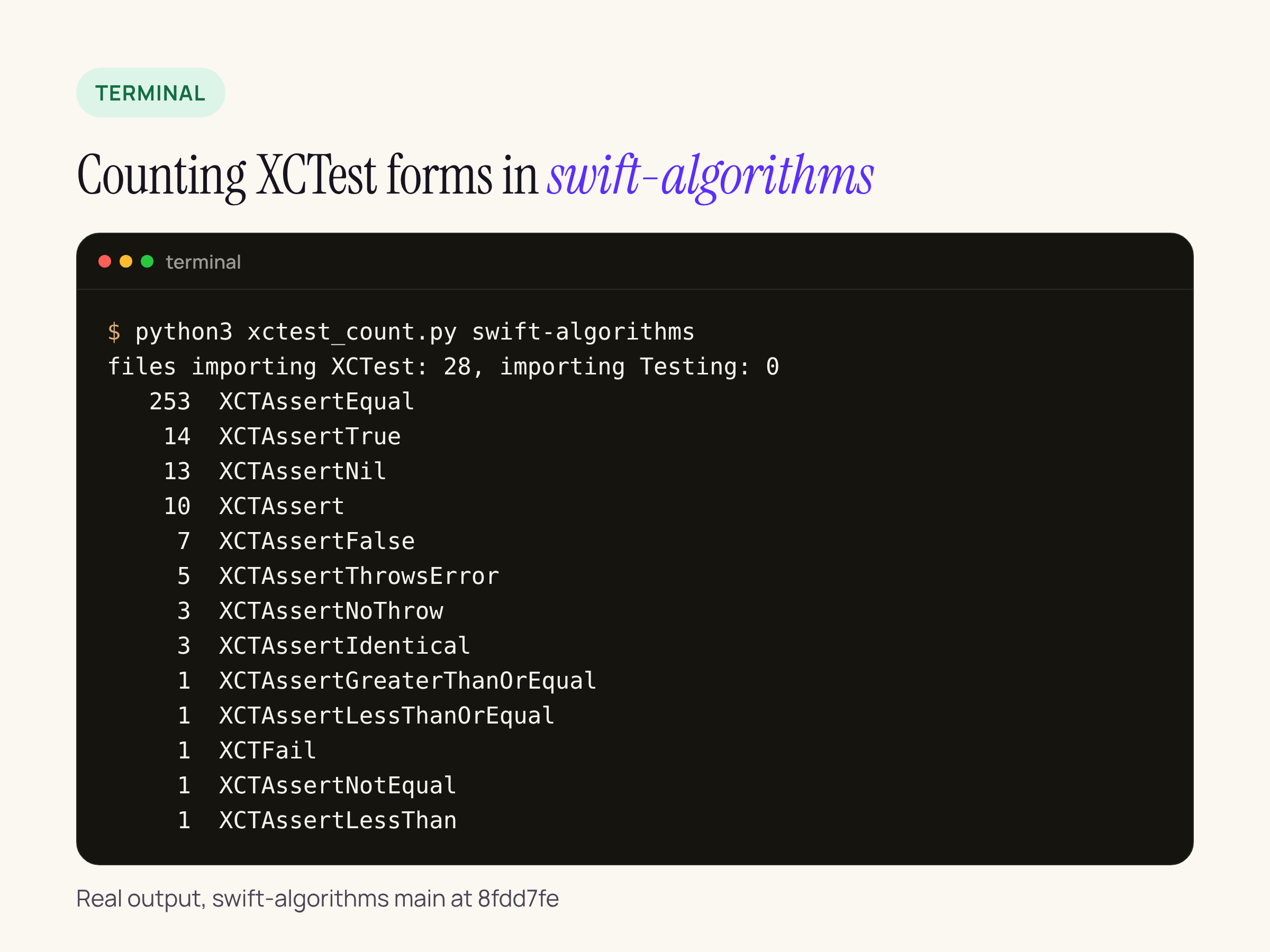
swift-algorithms is the easy case: 313 calls, every one of them in Apple’s table.
What the five packages showed, at their main commits on 18 Nov 2026:
| Package | State | What is left |
|---|---|---|
| swift-algorithms (8fdd7fe) | 28 XCTest files, 0 Swift Testing | 313 calls, all mechanical |
| swift-nio (93bd8f2) | 147 XCTest, 24 Swift Testing | 418 calls need hand work |
| swift-collections (8c409d4) | 61 XCTest, 2 Swift Testing | own helpers: 2,480 expectEqual calls |
| swift-argument-parser (d7b6ceb) | 0 XCTest, 60 Swift Testing | done |
| swift-log (c7413d9) | 0 XCTest, 18 Swift Testing | done |
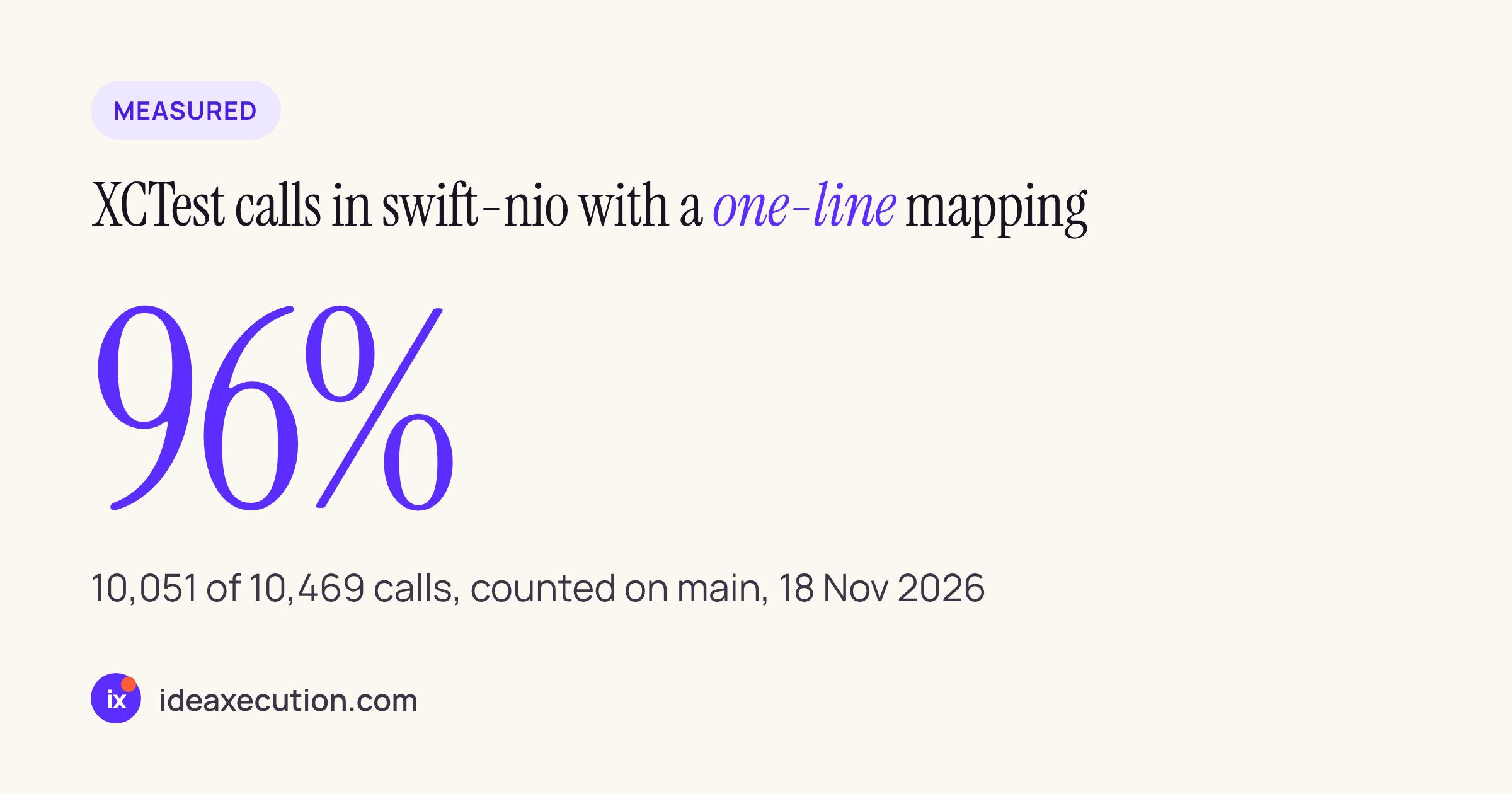
The 96% figure is a count of call sites, not of effort.
The 418 swift-nio calls without a table row are the useful part. They fall into three groups:
- Project helpers built on XCTest, such as
XCTAssertEqualWithoutAutoclosure(109 uses) andXCTAssertThrowsFileSystemErrorAsync(31). Port the helper once, with#expectandIssue.recordinside, and its call sites move for free. swift-collections shows the extreme: almost all its 61 test files call its ownexpectEqualfamily, so the port there is a port of one support module. - Skips: 107
XCTSkip, 22XCTSkipUnless, 6XCTSkipIf, plus a custom skip helper. Static conditions become.enabled(if:)traits; conditions only known while the test runs becometry Test.cancel(...), which Apple notes also works in XCTest. - Async expectations: 45
expectation(...), 44fulfillment(of:), 6wait(for:). These need a rewrite withconfirmation(). Apple’s article points out thatXCTestExpectationandConfirmationboth default to “exactly once”; a range of counts needs a lower bound.
The two packages that are already done used the Swift Testing features you would expect: swift-argument-parser has 576 @Test functions, 249 #expect(throws:) checks and 11 .serialized traits; swift-log has 183 @Test functions.
The porting plan
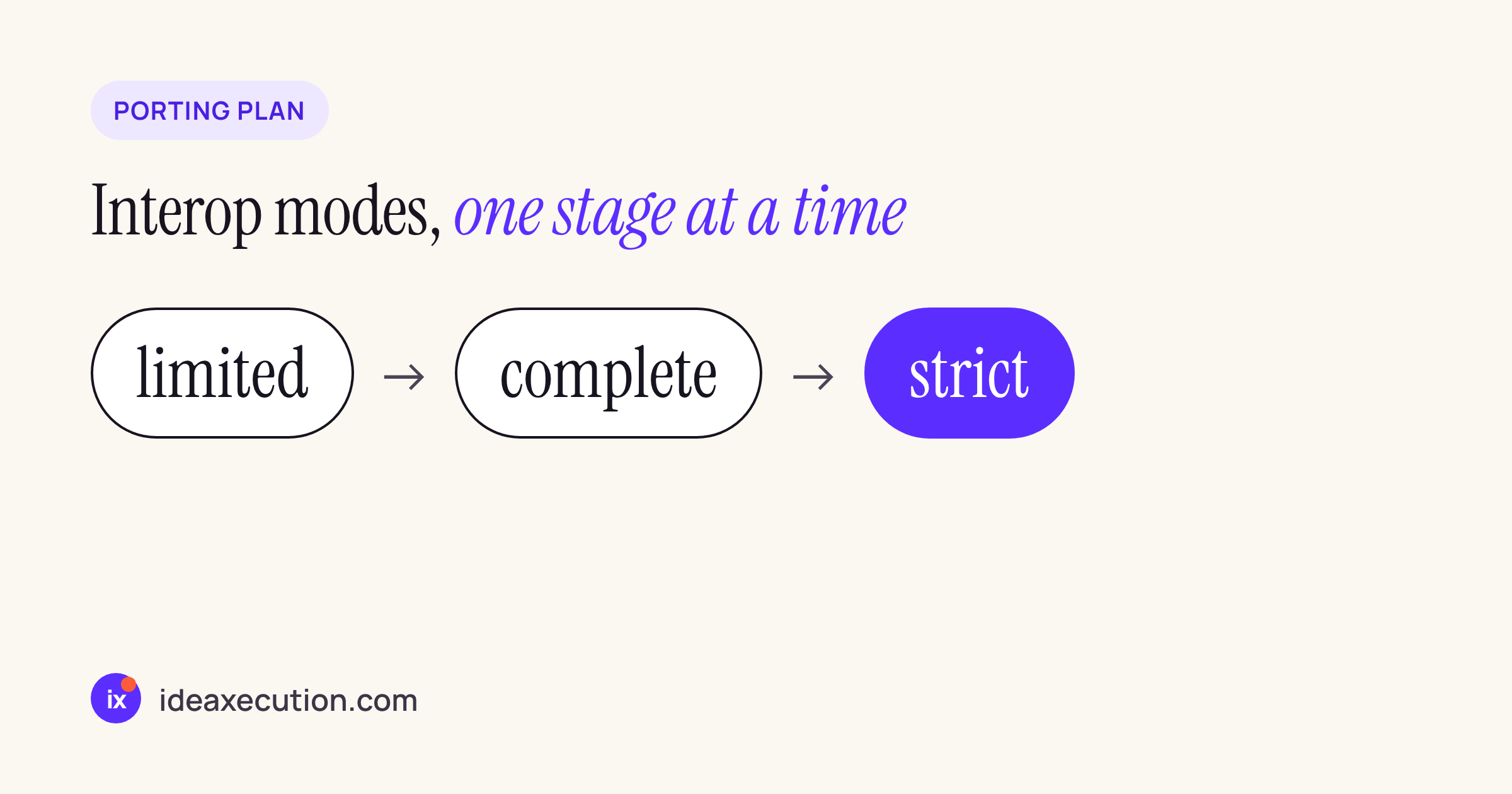
Raise the mode only when the previous stage is clean.
- Stay in limited mode (the default for a pre-6.4 tools version on Swift 6.4). Port the helpers first, then the files that are 100% mechanical. Watch the runtime warnings: each one is an XCTest call that a Swift Testing test was silently ignoring.
- Switch to complete by raising
swift-tools-versionto 6.4 or settingSWIFT_TESTING_XCTEST_INTEROP_MODE=completein the test scheme. Those warnings now fail the test run, so mixed files are safe. Port expectations, skips and known issues. - Finish in strict. Any XCTest API inside a Swift Testing test is now fatal, which proves the port is complete. Delete
import XCTestwhere nothing needs it.
Keep measure blocks and UI tests that use XCUIApplication in XCTest for now: the mapping above has no row for them, and none of the five packages uses either in its test targets.
What to check on your own app
- Run the counter on your test folder before estimating. The share of calls outside the table is the real size of the job.
- Grep for
accuracy:; each hit needs swift-numerics or a hand-written tolerance check. - Look for tests that share state through static properties or files: they need
.serializedonce they run in parallel. - Note your
swift-tools-version: it decides which interop mode you start in.