Takeaway: if your Android XR app calls Orbiter(position = ContentEdge.Top, ...) or any other Orbiter overload that does not take an OrbiterPosition, it will not compile against androidx.xr.compose:compose:1.0.0-rc01 (released 18 Nov 2026). Port those calls to OrbiterPosition while you are still on 1.0.0-beta02, where both APIs exist, then upgrade. Also check every SubspaceModifier.resizable() without arguments: its default minimum size went from zero to 150.dp, and panels are now clamped to a maximum safe size.
This post is a source and docs review. We diffed the public API signature files of androidx.xr.compose:compose (1.0.0-beta02 as it stood before the removal commit, against 1.0.0-rc01.txt), read the androidx-main commits behind each rc01 release note, and checked Google’s own android/xr-samples repository (commit 434a733, 22 Oct 2026) against the list.
Why we did this: we build Compose UIs for phones and for BMDB.fun on Android TV, and Android XR runs the same Compose stack. When a client asks for a spatial version of a catalogue or a banking dashboard, the Orbiter (a floating toolbar attached to a panel) is the first thing we reach for, so its API break is the one we have to plan around.
What changed between beta02 and rc01
The XR Compose release notes list one API change and several behaviour fixes for rc01. We matched each one to its commit:
| Change in 1.0.0-rc01 | Kind | Commit | What it means for your code |
|---|---|---|---|
| Deprecated Orbiter APIs removed | API break | 8d262a4 (8 Oct) | Calls using ContentEdge, OrbiterAlignment, OrbiterAnchorPoint, OrbiterOffsetType, OrbiterEdgeOffsetType or OrbiterPoseProvider stop compiling |
resizable minimumSize default is now 150.dp wide and high |
Behaviour | 63caf54 (7 Oct) | Panels can no longer be shrunk below 150.dp unless you pass a smaller minimumSize |
| Panels clamped to a safe rendering size | Behaviour | 6ee12a7 (2 Oct) | SpatialPanel content is capped; the default maximumSize follows that cap |
maintainAspectRatio = true stops at the first axis that hits min or max |
Behaviour | 09d15e6 (5 Oct) | A resizable with both an aspect lock and size limits keeps its proportions instead of stretching to meet both limits |
| Scale, alpha, movable and anchorable reset when the modifier is removed | Bug fix | listed in the release notes | Conditional modifiers now undo their effect when you remove them |
Diffing the two API files confirms that the Orbiter removal is the only public API change: 283 lines removed, 0 added. That covers 51 classes and interfaces and 5 Kotlin Orbiter overloads, all of them already marked @Deprecated in beta02. Everything else in the public surface is identical.
The Orbiter port
The five removed overloads took a ContentEdge.Horizontal, a ContentEdge.Vertical, an OrbiterAlignment, an OrbiterAnchorPoint or an OrbiterPoseProvider. The one that stays has a much shorter signature:
@Composable
fun Orbiter(
    position: OrbiterPosition,
    shape: SpatialShape = OrbiterDefaults.Shape,
    content: @Composable () -> Unit,
)
OrbiterPosition has one class per anchor (TopStart, TopCenter, TopEnd, CenterStart, Center, BottomEnd and so on, plus Left/Right variants that ignore layout direction). Each takes an EdgeAlignment per axis and a DpVolumeOffset. OrbiterPosition already exists in beta01 and beta02, so you can port first and upgrade second.
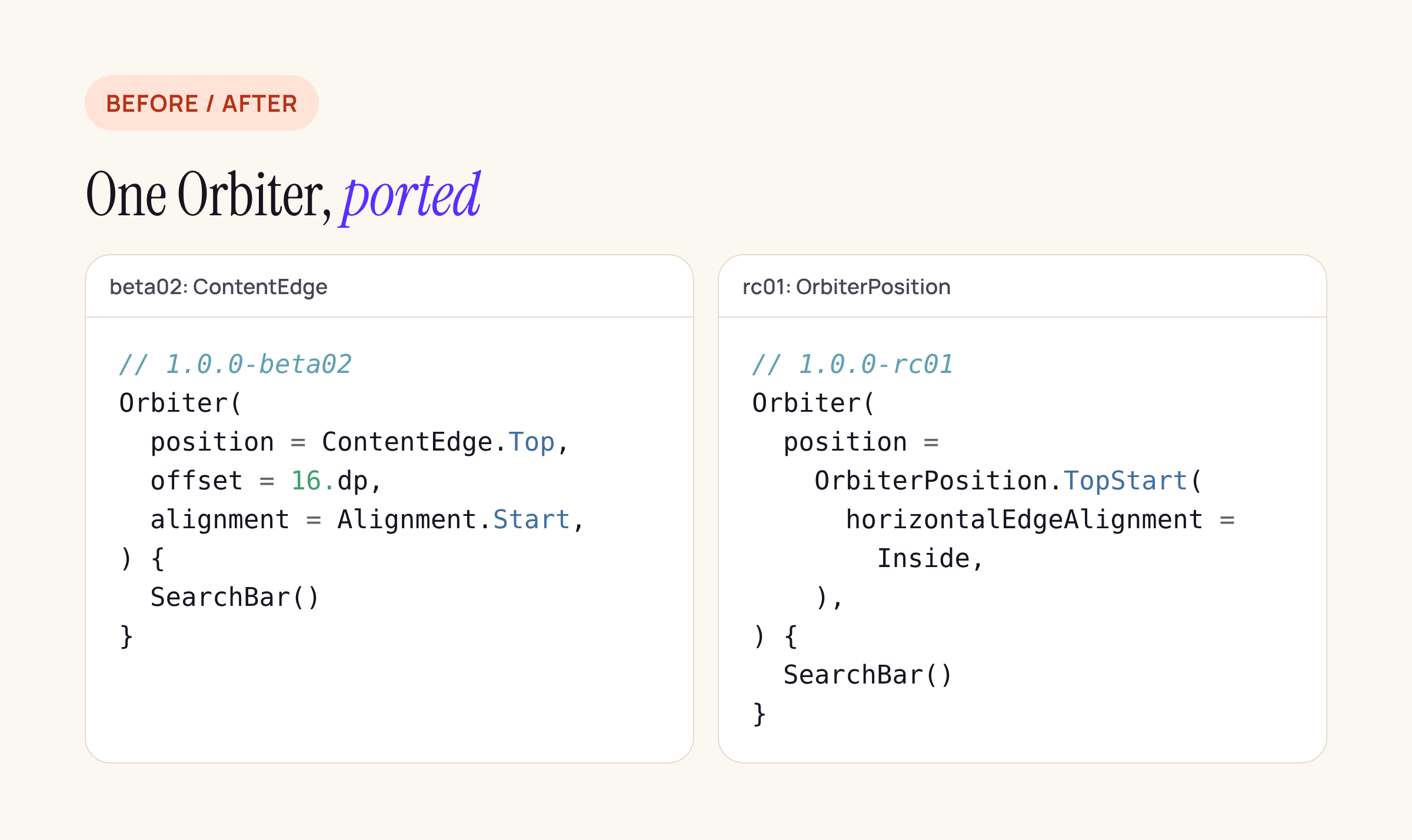
The same top-start toolbar written against beta02 and rc01.
How the old parameters map, from the deprecation messages and the removed source:
| Old (beta02) | New (rc01) |
|---|---|
position = ContentEdge.Top + alignment = Alignment.Start |
OrbiterPosition.TopStart(horizontalEdgeAlignment = EdgeAlignment.Inside) |
ContentEdge.Top + Alignment.CenterHorizontally (the old default) |
OrbiterPosition.TopCenter() |
ContentEdge.Top + Alignment.End |
OrbiterPosition.TopEnd(horizontalEdgeAlignment = EdgeAlignment.Inside) |
OrbiterEdgeOffsetType.OuterEdge / InnerEdge / None |
EdgeAlignment.Outside / Inside / Center |
OrbiterOffsetType |
removed; it pointed to OrbiterEdgeOffsetType, which points to EdgeAlignment |
elevation = 8.dp |
z of offset = DpVolumeOffset(x, y, 8.dp) (default z is OrbiterDefaults.Elevation) |
offset = 16.dp (a gap from the outer edge) |
an x/y shift in offset, applied after the edge alignment |
shouldRenderInNonSpatial |
no parameter in the new overload |
Two rows need care. The old top-start toolbar sat above the panel but inside its width; the new TopStart defaults to Outside on both axes, which places it diagonally off the corner. That is why the port sets horizontalEdgeAlignment = Inside. And the old offset was a single gap measured from the outer edge, while the new one is a plain x, y, z shift. Carry the value over and check the direction in the Android XR emulator, because the sign depends on which edge you anchor to. Treat the snippets as a starting point and compile them against your own target.
Google’s own sample still uses the removed API
We searched android/xr-samples at its latest commit (434a733, 22 Oct 2026). It pins androidx.xr.compose:compose to 1.0.0-beta02 and uses exactly the overload that rc01 removes:
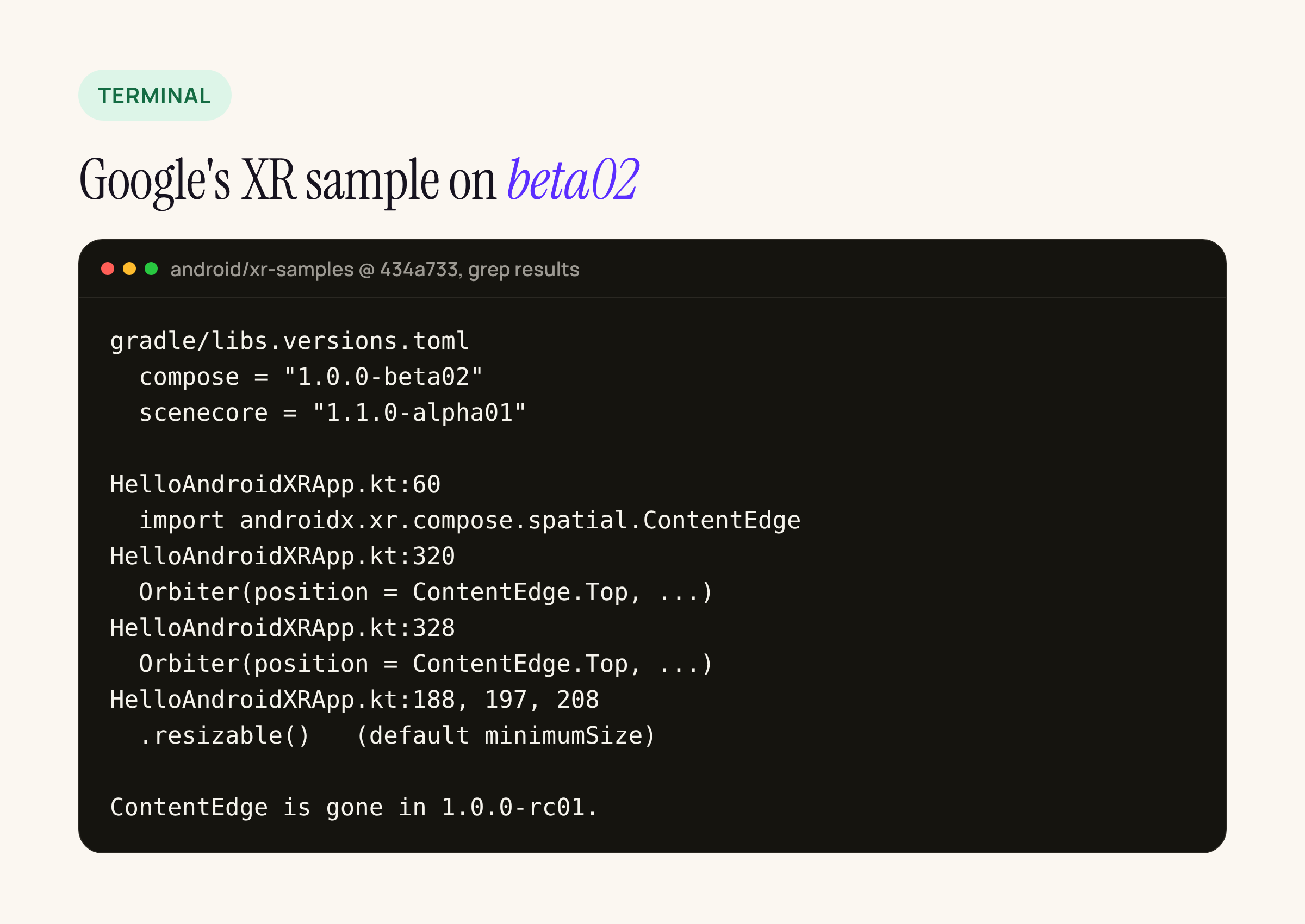
What a search of android/xr-samples finds: two ContentEdge.Top Orbiters and three resizable panels on default sizes.
So the Hello Android XR sample will not compile on rc01 until it is ported. If you started your app from it, your toolbars almost certainly use ContentEdge too. The sample also pins SceneCore explicitly (1.1.0-alpha01) instead of taking the version XR Compose brings with it.
Resizable panels: check the new limits
The sample’s three panels call .resizable() with no arguments, which is common. After rc01 that call means:
fun SubspaceModifier.resizable(
    enabled: Boolean = true,
    minimumSize: DpVolumeSize =
        DpVolumeSize(150.dp, 150.dp, 0.dp),
    maximumSize: DpVolumeSize = DpVolumeSize(
        Dp.Unspecified, Dp.Unspecified, Dp.Unspecified,
    ),
    maintainAspectRatio: Boolean = false,
    resizePolicy: ResizePolicy = ResizePolicy.Default,
): SubspaceModifier
The minimum used to be DpVolumeSize.Zero. The commit message gives the reason: a panel shrunk close to zero was hard to grab and enlarge again. The Dp.Unspecified maximum now means “work out a safe size”: in the source, SpatialPanel caps its constraints at 7,800 by 4,000 pixels. Layout groups and SpatialExternalSurface can still be larger, but any SpatialPanel inside them is clamped.
What to look for in your code:
- A panel meant to shrink to a small chip (a mini player, a timer) needs an explicit
minimumSizebelow 150.dp. - A panel with
maintainAspectRatio = trueand both size limits now stops resizing when the first axis hits its limit. If you relied on it reaching both limits, adjust the limits instead. - Very large panels (a wall of posters in a catalogue browse screen) now stop at the safe size. Split them or move the content into a layout group of smaller panels.
The SceneCore memory leak note
The beta02 release notes carry a known issue: XR Compose 1.0.0-beta02 depends on androidx.xr.scenecore 1.0.0-rc01, which has a memory leak, and Google suggests overriding SceneCore to 1.0.0 (stable since 21 Oct 2026). The rc01 notes do not say whether the dependency moved. Pin it yourself until 1.0 stable and confirm with ./gradlew :app:dependencies:
dependencies {
    implementation("androidx.xr.compose:compose:1.0.0-rc01")
    // keep SceneCore on a version with the leak fix
    implementation("androidx.xr.scenecore:scenecore:1.0.0")
}
Upgrade order
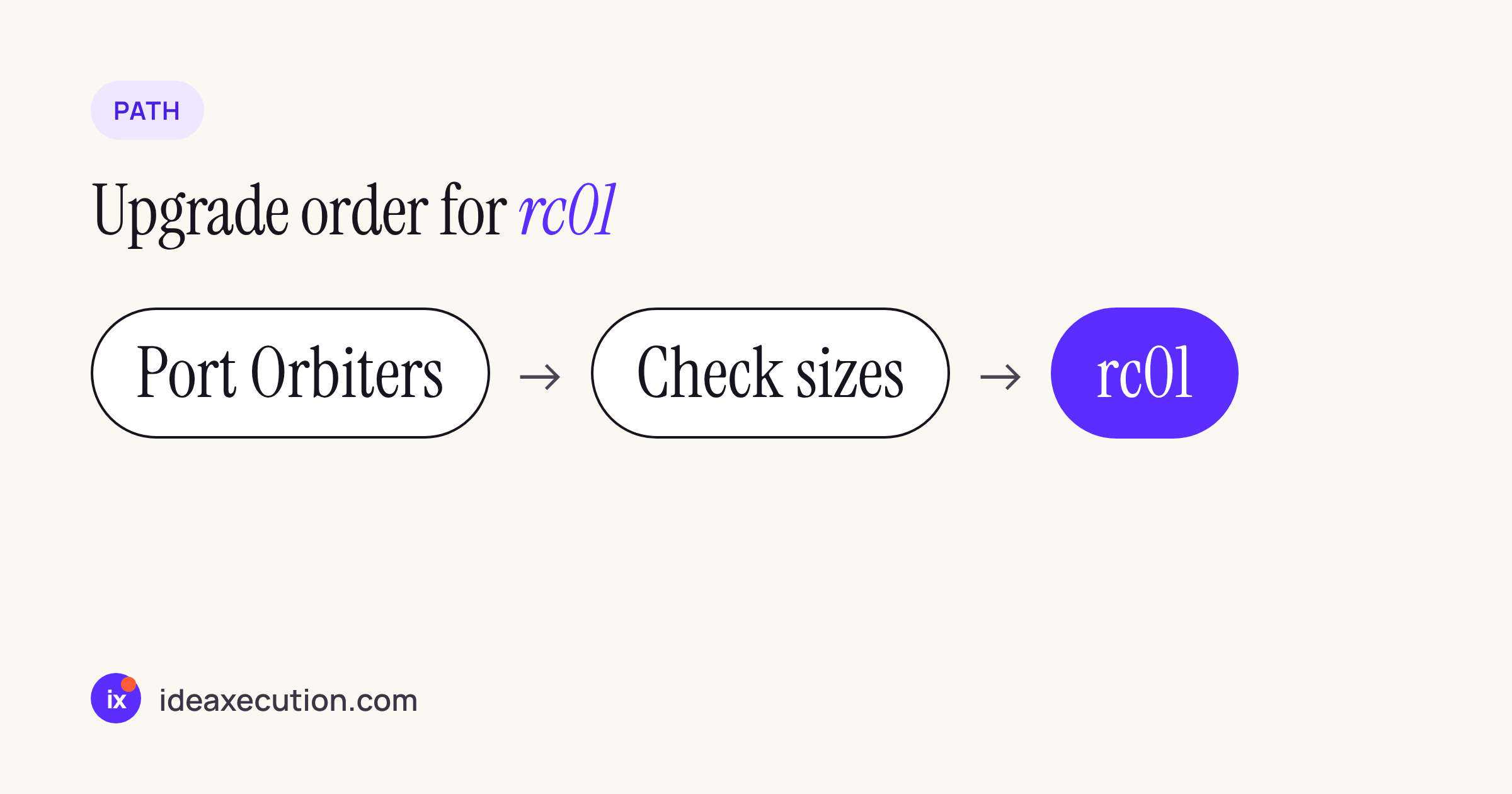
Port on beta02, check sizes, then bump the version.
- On beta02, replace every Orbiter call that does not take an
OrbiterPosition. The compiler already flags them as deprecated, so turn onallWarningsAsErrorsfor one build to find them all. - Search for
.resizable(and decide for each panel whether 150.dp and the safe maximum suit it. - Pin SceneCore to 1.0.0 or later.
- Bump
androidx.xr.compose:composeto 1.0.0-rc01 and fix anything left.
No date for 1.0.0 stable is announced. XR Compose has shipped every four weeks (beta01 on 23 Sep, beta02 on 21 Oct, rc01 on 18 Nov), which points to 16 December; AndroidX release days come every other Wednesday, so 2 December is possible too. With the API frozen at rc01, the port above is the work stable will ask for. We will update this post with the stable version and its release notes when it ships.
What to check on your own app
- Build once against rc01 on a branch, even before you port, to get the full list of broken call sites.
- Compare toolbar placement in the Android XR emulator before and after the port, panel by panel.
- Shrink each resizable panel to its minimum and enlarge it to its maximum.
- Run your leak checks (LeakCanary or the profiler) after pinning SceneCore.