
If your Android app still declares minSdk 23 (Android 6.0), the next AndroidX bump can stop the build with a manifest merger error. As of 17 Nov 2026, four libraries say in their own release notes that they now require minSdk 24: WebKit 1.16.0 (May 2026), Navigation 2.10.0 (from rc01, Aug 2026), WorkManager 2.12.0 (Sep 2026) and Media3 1.12.0 (from alpha01, Oct 2026). Before you bump any of those, decide: raise your own minSdk to 24, or pin the last version that still supports 23.
Google announced the move on the AndroidX release page: “Starting in July 2026, new releases of many AndroidX libraries previously targeting minSdk 23 will be updated to require minSdk 24.” The same page says some libraries will not be re-released and so keep supporting 23. What it does not give is the list, so we built one from the release notes, and checked what React Native 0.75.5 to 0.89.0-rc.1 and five common RN libraries declare in their published Android sources.
Why we did this: Peepal and Shopkeeper run on low-end phones, and the BMDB TV app runs on Android TV boxes that ship old Android versions. Every one of those apps has a minSdk decision to make before its next dependency update.
Libraries whose release notes say minSdk 24
We read the release notes of 16 AndroidX libraries on developer.android.com on 17 Nov 2026 and kept only sentences we could quote. Every row links to the page.
| Library | First on minSdk 24 | What the notes say |
|---|---|---|
| WebKit | 1.16.0-alpha03 (11 Mar 2026); stable 1.16.0 (6 May 2026) | “The minimum supported SDK (minSdk) for this library has been increased to 24.” |
| Navigation | 2.10.0-rc01 (12 Aug 2026) | “The minimum SDK for Navigation has been moved to API 24 along with the rest of the AndroidX libraries.” |
| WorkManager | 2.12.0 (23 Sep 2026) | “The minSdk has been updated from API 23 to API 24″ |
| Media3 | 1.12.0-alpha01 (21 Oct 2026), now at beta01 | “Increase Gradle minSdk to 24.” |
| Benchmark | noted in Compose UI 1.13.0-alpha01 (12 Aug 2026) | “androidx.benchmark now has a minSdk of 24.” |
Benchmark is a test dependency, so it only matters for your benchmark module. Note the WebKit timing: it moved in March, before the July date on the announcement. WebKit 1.15.0 (Dec 2025) was the release that went from 21 to 23, so the 1.15 line is the last stable WebKit for a minSdk 23 app.
Libraries whose notes do not mention it yet
For these, the release notes up to the version shown say nothing about minSdk 24. That is not proof that the published artifact still allows 23: Navigation’s own wording (“along with the rest of the AndroidX libraries”) suggests the change can ride along without a line in every changelog. Treat this list as “check the merged manifest”, not “safe”.
| Library | Newest entry read |
|---|---|
| Core | 1.19.1 (23 Sep 2026) |
| AppCompat | 1.8.0 (12 Aug 2026); 1.8.0-alpha01 moved 21 to 23 |
| Activity | 1.14.0-alpha03 (23 Sep 2026) |
| Fragment | 1.9.1 (23 Sep 2026) |
| Lifecycle | 2.12.0-alpha05 (21 Oct 2026) |
| Compose UI and Foundation | 1.13.0-rc01 (4 Nov 2026) |
| CameraX | 1.7.0-rc02 (4 Nov 2026) |
| Biometric | 1.4.0-beta01 (4 Nov 2026); 1.4.0-alpha05 moved 21 to 23 |
| Room | 2.8.5 (9 Sep 2026) |
| RecyclerView | 1.4.0 (15 Jan 2025) |
Compose 1.13 and CameraX 1.7 are the two to watch: both are close to stable, and our CameraX 1.6 to 1.7 post covers the capture side of that upgrade.
What the error looks like and how to read it
When a dependency’s manifest declares a higher minSdkVersion than your app, the Android Gradle Plugin’s manifest merger stops the build with “uses-sdk:minSdkVersion 23 cannot be smaller than version 24 declared in library …”, names the library, and suggests three ways out: a compatible library, a higher minSdk, or tools:overrideLibrary. Before you pick one, find every library that pushes the floor up. On any Gradle project:
# Build the merged manifest, then read the merger report
./gradlew :app:processDebugMainManifest
grep -n "minSdkVersion" \
  app/build/outputs/logs/manifest-merger-debug-report.txt
The report names the library each uses-sdk value came from. To see which version of a library the build resolved, and which dependency pulled it in:
./gradlew :app:dependencyInsight \
  --configuration debugRuntimeClasspath \
  --dependency androidx.work:work-runtime
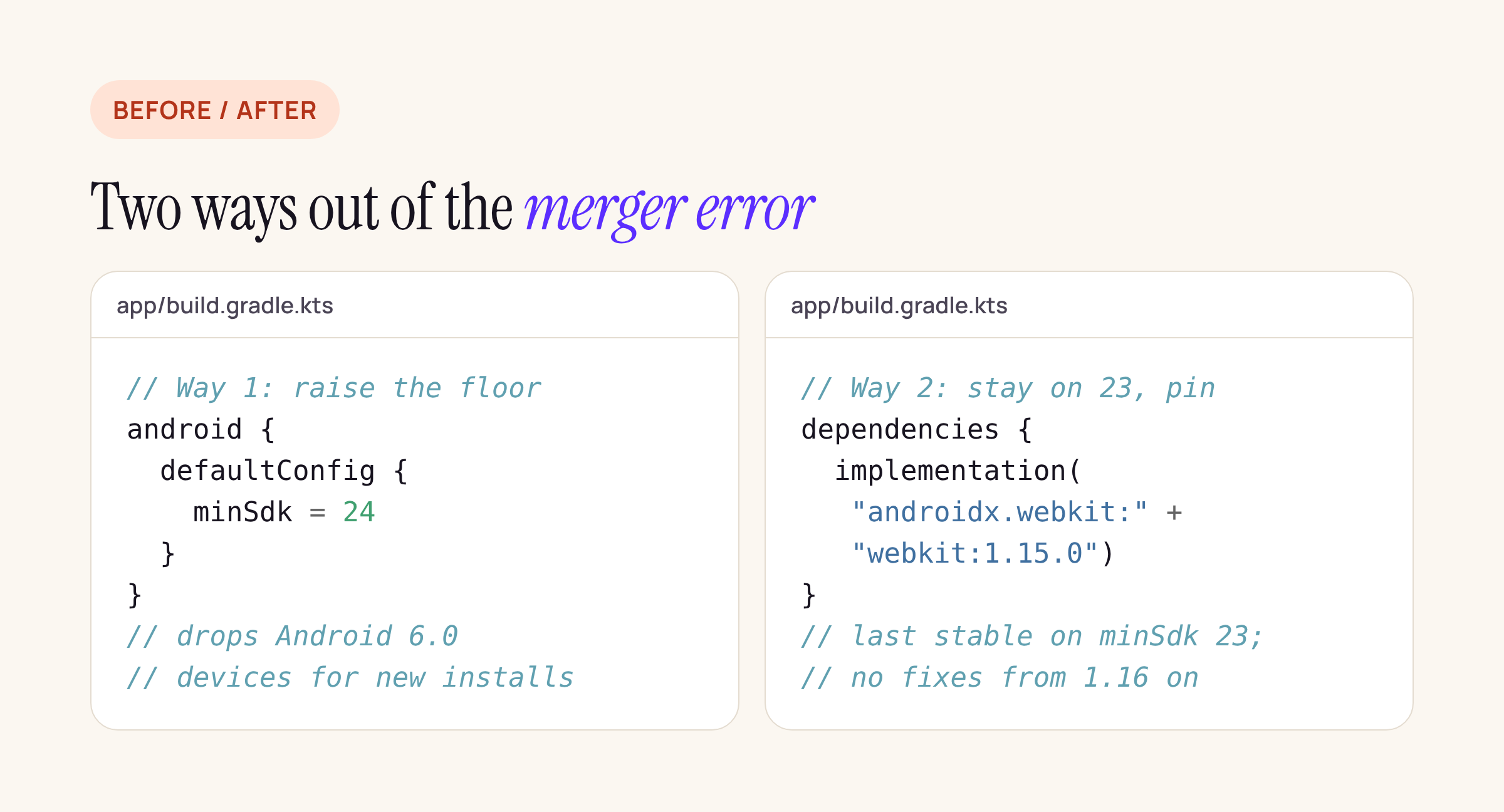
Way 1 raises your floor; way 2 keeps it and freezes one library.
Two ways out, and what each costs
Raise minSdk to 24. One line in defaultConfig. Android 6.0 devices can no longer install new versions of the app; existing installs keep the last version that supported them. Check your Play Console device catalogue before deciding; for a phone app in 2026 the share of API 23 devices is usually small, for TV boxes and kiosk hardware it can be the whole fleet.
Stay on 23 and pin. Keep the library on the last line that supports 23 (WebKit 1.15.x, for example) and make sure no other dependency pulls a newer one in transitively. Use a strict version or a Gradle constraint so an update of an unrelated library cannot lift it. The cost: no fixes from the newer line, and the pin has to be revisited every time you update.
What we would not do: tools:overrideLibrary silences the merger, but the library is then free to call API 24 methods on a device that does not have them. That moves a build error to a crash on the oldest phones in your user base.
The React Native side
React Native apps are mostly already past this. We ran npm pack on react-native and five common libraries and read the minSdk their Android builds declare:
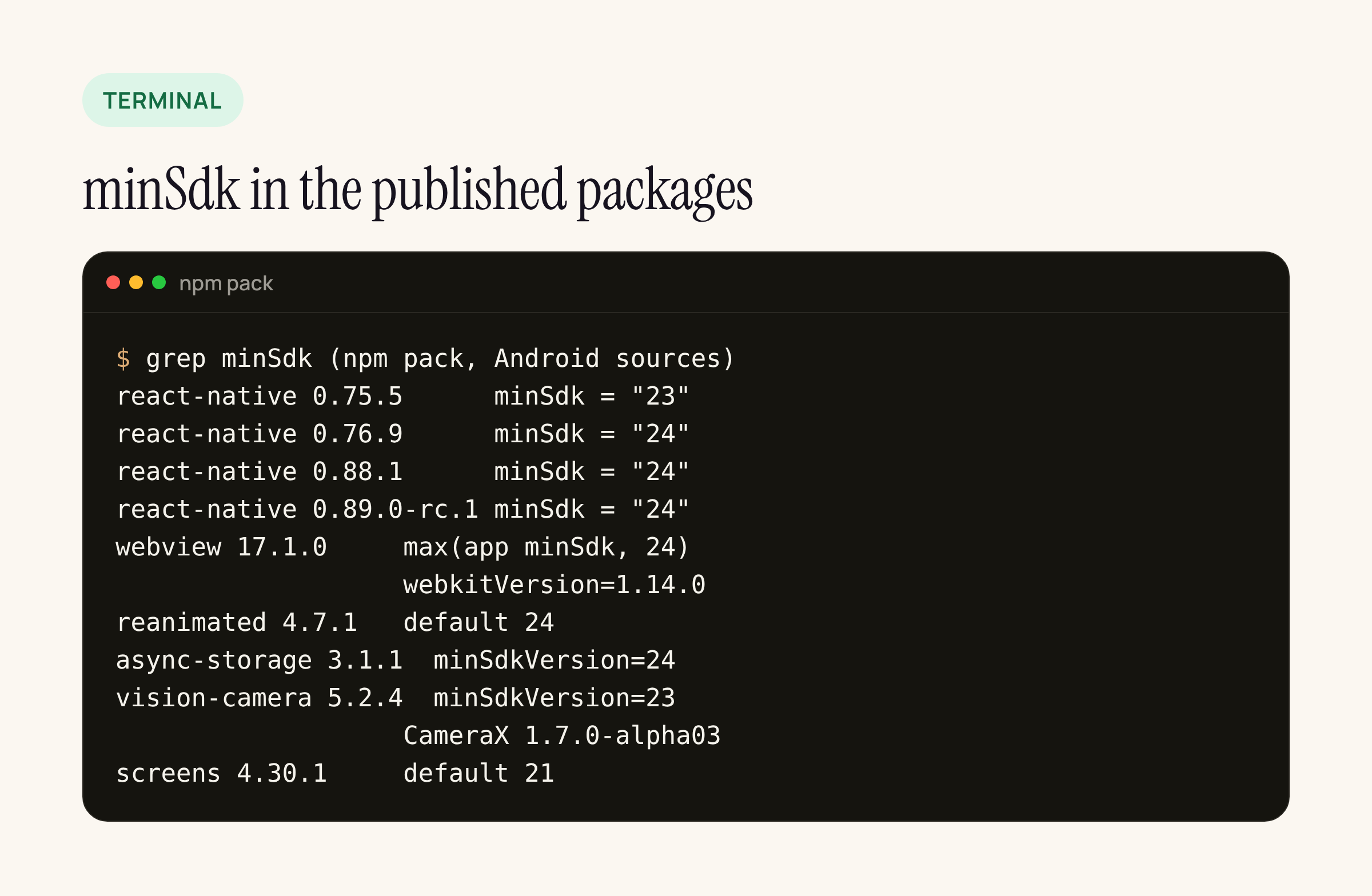
Real output from our test server, reading the published npm packages.
- react-native moved from 23 to 24 between 0.75.5 and 0.76.9 (
gradle/libs.versions.toml), and 0.88.1 and 0.89.0-rc.1 are on 24. The app templates for both setminSdkVersion = 24. An RN app on 0.76 or newer cannot be on 23 anyway. - react-native-webview 17.1.0 uses
Math.max(<app minSdk>, 24)for its own module and pinsandroidx.webkit1.14.0 through thewebkitVersionproperty (the same in 16.0.2 and 17.0.0). You can raisewebkitVersionto 1.16 without touching your floor, because the library already requires 24. - react-native-reanimated 4.7.1 and async-storage 3.1.1 default to 24.
- react-native-vision-camera 5.2.4 declares 23 but builds against CameraX 1.7.0-alpha03; react-native-screens 4.30.1 defaults to 21. Both follow the app’s
minSdkwhen you set one in the rootbuild.gradleextblock.
So for an RN app on a current release, the minSdk 24 wave is a non-event. It matters for native Kotlin apps that kept 23, and for RN apps stuck before 0.76.
What to check on your own app
- Run the merger report above on your current dependencies and note every
uses-sdkvalue of 24. - Before updating WorkManager to 2.12, Navigation to 2.10, WebKit to 1.16 or Media3 to 1.12, make the
minSdkdecision first. - If you stay on 23, add version constraints for those four libraries so a transitive update fails loudly in review, not at merge time.
- Repeat step 1 after each Compose, CameraX, Core or Lifecycle bump; their notes do not mention the change yet, but the announcement covers “many AndroidX libraries”.