CameraX 1.7.0-rc02 shipped on 4 November 2026, and the current stable line is 1.6.2 (26 August 2026). If you have a document or selfie capture screen, three things in 1.7 need action before you bump the version: the old Camera2Interop and Camera2CameraInfo classes are deprecated in favour of a new interop API, Low Light Boost and the torch now follow “last setting wins” instead of rejecting each other, and the library targets Java 11. If your React Native app uses VisionCamera 5.x, you are already on a 1.7 alpha.
This post is a table we built from the official CameraX release notes for 1.7.0-alpha01 through rc02, plus a source check of the Android side of react-native-vision-camera 4.7.3 and 5.2.4. It is written from the release candidate. AndroidX ships every second Wednesday, so 1.7.0 stable may land on 18 November or 2 December.
Why we did this: identity and cheque capture are part of the Beacon-type banking apps we build, on native Android and on React Native. A camera library bump in a KYC flow is not a routine dependency update.
Where 1.7 stands today
| Artifact group | Stable | Release candidate | Source |
|---|---|---|---|
| camera-core, camera2, lifecycle, video, view, extensions, compose, effects, mlkit-vision | 1.6.2 (26 Aug 2026) | 1.7.0-rc02 (4 Nov 2026) | Camera release notes |
| Camera Viewfinder, Feature combination query | 1.7.0-rc02 (4 Nov 2026) | AndroidX all-channel, 4 Nov |
The 1.7 line went alpha01 (11 March), alpha02 (1 July), alpha03 (12 August), rc01 (21 October) and rc02 (4 November). There was no beta. rc02 only fixes two bugs, which is the usual sign that stable is next.
The API changes that touch a capture screen
Every row comes from the CameraX release notes; the version is where the change first appeared.
| Change | Version | What it means for KYC capture |
|---|---|---|
Camera2Interop.Extender, Camera2CameraControl, Camera2CameraInfo and CaptureRequestOptions deprecated; new Camera2Interop with forUseCase, forImageCapture, forSessionConfig, forCameraControl and setInterop / applyInteropAsync |
alpha03 | If you force focus mode, AE settings or a capture template for sharp document shots, that code now produces deprecation warnings. Plan the move to the new interop entry points |
CameraInfo.cameraId, CameraInfo.cameraCharacteristics and String.toCameraSelector() as Kotlin extensions |
alpha03 | Picking the back camera by ID, or reading characteristics, no longer needs Camera2CameraInfo.from(...) |
Interop types (ImageCaptureCamera2Interop and others) changed from interfaces to abstract classes |
rc01 | Anything that implemented them in alpha03 will not compile on rc01. Only matters if you adopted the alpha |
Preview.setMirrorMode / getMirrorMode public, VideoCapture.setMirrorMode public, ExperimentalMirrorMode removed |
alpha03 | Selfie screens that opted in to the experimental annotation must drop the opt-in |
CameraInfo.isNightModeIndicatorSupported() and getNightModeIndicator() |
alpha02 | A clean way to tell the user “too dark, move to better light” before they shoot an ID card |
ImageAnalysis.OUTPUT_IMAGE_FORMAT_PRIVATE and ImageProxy.getHardwareBuffer() |
alpha02 | Face or document detectors that can consume a HardwareBuffer can skip a YUV copy |
FocusMeteringAction gains setLockingMode |
alpha02 | Tap-to-focus on a card can hold focus instead of drifting back |
CameraController.setSessionConfig() and setAutoRotationEnabled(boolean) |
alpha01, alpha02 | Controller-based screens get the same session config as the use-case API |
CameraXViewfinder gets built-in pinch-to-zoom, tap-to-focus, screen flash and stream state |
alpha02 | Compose capture screens can drop hand-written gesture code |
ExtensionsManager#getExtensionEnabledCameraSelector deprecated |
alpha02 | Night or HDR extension modes move to ExtensionSessionConfig |
SessionConfig.Builder Kotlin DSL property getters deprecated; new DSL builders for preview, imageCapture, imageAnalysis, videoCapture |
alpha03 | Style change in Kotlin code, warnings only |
Behaviour and build changes
These do not show up as compile errors, which is why they matter more.
| Change | Version | Action |
|---|---|---|
| Low Light Boost and Torch: “last setting wins” instead of the second request being rejected; the flash can fire during capture with Low Light Boost on | rc01 | If your cheque screen turns the torch on to kill shadows and also enables Low Light Boost, the order of the two calls now decides the result. Set them in one place |
| Library compiled for Java 11 (class file version 55) | alpha01 | Apps on an older toolchain may need core library desugaring |
| camera-compose needs compileSdk 37 and AGP 9.2.0 | alpha02 | Only if you use the Compose artifact; the core artifacts dropped the compileSdk 37 requirement in the same release |
| lifecycle-runtime 2.10.0 dependency; its lint checks need AGP 9.5.0-alpha04 or newer | rc01 | Teams still on AGP 9.4 may see lint failures after the bump |
Physical camera selection through CameraInfo.getPhysicalCameraInfos() |
rc01 | Useful for picking the main lens instead of the ultra-wide for close document shots |
Two fixes are worth knowing about if you were on an alpha: HDR video failed on some Galaxy S25, S26 and Fold 7 models (fixed in alpha03), and an ImageAnalysis resource leak was fixed in rc01. The AndroidX all-channel page also notes that from July 2026 many AndroidX libraries move from minSdk 23 to 24; the 1.7 camera notes themselves do not name a minSdk change, so check the merged manifest after the bump.
What React Native teams get, and when
We unpacked the npm packages of react-native-vision-camera 4.7.3 (the last 4.x, November 2025) and 5.2.4 (the current latest, 29 October 2026) and read android/build.gradle in each.
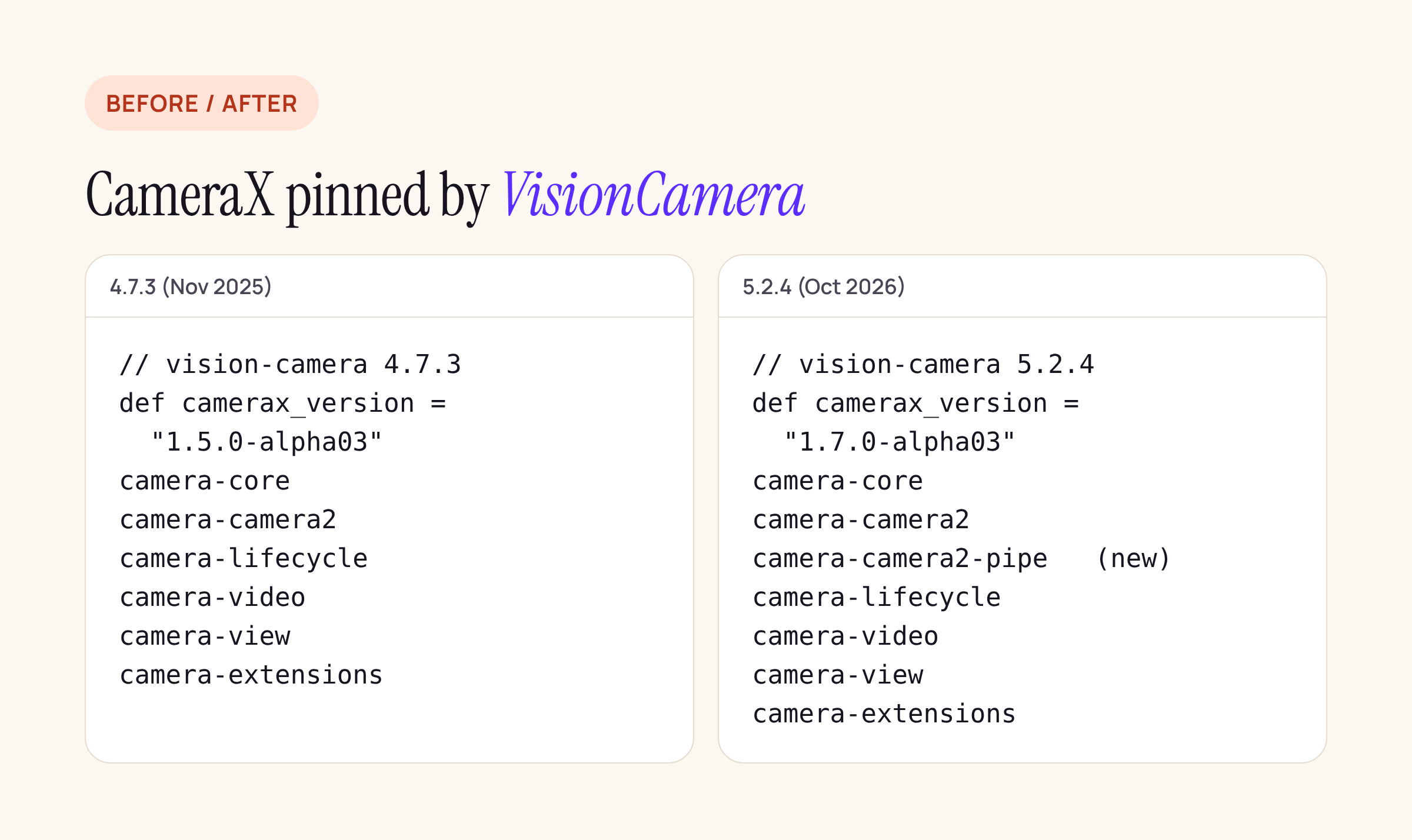
The CameraX version each VisionCamera release pins, from its published Gradle file.
So an RN app on VisionCamera 5.2.4 already runs a 1.7 alpha, not 1.6.2. The 5.2.4 sources use the alpha03 APIs directly: the new cameraId and cameraCharacteristics extensions, and the now-public setMirrorMode on preview and video outputs. They still call ExtensionsManager.getExtensionEnabledCameraSelector, which 1.7 deprecates, so expect a library update once stable ships. An app on 4.7.3 is on a 1.5 alpha and gets none of this.
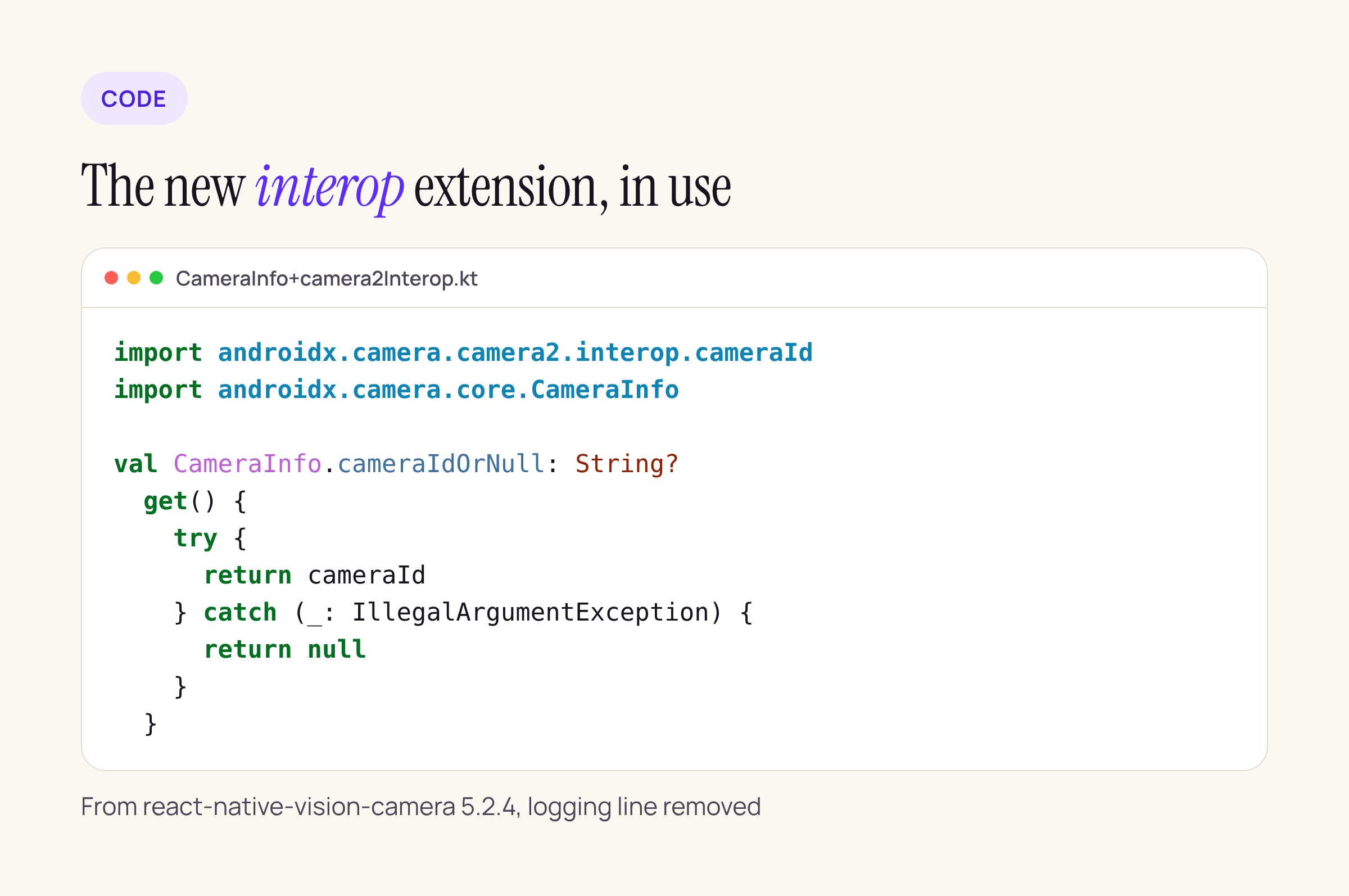
The new interop extension as VisionCamera 5.2.4 uses it.
If you need to bump CameraX yourself inside an RN app (for example to pick up the rc02 fixes before VisionCamera does), a Gradle resolution rule in the app module forces the version. Treat this as a starting point and test it against your own target:
// android/app/build.gradle
configurations.all {
    resolutionStrategy.eachDependency { details ->
        if (details.requested.group == "androidx.camera") {
            details.useVersion "1.7.0-rc02"
        }
    }
}
Forcing past what the library was written against is a trade-off: the rc01 interface-to-abstract-class change shows that alpha users can break between pre-releases.
What to check on your own capture screen
- Search the codebase for
Camera2Interop.Extender,Camera2CameraInfo.fromandCamera2CameraControl.from. Each one is a deprecation warning after the bump; list them before you start. - Search for
@ExperimentalMirrorModeand remove the opt-ins. - Find every place that sets the torch and Low Light Boost. Make one function own both, so the “last setting wins” order is deliberate.
- Check your AGP version: 9.5.0-alpha04 or newer avoids the lifecycle lint problem.
- If you use camera-compose, confirm compileSdk 37 and AGP 9.2.0 first.
- For RN apps, read the CameraX pin in your installed camera library’s
android/build.gradlebefore assuming you are on 1.6.
Sources
- CameraX release notes, 1.6.0 to 1.7.0-rc02
- AndroidX all-channel release list, 4 November 2026
react-native-vision-camera4.7.3 and 5.2.4 from npm,android/build.gradleandandroid/src