Laravel 13.40.0 added a strict argument to the typed request accessors integer(), float(), boolean() and string(). Without it, ?page=2,024 becomes 2 and ?hd=maybe becomes false, silently. With strict: true, any value that is not a clean integer, number, boolean word or string gives you the default you passed instead. The takeaway: pass null as the default when you use strict: true on anything that matters, because a default of 0 or false looks exactly like a real value. It does not throw and it is not validation.
We ran 17 inputs through Illuminate\Http\Request from laravel/framework 13.43.0 (with symfony/http-foundation 7.4) on PHP 8.3.6, on a Linux test server, loose and strict side by side. We also read the change itself: the diff of src/Illuminate/Support/Traits/InteractsWithData.php between the v13.39.0 and v13.40.0 tags.
Why we did this: after taking a Laravel catalogue app from 10 to 13, the controllers were full of (int) $request->input(...) and $request->boolean(...) calls written for forms that only ever sent clean values. Query strings and API clients do not.
What the new argument does
The whole feature is one new parameter on five methods (str() passes it through to string()). From the 13.40.0 diff:
| Method | Loose (default) | With strict: true |
|---|---|---|
integer($key, $default = 0) |
(int) $value |
default unless filter_var(..., FILTER_VALIDATE_INT) passes; booleans rejected |
float($key, $default = 0.0) |
(float) $value |
default unless FILTER_VALIDATE_FLOAT passes; booleans rejected |
boolean($key, $default = false) |
FILTER_VALIDATE_BOOLEAN, anything unknown is false |
default unless the value is 1, true, on, yes, 0, false, off or no |
string($key, $default = null) |
new Stringable($value) |
default unless the value is a string, int, float or Stringable |
Laravel’s own request documentation describes it the same way and uses named arguments, which is the readable form: $request->integer('count', 5, strict: true). The source is in InteractsWithData.php on the 13.x branch. The same trait is used by Fluent and other data objects, so they get the argument too.
17 inputs, loose and strict
Each row below is a real call on a POST request with one form field. The strict column passes null as the default ('n/a' for string()), so you can see when strict mode rejected the value.
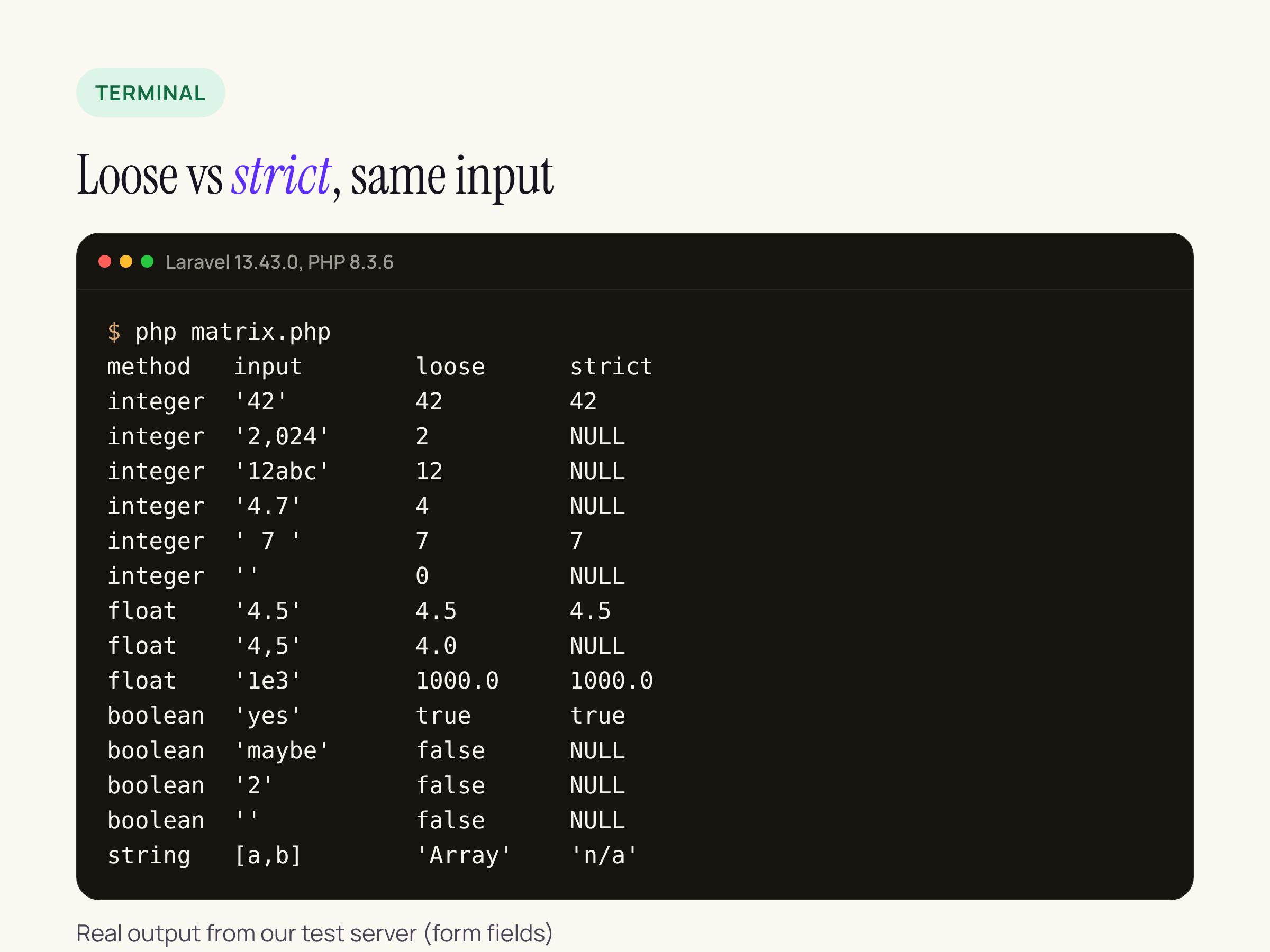
The rows that matter in practice:
'2,024'and'12abc'become2and12when loose. That is PHP’s numeric-prefix cast, and it is how a pasted year or a typo turns into a valid-looking ID. Strict returns the default.'4.7'becomes4forinteger(). Strict rejects it rather than rounding.'4,5'becomes4.0forfloat(). A decimal comma from a European keyboard quietly loses its fraction. Strict rejects it.' 7 'and'1e3'pass strict mode.filter_vartrims whitespace for integers and accepts exponent notation for floats. If you need digits only, that is a validation rule, not this flag.'maybe','2'and''are allfalsefor looseboolean(). With strict and anulldefault you can finally tell “unchecked” from “garbage”.- An array for
string()(?name[]=a&name[]=b) gives'Array'plus a PHP warning (“Array to string conversion”) when loose. Strict returns the default with no warning.
JSON bodies go through the same code, with one difference worth knowing:
JSON body
integer  true         1          NULL
integer  5.0          5          5
integer  3            3          3
A JSON true sent to integer() is 1 when loose. Strict mode checks for booleans explicitly (the source has a comment about FILTER_VALIDATE_INT turning true into 1) and returns the default. A JSON 5.0 still counts as an integer.
The trap: strict with a 0 or false default
Our first test used the methods’ own defaults, and strict boolean('hd', false, strict: true) on 'maybe' returned false, the same as loose mode. Nothing changed, because the rejected value fell back to a default that is also a valid answer. The same goes for integer('page', 0, strict: true).
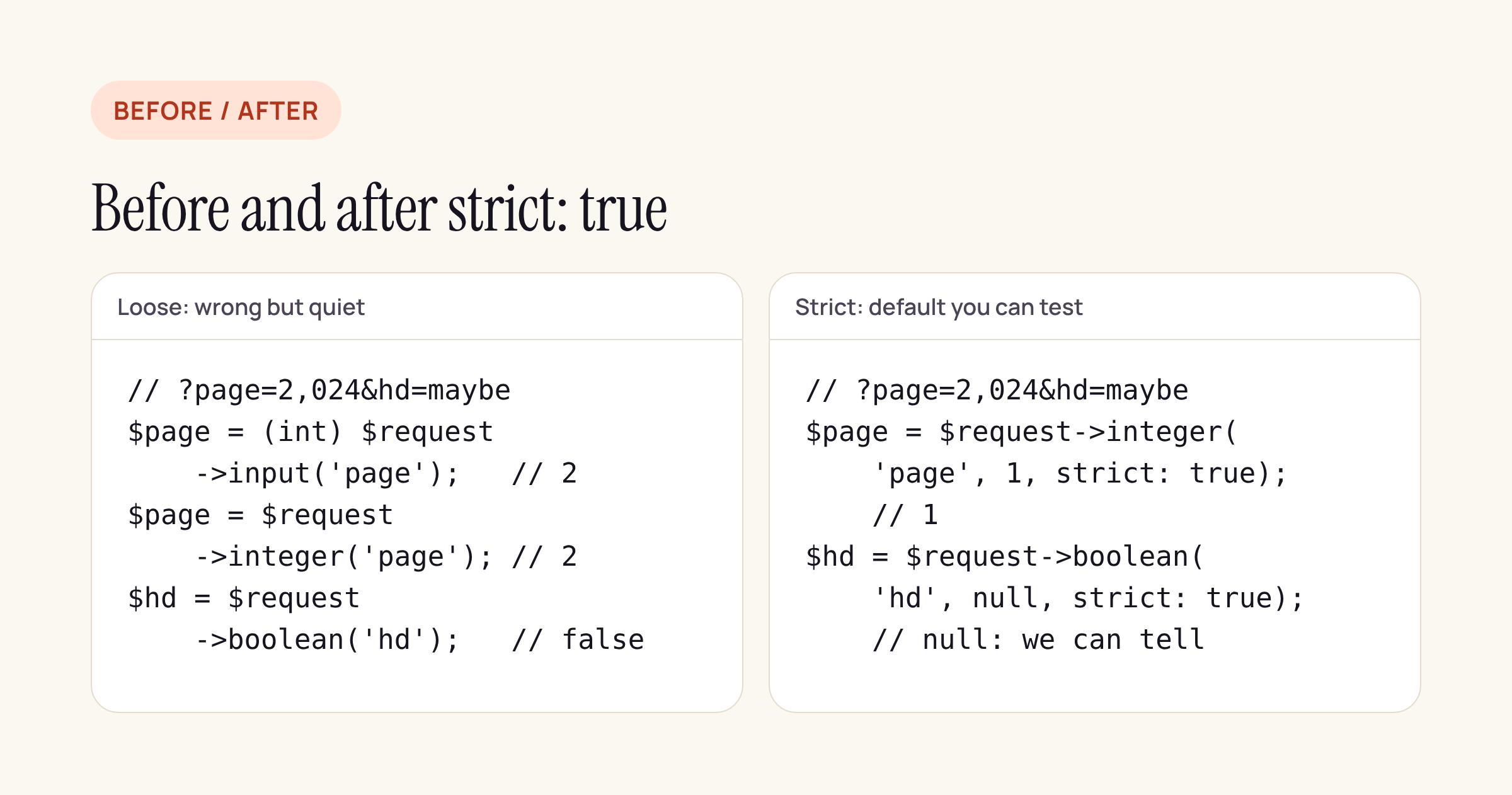
Pick the default by what the code does next:
// Listing filters: a bad value should fall back quietly.
$page    = $request->integer('page', 1, strict: true);
$perPage = $request->integer('per_page', 20, strict: true);

// Something you act on: a bad value should be visible.
$hd = $request->boolean('hd', null, strict: true);
if ($hd === null && $request->filled('hd')) {
    abort(422, 'hd must be yes or no');
}
Strict accessors are not validation
strict: true and the validator do not agree on what a boolean is. From validateBoolean() in the same framework version, the boolean rule accepts true, false, 0, 1, '0' and '1', and boolean:strict only true and false. Strict boolean() also accepts 'yes', 'on', 'true' and their opposites. So a request can fail 'hd' => 'boolean' validation and still read as true through $request->boolean('hd', strict: true).
Our rule of thumb:
- Writes (forms, API create and update): validate with a FormRequest and read from
$request->validated(). That is where a 422 with a message belongs. - Reads (pagination, sorting, filters, feature flags in query strings):
strict: truewith a sensible default is enough, and much less code than a FormRequest per listing page.
Finding the loose calls in your app
These two searches list every place a controller casts input itself. Run them from the project root:
grep -rnE "\((int|float|bool|string)\) ?\\\$request->(input|get|query)\(" app/ routes/
grep -rnE "\\\$request->(integer|float|boolean|string|str)\(" app/ routes/
For each hit, decide which of the two groups above it belongs to, then either move it into validation or add strict: true with an explicit default. If you test controllers, add one case per accessor with a value like '12abc' or 'maybe': those are the inputs that changed behaviour in our table.
Version notes
- The argument exists from laravel/framework 13.40.0. On 13.39 and earlier, passing a third argument is simply ignored by PHP (extra positional arguments to a user function are allowed), but a named
strict:argument fails with an “Unknown named parameter” error. Bumplaravel/frameworkbefore you deploy code that uses it. - We tested the 13.x branch at version 13.43.0 (20 Nov 2026); the four accessors have not changed since 13.40.0.
- Laravel 13 needs PHP 8.3 or newer.