Android 17 QPR2 carries a minor SDK release, API 37.2, and the practical change for app teams is small but easy to get wrong: targetSdk stays 37 (you cannot target or require a minor version), Build.VERSION.SDK_INT stays 37 on QPR2 devices, and any 37.2 API must be guarded with Build.VERSION.SDK_INT_FULL >= Build.VERSION_CODES_FULL.CINNAMON_BUN_2, not with SDK_INT. This post is based on the QPR2 beta SDK: Beta 7.1 (build CP41.260831.019, 16 Oct 2026), the QPR2 release notes as updated on 9 Nov 2026, and the 37.1 to 37.2 API diff report. Google has not published a stable date; Android Authority wrote on 30 Oct that QPR2 is expected in December alongside the December Pixel Drop.
Why we did this: BMDB on Android TV, Peepal and Shopkeeper all compile against API 37, and minor SDKs are the release type our version checks were never written for. We built the tables below from Google’s own pages so each row can be checked.
What QPR2 is, from the release notes
The QPR2 release notes say “Android 17 QPR2 includes a minor SDK release. This incremental update has no planned behavior changes, minimizing the need for compatibility testing”, and link the API diff report, titled “API Differences between 37.1 and 37.2”.
| Build | Date | Build ID |
|---|---|---|
| Beta 1 | 20 Jul 2026 | CP41.260701.005 |
| Beta 4 | 28 Aug 2026 | CP41.260814.003 (A2, B1, C2) |
| Beta 6 | 24 Sep 2026 | CP41.260831.007 |
| Beta 7 | 9 Oct 2026 | CP41.260831.016 |
| Beta 7.1 | 16 Oct 2026 | CP41.260831.019 (security patch 2026-10-05) |
Selected rows; the release notes list nine beta builds in total. The get page lists 24 supported Pixel models, from Pixel 6a to Pixel 11 Pro Fold, plus the emulator (x86 64-bit and ARM v8-A images).
What changes in Gradle: less than you think
- compileSdk. Google’s Android 17 SDK setup page (updated 28 Oct) still shows only
compileSdk = 37, and asks for at least AGP 8.9.0-rc01 and Android Studio Meerkat or newer. The SDK Manager entries are “Android SDK Platform Cinnamon Bun” and the latest Build-Tools 37.x. - targetSdk. The uses-sdk reference is explicit: “It’s not possible to specify that an app either targets or requires a minor SDK version.” So
targetSdk = 37andminSdkdo not change for QPR2. - AGP. The AGP 9.5.0 notes give API level 37 as the maximum it supports, and AGP 9.1.1 says “Android API level 37.0 and lower”. Neither page names 37.2.
- The new compileSdk block. AGP 9 added a block form of the
compileSdkandtargetSdkDSL (the AGP 9.1 notes mention a lint fix for “the new compileSdk and targetSdk DSL from AGP 9.0”). None of the Android 17 pages we read shows a minor-level setting inside it, so check the DSL reference for your exact AGP version before adding one.
// app/build.gradle.kts, as the Android 17 setup page shows it
android {
    compileSdk = 37
    defaultConfig {
        targetSdk = 37
    }
}
Runtime checks: SDK_INT is not enough any more
SDK_INT only moves on major releases. The Build.VERSION reference describes SDK_INT_FULL as “the major and minor SDK version of the software currently running on this hardware device”, says minor releases “can add new APIs” with “no changes gated by targetSdkVersion”, and adds that SDK_INT_FULL “is increased on every release”. Possible values live in Build.VERSION_CODES_FULL:
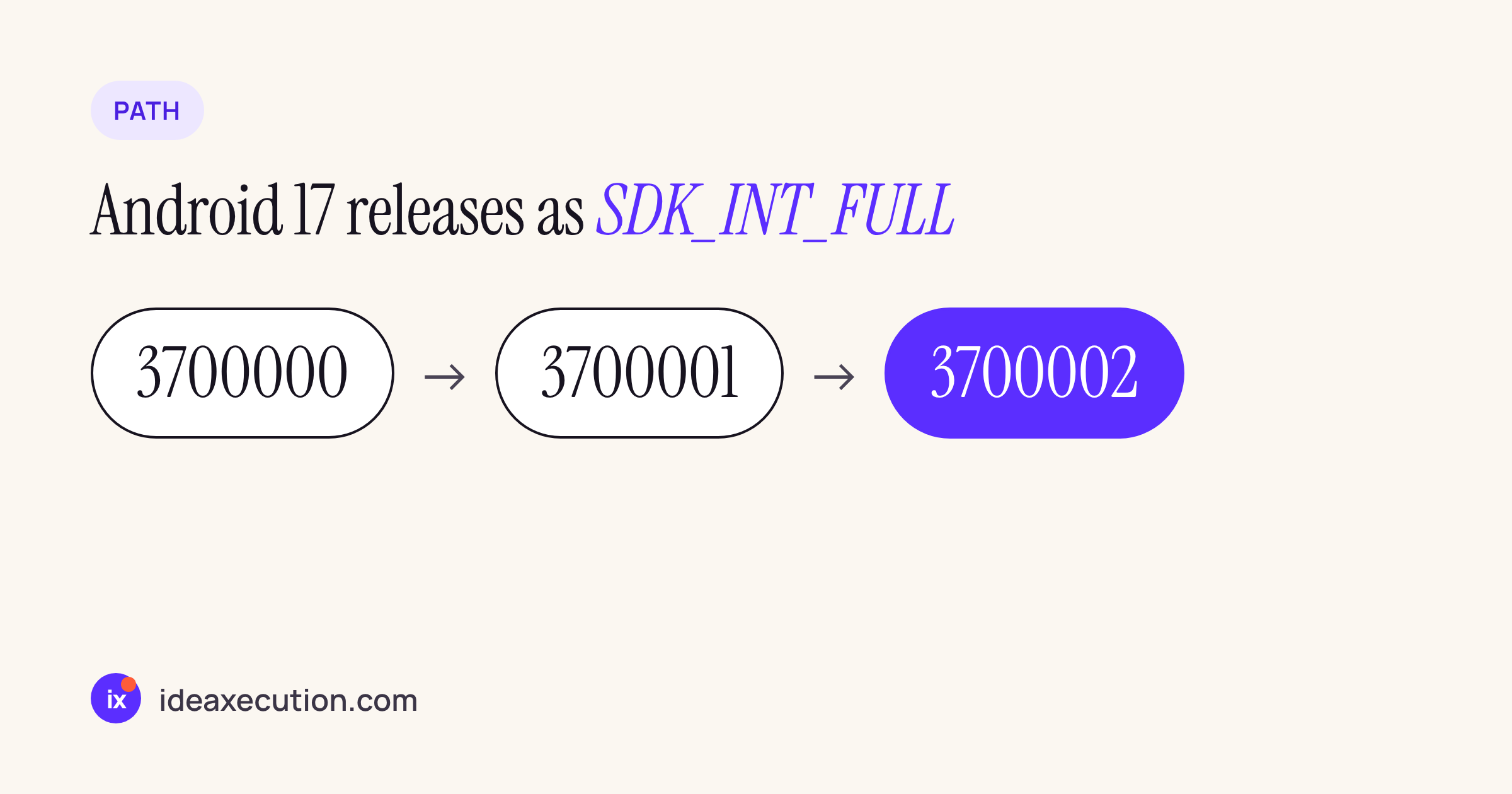
CINNAMON_BUN is 3700000, CINNAMON_BUN_1 (37.1) is 3700001, CINNAMON_BUN_2 (37.2) is 3700002.
Google says the actual numbers “should be considered an implementation detail”, so compare against the constants, never the literals. One more detail: SDK_INT_FULL was added in API level 36, so read it only after an SDK_INT check, or older devices fail on a missing field.
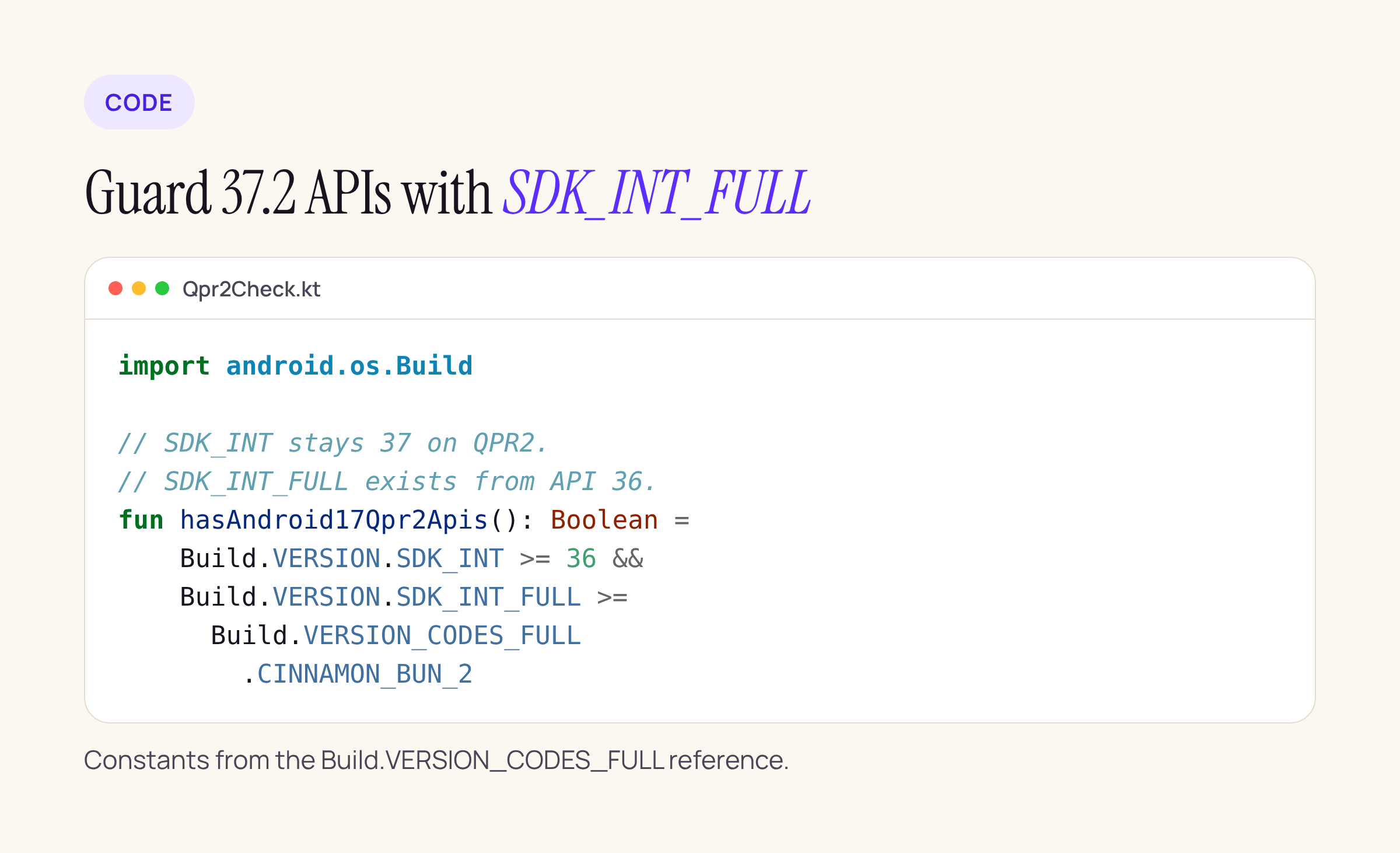
Use this in front of any API the diff report marks as added in 37.2.
import android.os.Build

fun hasAndroid17Qpr2Apis(): Boolean =
    Build.VERSION.SDK_INT >= 36 &&
    Build.VERSION.SDK_INT_FULL >=
        Build.VERSION_CODES_FULL.CINNAMON_BUN_2
The NDK has no equivalent: the NDK version guide says “there is no way to get the full device API level directly from an NDK call”, because minor levels are not tied to behaviour changes. Native code that needs it has to ask the Java side.
What 37.2 adds, from the API diff
The changes summary (generated 28 Aug 2026) lists 18 added packages and 46 changed ones, and no removed packages. The ones an ordinary app is most likely to touch:
| Package | Change in 37.2 | What is in it |
|---|---|---|
| android.util.function | Added | IntObjFunction and LongObjFunction |
| android.app.time | Added | TimeManager, a system service for time and time zone (aimed at system components) |
| android.os | Changed | Added VibrationEffect.Builder, Envelope, Event, Preset and VibrationParseException; changed Build.VERSION_CODES_FULL, Process, UserManager, VibrationEffect and Vibrator |
| android.os.multisensory | Added | New package |
| android.security.authenticationpolicy | Added | New package |
| android.app.personalcontext | Added | New package, with hint, insight and understander subpackages |
Changed packages also include android.app, android.content.pm, android.hardware.biometrics, android.media, android.view, android.widget, android.window and java.time; each has its own page under the diff report. If you call anything new in them, put it behind the helper above.
The one behaviour note worth reading
“No planned behavior changes” does not mean nothing moves. The release notes call out call-forwarding USSD codes: sendUssdRequest() is “no longer accessible for call-forwarding codes using only the CALL_PHONE permission”, the request fails with USSD_ERROR_NOT_ALLOWED, and the suggested route is an ACTION_DIAL intent. Retail and banking apps that offer a “forward calls” shortcut should check this path.
What we check in BMDB, Peepal and Shopkeeper
- Search for every
SDK_INT >=check that is meant to gate a minor-release API, and move it to the helper above. - Keep
targetSdk = 37; do not try to express 37.2 in the manifest or Gradle. - Run lint against the 37.2 platform once it is installed and read every NewApi warning.
- On the Android TV build of BMDB, nothing in the diff touches Leanback or TV input, so the work there is the version check only.
- Watch the release notes for the stable build ID, and update the SDK platform package in the SDK Manager when it lands.
For the last Android release-cycle change we wrote up, see Play’s February 2027 DEX rule, tested on Now in Android.